
Last week, the Heritage Foundation released a study from yours-truly called From Mass Deception to Meaningful Accountability: A Brighter Future for K–12 Education. The basic argument: the good intentions of the No Child Left Behind era were completely undermined by opponents, who both defanged state rating systems and tamed charter school laws. On the first assertion, I offered charts like:

Ooof, and even worse this comparison between Arizona’s school grades in Maricopa County and GreatSchools private ratings for schools within 15 miles of Phoenix (the closest approximation on the GreatSchools site) after converting the GS 1-10 ratings onto a A-F scale:
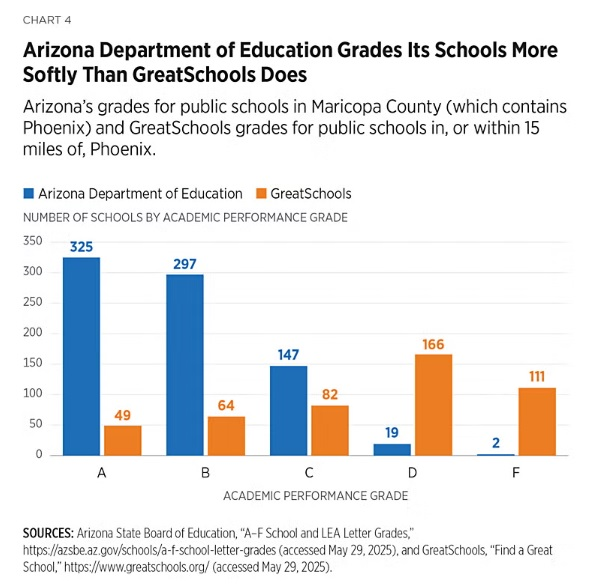
Charter schools always and everywhere had waitlists, ergo, accountability amounted to “trophies for everyone” state systems and charter school sectors that never matched demand with supply. Take a look at the above chart, however, and you’ll see that GreatSchools is a much, much tougher grader than the state of Arizona. The usual suspects have a much tougher time undermining private rating organizations, and they gather reviews (which research shows families value). Ergo the backgrounder makes the argument that we should not rely upon state rating systems in preference to the already superior, more trusted and versatile private efforts. Furthermore, we should expand rating systems into the broader universe of education service providers active in today’s ESA and robust personal use tax credit programs, specifically to gather reviews accessible to families for purposes of navigating the wide world of choice, which we need much more of.
Okay so a couple of reader requests. First, I was asked if I could create something like the Phoenix chart for a district in Florida. I chose Miami:

So not as much of a contrast as Arizona but…if I were looking for a school in Miami, I would look at GreatSchools.
Next, I received a request about this chart from Sandy Kress:

Putting the NAEP improvement numbers in context: In the 2024 NAEP, the total across the four mathematics and reading exams between the highest scoring state (MA) and the lowest scoring state (New Mexico) was 10%. So, the nation-leading 5% improvement in Mississippi scores should be seen as meaningful. Sandy asked me to look at an earlier period from the mid-1990s until 2011 rather than the 2003 to 2019 period, as his contention was that that period saw a lot more academic improvement before the federal law was defanged on a bipartisan basis during the Obama administration.
All states began taking NAEP in 2003, so stretching back to the 1990s loses a number of states. Also, 1996 didn’t include the two reading tests, so I substituted 1998. Nor can we automatically attribute the trends exclusively to standards and accountability (other things also going on), but Sandy is correct that NAEP showed a lot more academic improvement during those earlier years:
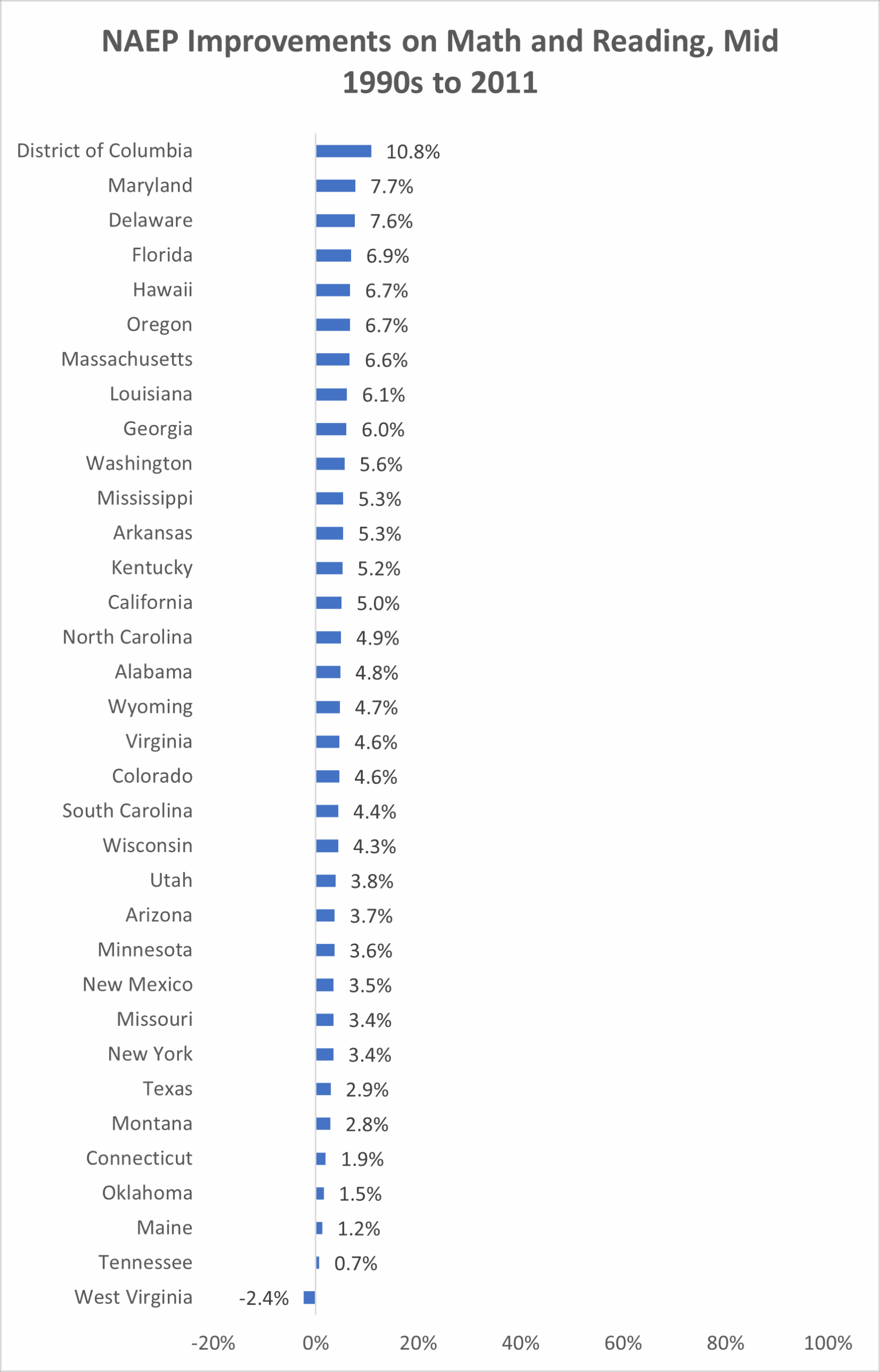
Accountability hawks/the federal government may have indeed coaxed more productivity out of the public school system. Then on a bipartisan basis, Congress removed federal pressure (passed the Senate 85-12 and the House 359-64). Subsequently a large majority if (perhaps?) not every single state merely went through the motions of “accountability” with trophies for (almost) everyone. Kress can justifiably look at these data to claim, “the juice is worth the squeeze” and I can look at the same data to say, “academic transparency is too important to leave to politicians and their appointees.”
Franklin Roosevelt noted ““It is common sense to take a method and try it. If it fails, admit it frankly and try another. But try something.” Every state in the union remains entirely free to adopt tough accountability practices, but apparently few if any have chosen to do so. The next something to try in my opinion are enhanced private rating systems and robust choice programs. Temporarily semi-tough accountability systems run by states and charter school waitlists ultimately proved to be a strategy with limited political sustainability.

