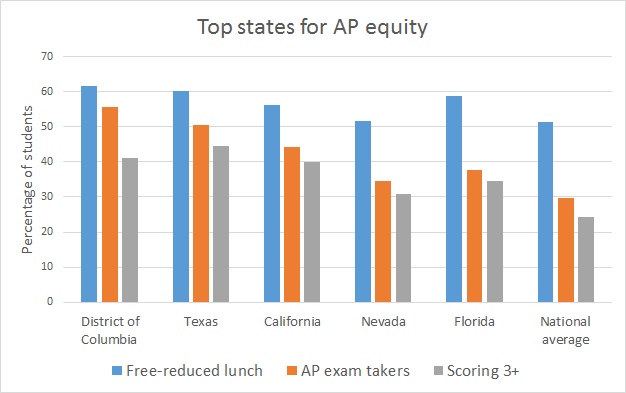
These four states and Washington, DC were among the best at closing the "equity gap." They had high percentages of students who qualified for free- and reduced-price lunches and took Advanced Placement exams. Source: College Board, 2015 AP Cohort Report, compiled here.
Florida remains near the top of the class, not just for getting large numbers of students to pass Advanced Placement tests, but for making those courses available to low-income students.
New data released Wednesday by the College Board showed Florida students in the class of 2015 were more likely to pass at least one AP exam than their peers in all but two states (Maryland and Massachusetts).
The Sunshine State also ranked no. 3, behind Connecticut and Massachusetts, for growth in the number of students passing AP tests over the past decade.
Like in previous years, Florida's demographics set it apart.
Nearly 31 percent of Florida students passed at least one AP exam, allowing them to earn college credit before graduating high school. No state with a comparable percentage of students who qualified for free or reduced-price lunch matched that success rate. The national rate was 22.4 percent.
More than 58 percent of Florida students qualified for free- and reduced-price lunch, while 37.8 percent of those students took at least one AP exam. Only one state — Texas — had a smaller "equity gap" and a higher percentage of low-income students.
California and Nevada also had relatively high percentages of low-income students taking the tests, though Washington, DC out-performed all states on this count.
Meanwhile, three Florida school districts — in Indian River, Lee and Miami-Dade Counties — made the national honor roll for expanding access to AP courses while increasing or holding steady the percentage of students who passed exams.
Students can also pursue college credits through Cambridge, International Baccalaureate and dual enrollment programs, so AP numbers don't provide a full measure of high school students' performance in advanced courses. Still, these latest results suggest that, compared to a decade ago, thousands more low-income students in Florida are taking steps toward college.
See a breakdown of states' success rates and equity ratios here.
See more coverage from the Orlando Sentinel. Naples Daily News. Bridge to Tomorrow.

