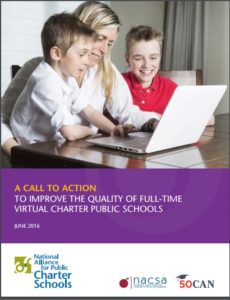
A new report calls for states to subject virtual charter schools to greater scrutiny.
States need to overhaul the way they fund and regulate online charter schools and rein in "large-scale underperformance," a new report argues.
The argument isn't coming from the usual anti-charter school suspects. The report was released this morning by the National Alliance for Public Charter Schools, the National Association of Charter School Authorizers, and the pro-charter advocacy group 50CAN (aka the 50-State Campaign for Achievement Now).
The three groups say they support full-time virtual schooling, and that the model can be beneficial for some students. But the report says recent research has found negative effects so significant and widespread that "[t]he breadth of underperformance by full-time virtual charter schools convinces us that states need to change the policy framework within which these schools can operate."
"If traditional public schools were producing such results, we would rightly be outraged," the report adds. "We should not feel any different just because these are charter schools."
Online learning companies and some allied advocacy groups have disputed some of the most widely cited studies of virtual charters' effectiveness, pointing out that virtual charters often serve disadvantaged students who change schools frequently, making their performance hard to gauge.
The report addresses this argument, noting that in a study by Stanford University's Center for Research on Education Outcomes, the "mobility" rates of virtual charter students and their comparison groups in traditional public schools are similar. Other observers have concluded the negative findings are simply too strong to explain away.
Virtual charter schools have spread rapidly across the country, especially in the "big three" states of California, Pennsylvania and Ohio. The national charter school alliance says that, as of August 2014, they enrolled some 180,000 students in 23 states and Washington, DC.
Florida is now home to 11 active virtual charters. All but three are Florida Virtual Academies operated by K12, and at least one was recently threatened with closure.
The report makes several recommendations, saying states should:
The recommendations were greeted with a strongly worded response from the advocacy group PublicSchoolOptions.org, which said in an e-mailed statement that the proposals rely heavily on test-based measures of student performance and would "threaten" online learning options.
“As virtual school parents we know why we choose this option and why our students are succeeding," the organization's president, Tillie Elvrum, who enrolled her son at Colorado Connections Academy, said. "If parents didn’t choose these schools, they wouldn’t exist."
How would the recommendations apply to Florida? Here are a few points worth keeping in mind:
This report, and the debate it's already starting to trigger, matter for several reasons.
For one thing, this one of several recent examples of charter school advocates calling out their own side and demanding improvements.
What's more, it has implications beyond virtual charter schools. Under the new definition of public education, parents control how public money is spent educating their children. It's important to respect their decisions about how to educate their children, but it's also important to protect the public good, and to ensure schools are truly helping children learn. The debate over how to regulate virtual charter schools is fundamentally a debate about how to reconcile those values.

