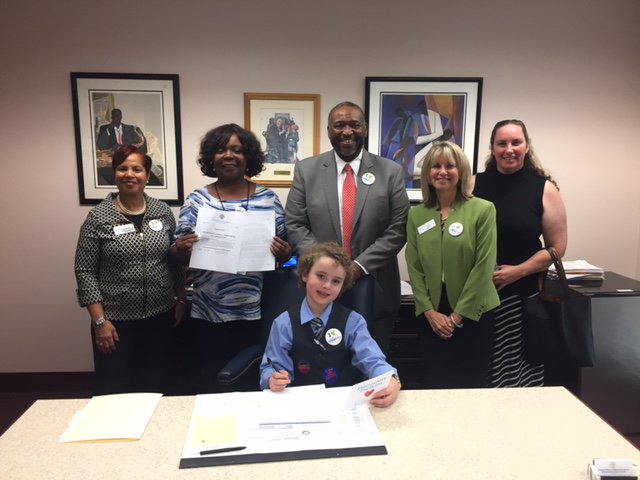
Branden Ojeda, front, pictured with FLVS executives and his mother, Sherrie Johnson-Ojeda, far right.
Sherrie Johnson-Ojeda knew she had to find a solution for her son Branden.
The nine-year-old suffers from diabetes and was struggling in a public school in Lake County, Fla.
It became difficult on a day-to-day basis, as Branden was often ill.
“He would come home with pounding headaches and sweat was beating off his forehead," Johnson-Ojeda said, due to blood sugar levels several times higher than normal.
As a result, she began looking for an alternative for her son and learned about Florida Virtual School.
FLVS functions like a statewide school district, enrolling students in online classes full- and part-time.
Johnson-Ojeda decided to homeschool Branden and enroll him in FLVS Flex, which offers part-time courses, during the 2016-17 school year. She said he made rapid progress.
“He is a straight-A student,” she said of her son’s progress in third grade. “Not only has my son benefited from my teaching, but the interactions with his Florida Virtual School teachers have had a huge impact and difference on my son’s education.”
FLVS gives Johnson-Ojeda more flexibility to schedule doctor appointments for her son and monitor his health more closely, she said.
But whether he can attend FLVS next year remains in question because state law restricts eligibility for virtual schools.
Based on current statutes, Branden is not able to take part-time FLVS courses for his fourth- grade year because he did not attend a public school last year.
Sen. Dennis Baxley, R-Ocala, is trying to change the law, after learning about the restrictions and his granddaughter's troubles in enrolling in FLVS because she did not attend a public school the previous year.
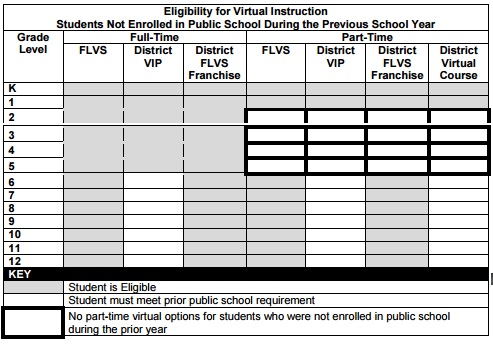
This diagram from Florida House staff breaks down the current eligibility gaps for virtual courses.
Baxley filed SB 868, which would eliminate Florida’s last remaining restrictions for part-time virtual courses. Similar legislation by Rep. Jennifer Sullivan, R-Mount Dora, is moving through the House.
“Right now, we need to remove this obstruction requiring you to go to a brick and mortar school before going to a virtual school,” Baxley said. “There are still barriers that have to be broken for us to truly open up opportunities for children to do what works for their family.”
Under existing laws, students in second through fifth grades can’t enroll in virtual courses part-time. Children in middle and high school can only take certain part-time courses if they were enrolled in public schools the previous year.
As a result, FLVS and its district-run franchises must turn some students away. For a number of years, FLVS has been expanding its elementary school offerings after a state law allowed such a change in 2011. Even so, students are unable to enroll in those courses unless they take virtual courses full-time or have attended public school the previous year.
Baxley's legislation would also extend Florida's public-school open enrollment policy to virtual charter schools and other virtual programs.
The part-time program known as FLVS Flex serves nearly 200,000 students in K-12, according to Holly Sagues, executive director of FLVS governmental affairs. If Baxley’s bill passes, she said she expects enrollment at the virtual school will increase.
“This bill will remove the last of any restrictions on virtual education in Florida,” she said. “Whether you are a home education student, a public school student or private school student, if you wish to take a virtual course on a part-time course you will now be able to do that without having to meet some eligibility requirements.”
If the legislation does not pass, Johnson-Ojeda said she will be faced with having to put her son back in the public school system or home school him full-time, which would require her to develop a county-approved curriculum.
“It is like reinventing the wheel,” she said. “You have the right to home school your child. The benefit of using FLVS flex is it is an already approved curriculum.”
And her son continues to make progress in FLVS, she added.
“I think in a lot of ways we know the teachers better than we would if Branden was in a brick and mortar school,” she said. “He is receiving all his core curriculum: math, science and social studies. He is also receiving Spanish. Most schools don’t offer Spanish in the third grade. I have a healthy child that will have a healthy future.”

