 In the spirit of the holidays, the Hispanic Council for Reform and Educational Options, the Black Alliance for Educational Options and the redefinED blog are partnering on something a little bit different this year to raise awareness: A fun, one-day Twitter campaign.
We need you to help us. All you have to do is tweet.
Just think of one thing you wish would change to help the cause of vouchers, or charter schools, or parental empowerment, or anything else related to parental school choice. Then, on Wednesday, Dec. 18, tweet it out with #schoolchoiceWISH as a hash tag.
It can be personal. It can be political. But whatever it is, make it heartfelt.
If you’d like, attach a photo. We might even put it up on our facebook page.
We’ll be following everyone’s #schoolchoiceWISH tweets all day, and retweeting and replying. Please join us. Happy tweeting!
On a related note, we’ll soon be running a series of special guest blog posts on the wish list theme, too. More details soon.
Editor's note: This piece is in response to the U.S. Department of Justice's legal action against the voucher program in Louisiana. It is co-authored by Howard Fuller, board chairman of the Black Alliance for Educational Options, and Kevin Chavous, executive counsel of the American Federation for Children.

Fuller and Chavous: The DOJ has wrongly decided that allowing these children a life line to getting a better education must take a back seat to whether or not they impact desegregation. (Image from baeo.com)
It is easier to say we must take the long view when grappling with the issue of social justice than it is to actually practice it. Such is the problem the U.S. Department of Justice (DOJ) has today as it wrongly inserts itself in the effort to give low-‐income children in Louisiana an opportunity to get a better education. DOJ is suing the state of Louisiana, more specifically 34 parishes in the state that are still under a desegregation law, claiming that the state’s school choice scholarship program unlawfully allows students to leave failing public schools and go to high-‐performing private schools by way of a scholarship. DOJ thinks it’s wrong and illegal to allow that to happen.
When one takes the long view, it’s necessary to understand the moment in history in which you exist and what is the primary problem being faced at that particular moment in the continuum of the struggle for social justice over time.
In America today the primary problem facing children from low-income and working class families is getting a quality education. The Louisiana Scholarship Program was created to give these students a way to escape failing schools. It allows them to apply for a scholarship and choose a school that for them holds the promise of a better education.
The DOJ has wrongly decided that allowing these children a life line to getting a better education must take a back seat to whether or not they impact desegregation. No one with any sense of history will deny that at one point in time the state of Louisiana used this power to fund schools that were for whites only.
But that was then and this is now. In this instance, the state of Louisiana is on the right side of history because its actions are giving children the best chance to ultimately participate in mainstream American society by giving them access to better educational opportunities. (more…)
Hage
Vouchers, here. Charters, there. Virtual, over there. Politically, school choice sectors have been islands. But there are signs the movement is building bridges to advance common goals.
Florida's lead here surfaced at this week’s American Federation for Children summit, during a panel discussion on just that topic. In the Sunshine State, charter schools and supporters of vouchers and tax credit scholarships have teamed up to advance legislation, said panelist Jon Hage, founder and CEO of Florida-based Charter Schools USA.
“We realized it was time to join forces,” Hage said. “We felt we were sort of the Army, and they were the Navy … What we’re trying to do is have a common Department of Defense.”
The Florida school choice coalition doesn’t stop at two sectors. Through a group formed in 2010 – the Florida Alliance for Choices in Education – it includes online providers, home-schoolers and district school choice options like magnet schools. In the middle of this year’s legislative session, the group held a rally that, for the first time, brought parents together from across the spectrum.
Panelists suggested the benefits of a united front included strength in numbers, a more focused message and crossover appeal.
In response to a question from moderator Nina Rees, CEO of the National Alliance for Public Charter Schools, Hage said some Democratic lawmakers in Florida were more willing to support charter bills this year because they had supported tax credit scholarships in the past. Plus, the coalition offered a tighter, more compelling argument – one that emphasized school choice options even more and better deflected the usual criticisms. (more…)
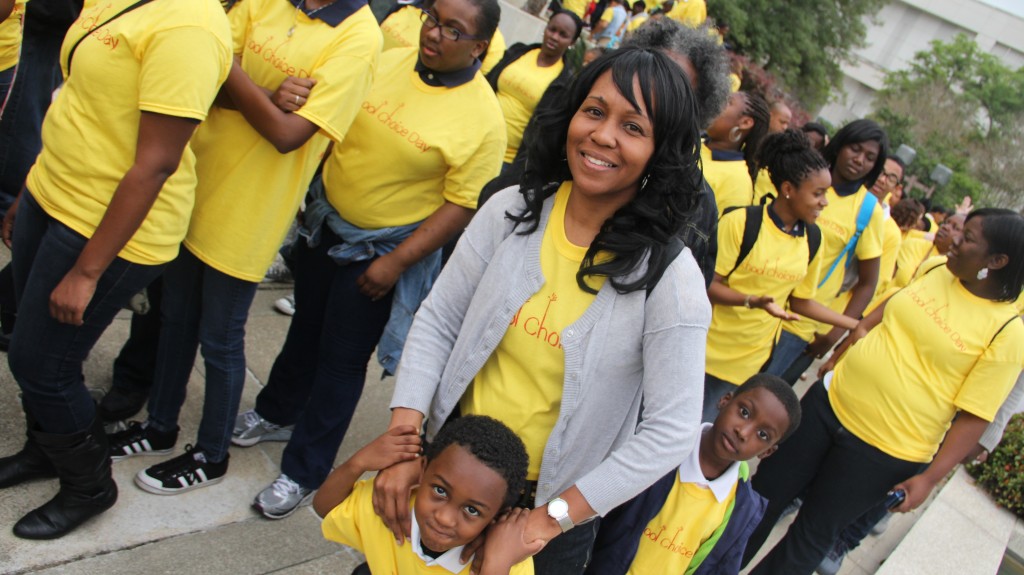
These folks were among those who attended the school choice rally in Tally earlier this month.
It’s true: ALEC likes school choice. Walton likes school choice. Jeb Bush likes school choice. Some of the folks who like school choice even say bad things about traditional public schools and teachers unions.
But this is true too: President Barack Obama is a fan of charter schools. Former President Bill Clinton is ga-ga about KIPP. Liberal lions like Daniel Patrick Moynihan and Hubert Humphrey supported public funding for private options.
More importantly, this is true: Growing numbers of parents and politicians of all stripes like school choice. Many don’t bash public schools or teachers unions. Many could care less who the Koch Brothers are.
I know this is obvious to anybody who’s managed to take a peek beneath the surface of the choice debate. But at this time of year, with state legislatures in Florida and elsewhere in session, complexity is not a common commodity. Anything having to do with school choice is sealed into a boilerplate narrative about for-profit this and right-wing that. This year in Florida, the privatization label has even surfaced in stories about student data and IEPs for students with disabilities.
It’s different in the real world. Out here, parents are flocking to new learning options for the most personal of reasons: the success of their kids. (more…)
by Kenneth Campbell

Campbell
This week, NBC’s Education Nation is visiting New Orleans on its national tour to get a first-hand look at education challenges and opportunities being faced by local regions. On a national scale, Louisiana, more particularly New Orleans, has long been considered a hotbed for education reform. But this week’s visit is another chance to zero in on the many changes that have taken place and the progress that has been made as part of the massive reform movement that has emerged. Long before the state took on a national profile, the Black Alliance for Educational Options (BAEO) was at the forefront of the education reform movement in Louisiana - advocating on behalf of parents and students and fighting for expanded educational options across the state.
It’s no secret that in the last few years, Louisiana has adopted a number of education reforms centered on school choice and teacher accountability, among other key issues. Just last year, Gov. Bobby Jindal signed into law one of the most advanced and comprehensive education reform bills in the nation. BAEO has been on the ground for more than a decade to help bring these reforms to life.
Early on, we waged a battle against the status quo and promoted the belief that students must come first in all efforts to improve education in Louisiana. We provided a voice for Black children from low-income and working-class families and demanded they have an equal opportunity to compete and succeed. We have seen parents asking for help to rescue their children from failing schools and we have seen the passage and implementation of a comprehensive scholarship “voucher” program that allowed thousands of Louisiana children to trade their destitute educational environments for private schools that gave them hope and a greater chance to achieve. Along the way, we’ve helped parents fight for “choice” and “options,” as well as navigate the system and better leverage the options that are available to them today.
And while there is much more work to be done, we are proud today to see Louisiana has come a long way because of education reform. Today, many of the parents we met early on are reaping the benefits of their hard work and commitment to advocating for their children. Even more, we see those parents feeling empowered, standing up and volunteering to be a voice, not only for their children, but for all of the children who deserve access to a high-quality education. (more…)

I did not see any of these evil alien privatizers at the BAEO Symposium.
Only 76 miles separate the Step Up For Students office in Tampa and the Orlando hotel where the Black Alliance for Educational Options held its annual symposium last week. But my Corolla must have hit a black hole on I-4, because I landed on another planet.
I didn’t see anybody from the American Legislative Exchange Council on Planet BAEO. But at lunch, I did sit next to a sad-eyed woman from Kentucky whose grandson recently graduated from high school even though he can’t read.
I didn’t see anybody itching to privatize public schools. But I did learn about Papa Dallas, a black man whose eyes were burned out as a slave because he was caught learning the alphabet.
I didn’t see the Koch Brothers. But I did see, just minutes after arriving, an image of black men hanging dead from a tree while a crowd of white people loitered.
I learned as a reporter, years before joining Step Up, what BAEO was about. But it was still jarring to see, up close, how much reality clashes with “the narrative.”
The symposium drew 650 people from 20 states, including 50 current and former elected officials, the vast majority of them Democrats. All night Thursday and all day Friday, I heard them talking parental empowerment, black empowerment, achievement gaps, equal opportunity. I heard a lot of thoughtful, passionate people. I heard frustration and desperation too. If it was all a front for profiteers, then BAEO orchestrated more actors than a Star Wars flick.
Critics “call me a corporate reformer all the time,” said Sharhonda Bossier, a former public school teacher who helps lead Families for Excellent Schools, a school choice group based in New York City. “I’ve been told that I’m being duped. I’ve been told that I have an interest in undermining the black middle class. I’m like, ‘Are you looking at me?’ “ (more…)
Alabama: Gov. Robert Bentley signs the tax credit scholarship bill into law after the Alabama Supreme Court lifts a restraining order from a circuit court judge that prevented the bill from being sent to him (NPR). More from AL.com. The Alabama Education Association is running ads accusing lawmakers of betrayal for approving the bill (Sand Mountain Reporter).
 Indiana: Gov. Mike Pence tells a crowd of several thousand school choice supporters that vouchers and charter schools are key pieces in ed reform (Indianapolis Star). More from Associated Press, Fort Wayne Journal Gazette, Evansville Courier & Press. The proposed voucher expansion raises concerns about cost (Associated Press).
Pennsylvania: Lawmakers are set to consider several bills that would alter funding formulas for both virtual and bricks-n-mortar charter schools (Pittsburg Post Gazette).
Wisconsin: The state is holding back voucher funds from five Milwaukee private schools it says have financial and/or reporting issues (Milwaukee Journal Sentinel). Three private schools that lost accreditation continue to receive voucher funds because of a loophole in state law (Milwaukee Journal Sentinel).
Ohio: Gov. John Kasich proposes to hike charter school funding by 4.5 percent (Cleveland Plain Dealer).
Florida: One city in Florida turns its district schools into charter schools in an effort to boost quality (redefinED). A prominent Democrat helps lead the effort (redefinED). More than 600 gather in Orlando for the Black Alliance for Educational Options' annual symposium (redefinED). Legislation to require safety alerts for private schools clears two more hurdles (redefinED).
Tennessee: Gov. Bill Haslam's voucher proposal clears the House Education Committee (Associated Press). But a Republican senators puts forward a broader, alternative proposal (The Tennessean). The Rocketship charter school network plans to open eight schools in Nashville, beginning next year (Getting Smart). Nashville school district officials are stunned (The Tennessean). They also worry about the financial fallout of a bill that would create a statewide charter school authorizer (The Tennessean). (more…)

Fuller
Count legendary school choice activist Howard Fuller among those who don’t have a problem with for-profit entities in education reform.
At the Black Alliance for Educational Options symposium in Orlando on Thursday, Fuller, who is BAEO’s chair, told several hundred participants at a first-timers orientation that “you also need to not have, at least in my opinion, a knee-jerk reaction to for-profits.”
“At the end of the day, judge something by what it does,” he said. “Don’t start by judging the label.”
The participation of for-profit companies is often raised by critics in parental choice debates on everything from virtual and charter schools to parent triggers and tutoring providers. It's also an issue to some extent within the choice community. A few months ago, Rick Hess from the American Enterprise Institute and Ben Austin with Parent Revolution engaged in a back-and-forth on the issue after Austin suggested nonprofits are more likely to put children first.
Fuller weighed in after letting attendees know BAEO supports effective public private partnerships. Here’s the full text of his remarks, as best as I could hear them: (more…)
Campbell
Elected black Democrats who support vouchers and charter schools are slowly but surely finding themselves less isolated. And for that, they can thank relentless parents, said Kenneth Campbell, president of the Black Alliance for Educational Options.
The tide is changing because of “this constant drumbeat that they’re hearing from parents about how much their kids are struggling,” Campbell told redefinED in the podcast interview attached below. “More and more people are just coming to this realization that even if I don’t necessarily like the people that are proposing this, we don’t have any other options. And we’ve heard that time and time again, as we’ve gone out and worked with elected officials - that we can’t ignore the pleas of our parents anymore.”
Campbell offered his comments on the eve of BAEO’s annual symposium, which is being held today through Saturday in Orlando. The largest gathering of black school choice supporters in the country will draw 650 people this year, including 50 current and former elected officials. It comes amidst head-spinning ferment on the choice front, with states as disparate as Louisiana, Washington and New Hampshire passing historic measures in the past year alone.
“There are a lot of people in our community who are rightfully concerned and skeptical about motives, and about is this the right thing to do,” Campbell said. “But I think increasingly, we have reached the point where there’s no excuse for not acting with urgency in giving kids and parents options.”
BAEO has been a leading voice for parental school choice since it formed in 2000. Its ranks include a number of leading reformers, including Howard Fuller, Kevin Chavous and T. Willard Fair, who co-founded the first charter school in Florida and served as chair of the state Board of Education.
Florida is an apt place for the group to meet. (more…)
Editor's note: The Rev. Manuel Sykes is pastor of Bethel Community Baptist Church and president of the St. Petersburg NAACP, an active chapter on Florida's west coast. In this commentary, he responds to a recent Tampa Bay Times column that criticized a federal tax credit scholarship bill offered by U.S. Sen. Marco Rubio. The Times also published a letter to the editor from Rev. Sykes in today's editions.
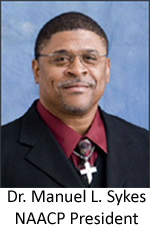 Florida offers the nation’s best lesson on whether private school options can help poor children, but the Tampa Bay Times seems uninterested in what these parents and students are telling us. Instead, it is busy pointing a distinctly partisan finger.
Argue if you want about whether the federal government should provide K-12 scholarships to low-income students, but the tax credit scholarship plan introduced by Republican U.S. Sen. Marco Rubio is not “bankrupt” or “craven.” It is instead a learning option that economically disadvantaged students wouldn’t otherwise have, and to label it as “money laundering” represents the kind of rhetorical excess that cheapens our public debate.
In Florida, more than 50,000 students are on a similar plan, and the results are encouraging to those of us who work with struggling children. The students who use the Florida Tax Credit Scholarship are truly poor – incomes barely above poverty and averaging less than $25,000 for a household of four – and more than two thirds of them are black or Hispanic. State research tells us they were among the lowest academic performers in the public schools they left behind, and testing results show they are making the same academic gains as students of all income levels nationally. Just as encouraging, the traditional public schools that are most impacted by students who choose the scholarships are themselves experiencing higher learning gains.
The educational results don’t seem to matter to those who prefer instead to dismiss scholarships as some kind of Republican conspiracy. Never mind that nearly half the Democrats in Florida’s Legislature also support this option, including a majority of the Black Caucus. Never mind those of us who work in disadvantaged communities in St. Petersburg and see children for whom these opportunities can make the difference between a diploma or a jail cell. Never mind that the Black Alliance for Educational Options, which represents elected black Democrats across the nation, has expressed its support for Rubio’s bill. (more…)

