By Brandon Larrabee
News Service of Florida
The Broward County School Board voted Wednesday to move ahead with legal action against a sweeping new education law, an initial step toward a court clash over one of the legislative session's most controversial bills.
During a special meeting called to discuss the potential lawsuit, board members voted unanimously to allow the district to hire an outside lawyer to help handle the case. Broward County expects to be followed by other districts — including Miami-Dade County — in mounting a challenge to the law.
The legislation (HB 7069), signed by Gov. Rick Scott last month, would overhaul a vast swath of state education law. It deals with everything from mandatory recess for elementary school students and standardized testing to charter school funding and teacher bonuses.
In a memo given to the Broward County board ahead of the meeting, the board's general counsel outlined five grounds to challenge the 278-page, $419 million measure. The grounds include an argument that the massive legislation violates the Florida Constitution's requirement that each bill deal with a single subject.
But it also launches broadsides against some aspects of the legislation that are friendly to charter schools. The new law makes it easier for charter schools to open near academically struggling traditional public schools, something the Broward County board says infringes on its authority over schools.
The law, championed by House Speaker Richard Corcoran, R-Land O' Lakes, also requires school districts to share with charter schools construction funds raised by local property taxes, something that could weaken the districts' credit outlook. (more…)
by Nia Nuñez-Brady
Thank God the Miami-Dade School Board did not investigate my address.
In 2003, I went to a high school where fighting was widespread and I was lucky if I wasn’t accidentally hit when a brawl broke out in the hallway.
One day, while I was using the ladies room, another girl, who was double my size or at least it felt that way at the time, threatened to bash my head on the wall if I didn’t stop hanging out with a guy she liked. Growing up, my dad always told me, “Your face is too pretty to get into a fight.” So, I said to her: “Please don’t hit me. I’ll stay out of your way.”
She laughed. I went back to class, and tried to focus.
The next day, while walking on the hallway at the school, this same girl grabbed another student close to me. She pushed her against the wall and instigated a fight. The difference between myself and this new student: This girl fought back. The bully wasted no time. She grabbed her Snapple bottle, broke it on the wall, and used a piece of glass to slash the student’s face.
 I was petrified. That could have been me.
I left school early that day, and begged my mom to transfer me to a safer school. I wasn’t worried about the quality of my education. I just wanted to get away from that environment.
My mom and dad had only been in America for four years. Their financial situation was tough, and they didn’t know the system yet. But they knew I had to attend the school where I was assigned, based on where we lived. (more…)
The Florida Board of Education tomorrow will decide appeals from three prospective South Florida charter schools.
In different ways, the cases spotlight a key tension in the Sunshine State, between removing roadblocks to new charter schools, which must be approved by their local school boards, and stopping schools that are unqualified, unlikely to serve students well, or at risk of shutting down soon after they open.
In Broward County, the school district has come under scrutiny for a large number of sudden, unexpected charter school closures, prompting a suggestion that it should screen charter applicants more closely.
In the case set to come before the state board tomorrow, it denied the Phoenix Academy of Excellence's application after finding what a school board attorney described as "a number of areas of weaknesses or concern." When the case reached the state Charter School Appeals Commission, the district prevailed. (more…)
As a spate of sudden failures has brought Florida's charter schools under a microscope, the state’s second-largest school district stands out.
Broward County is home to more charter schools than most states. And no district in Florida has shuttered more charters that opened since the 2012-13 school year. Some of those schools foundered shortly after they opened, uprooting students and sometimes leaving the district on the hook for millions of dollars.
A review by a national organization finds the district could be doing more to curb the problem.
The report, along with a similar evaluation of neighboring Miami-Dade County, sheds new light on a sometimes-overlooked dimension of Florida's charter school debate: The role of districts in stopping charter applicants who are not qualified to run schools.
Completed this summer by the National Association of Charter School Authorizers (NACSA) and obtained through a public records request, the review finds a "lack of rigor" in Broward’s process for reviewing charter school applications, which seemed "focused on statutory compliance rather than a quality assessment of a school’s likelihood of success."
Leslie Brown, the district’s chief portfolio services officer, said Florida law ties authorizers’ hands. Districts might spot red flags with charter schools that want to open, but as long as an application meets all the requirements in state law, a district that says “no” risks being overturned on appeal.
"There's a bit of a gap between what this national association includes in their principles and guidelines,” she said, and “what we have to do in Florida with regard to charter schools."
Sudden failures have created black eyes for the state’s more than 650 charter schools, prompting calls for change from charter boosters and critics alike. The turmoil became the subject of award-winning investigations by two newspapers, including one by the South Florida Sun-Sentinel that focused largely on Broward.
Katie Piehl, NACSA’s director of authorizer development, said Florida charter schools are three times as likely as their counterparts nationally to fail within a year of opening, which has prompted her group to make the state a priority.
With few exceptions, districts are the only groups allowed to authorize charter schools in the state, which makes them the first line of defense. Piehl said district officials sometimes feel hamstrung by state law, but when it comes to weeding out weak charter applicants, some do better than others.
"You're able to see some districts that are able to, within the confines of the existing law, make high-quality application decisions," she said.
There are different ways to slice and dice the data on charter school failures, but Broward appears to be ground zero for the problem. It's seen more first-and-second year closures than any other urban school district in Florida, and significantly more Miami-Dade County, its larger neighbor to the south.
While districts are getting more stringent in their reviews of charter school applications, Broward's approval rate remains relatively high, according to numbers state officials recently presented to a state legislative panel.
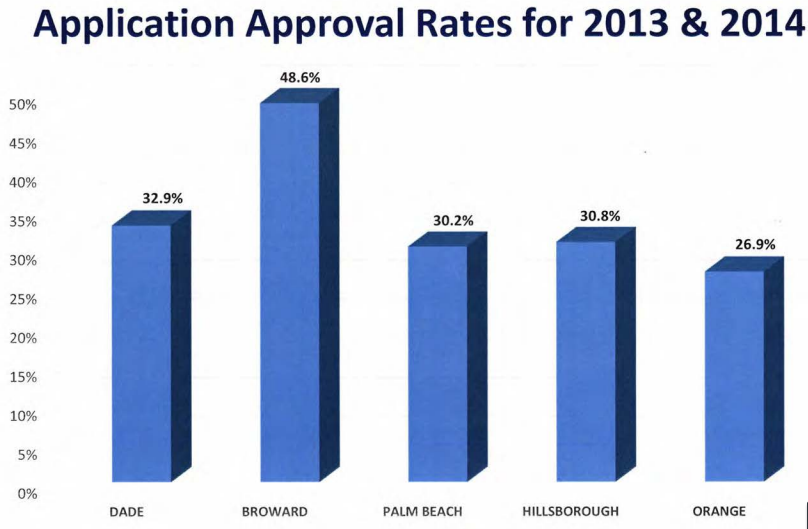
This graph by the Florida Department of Education shows Broward has recently approved applications at a higher rate than other urban districts.
NACSA's report acknowledges Broward’s charter school office has a small staff tasked with vetting dozens of applications and a growing portfolio of roughly 100 schools, while contending with a "seemingly ever-changing and limiting state statute."
At the same time, it says Broward's "current interpretation of Florida law hampers its work and creates an open- door mentality, yielding approval of applicants that then close within the first few months of operation."
There were some interesting exchanges when state Rep. Erik Fresen, R-Miami, stopped by the Broward County School Board this week (see the video here). One dealt with the role of charter schools in Florida's education system, and why parents might choose them even when their children already go to an A-rated school.
School board member Laurie Rich Levinson questioned the purpose of charter schools that open in the vicinity of district schools where students are already doing well.
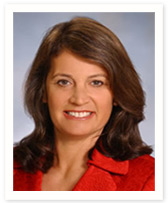
Levinson
"They're going to open in areas where we have our highest-performing schools, where there's not a need for a charter school," she said. If charter schools open right down the street from a high-performing school, "what are we achieving?"
Fresen responded with a case study from Broward's neighbor the south, Miami-Dade. Charters have opened in Coral Gables, where most existing public schools were already high-performing. Now, he said, while A-rated charter schools may draw students from A-rated district schools, all the schools have been forced to step up their game. District schools now offer language and international-baccalaureate programs they might not have otherwise.
In other words, competition from private and charter schools, which is more intense in Miami-Dade than in most Florida districts, may be adding to the school choice "tsunami" in South Florida. (more…)
One of the three Florida school districts in line to receive $3.3 million to recruit high-achieving charter schools into disadvantaged neighborhoods appears to be pulling away from the initiative.
Broward County School Board members decided Tuesday to tell the state, as one member put it, "thanks but no thanks."
District Superintendent Robert Runcie said the grants were part of a state effort to tackle the tricky problem of charter school quality.
Among other things, they would have allowed districts to hire more staff to help oversee the charters they authorize.
Broward, Florida's second-largest school district, indicated in grant documents that its charter school office has a staff of seven, charged with keeping tabs on nearly 100 charter schools — more, Runcie has pointed out, than there are in the entire state of New Jersey.
The grant would also have allowed the district to use charters to meet its own goals, rather than passively awaiting applications from operators who might be loathe to target areas with the greatest needs. The new, proactive approach called for seeking competitive proposals from charter organizations with strong track records, directing them toward an academically undeserved area west of Fort Lauderdale, and ensuring they cultivated ties with the surrounding community.
"This is a grant that affords us enormous flexibility to focus on a primary goal of improving student achievement in low-performing schools in the district — chronically low-performing schools where we've struggled in the past," Runcie said.
School Board members, however, did not see it what way. There was no vote on the plan after Tuesday's two-hour workshop, because the board needed consensus to proceed, and most members made clear that they opposed the idea.
One objection, they stressed over and over again, was the spread of low-quality charters that under-perform, and in the worst cases, shut down soon after they open — problems the grant proposal was intended to help address, and which board members repeatedly blamed on a lack of state "regulation" of charter schools.
Two proposed charter schools that were rejected by their local school boards will get to make their cases to the Florida Board of Education.
A panel that vets charter school appeals has sided with one of the prospective charters, but not the other. The state board is set to have its say at its meeting next week in Tallahassee.
The Florida Charter School Appeal Commission voted unanimously to support Discovery High School in Polk County after finding the school board did not show the alleged flaws in the school's plans justified the rejection of its charter application.
The proposed charter school would grow out of the existing Discovery Academy of Lake Alfred, a Title I charter in Polk County. The middle school received a C rating from the state in 2013-14, while serving one of the highest proportions of low-income students of all the charters in the district.
The Winter Haven News Chief reported this summer that the new charter school proposal has the backing of Lake Alfred's mayor, who said the town has long yearned for its own high school.
 There are times when it’s appropriate for a journalist to boil down a story into a he-said, she-said. And there are times when it’s just lackluster reporting.
As Jon East has noted in this blog post and this op-ed, Florida’s Amendment 8 – the “religious freedom amendment” – is not about private school vouchers. It’s clear if you look at the legal history for private education options in Florida. It’s clear if you look to see who is and isn’t bankrolling the campaign.
And yet, one news story after another has allowed the Florida Education Association, the Florida School Boards Association and other school choice critics to posit that it is about vouchers – and to let those assertions go unchallenged. Often it’s in terms so deep into an alternate reality, they beg for a little scrutiny. According to the Gainesville Sun, for example, an Alachua County School Board member described Amendment 8 as “the very death of public schools.”
With six weeks left before the vote, statements like these are surfacing in major newspapers nearly every day. Here are a few examples, along with how the story captures the legislative intent of the amendment, the constitutional underpinnings of school vouchers, the lack of a campaign or financial support by school voucher advocates, the factual history of private options in a state that now provides them to more than 200,000 students, or just some form of a statement from those with an opposing view:
From the South Florida Sun Sentinel (Aug. 21):
“Amendment 8 would remove the long-standing restriction in the Florida Constitution that prohibits the expenditure of public funds to support religious programs," the resolution (from the Broward County School Board) reads. "Passage of Amendment 8 could result in state funds being awarded to non-public schools, instead of allocated to support public and charter schools.”
The resolution stops short of saying whether those would be good or bad outcomes, but it was obvious where board members stood.
"We have a limited amount of resources, and you would continue to strain the resources for public and charter schools," board member Robin Bartleman said.
Response from other side: None
Supporting evidence: None
***
From the Daytona Beach News Journal (Sept. 15):
The title and wording of the amendment were the subject of a lawsuit in which Ormond Beach school principal Susan Persis and Palm Coast rabbi Merrill Shapiro were plaintiffs.
They and other representatives of school-related organizations and clergy tried to get the amendment thrown off the ballot, but a judge allowed it to go before voters after Florida Attorney General Pam Bondi rewrote the proposal.
Persis said she fears passage of Amendment 8 would divert money from public schools to religious ones. "This would further reduce funding for public education," said Persis, who's principal of Pine Trail Elementary. "Any further reduction will be devastating to our schools." (more…)

