by Renée Stoeckle
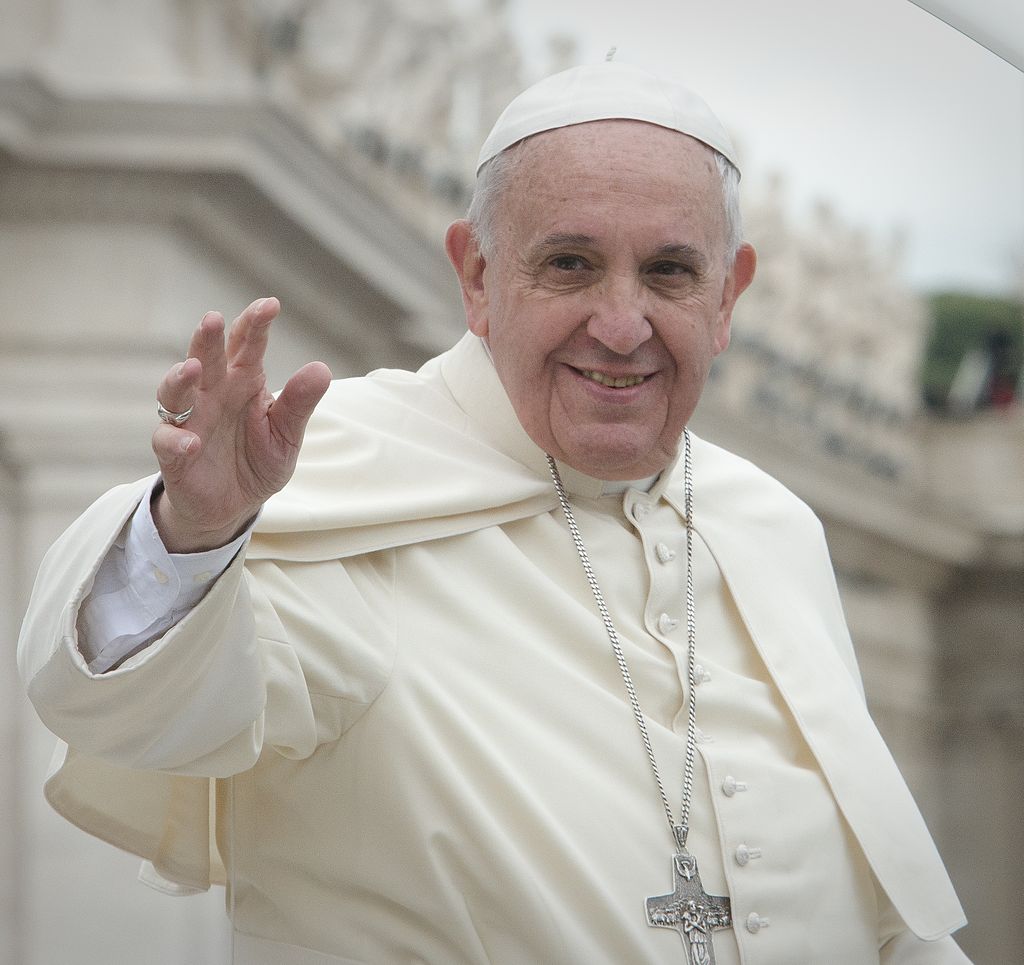
Pope Francis has referred to Catholic education as "too selective and elitist." (Image from Wikipedia by Jeffrey Bruno.)
Pope Francis is exhorting church leaders across the globe to join the school choice movement.
Earlier this month, Pope Francis issued the second apostolic exhortation of his papacy, Amoris Laetitia (The Joy of Love). The document is not official church doctrine, but rather a public teaching of the pope that calls the faithful to action on a particular subject – in this case, the modern family. Given that this pope has issued only two apostolic exhortations in his three-year papacy, the inclusion of school choice speaks volumes about Francis’ priorities.
In Amoris Laetitia, the pontiff reiterates the church’s teaching that choice in education is a fundamental right of parents who are “called to defend and of which no one may claim to deprive them,” meaning the state must not deny parents the right to select their child’s educational path, be it public or private, regardless of their financial means.
Francis calls upon the state to provide educational opportunities for all families but emphasizes that “parents themselves enjoy the right to choose freely the kind of education – accessible and of good quality – which they wish to give their children in accordance with their convictions” (paragraph 84).
Amoris Laetitia comes in response to last fall’s Synod on the Family, a weeks-long global meeting of Catholic Bishops that stirred conversation related to the church’s relationship with the modern family. Like much of Francis’ papacy, the Synod challenged the church to extend greater mercy towards families, particularly the most vulnerable in society and those who may feel unwelcomed in the church.
Francis’ words on parental choice challenge both church and ctate leaders to ensure the poor are not left in the margins of educational opportunity. This message is not new for Francis, nor is it new for the Catholic Church as a whole. But with tuition costs averaging $10,000 for high school freshmen, the pope has repeatedly implied that Catholic schools in the United States and across the globe seem to have strayed from this mission.
In November of last year, Francis candidly referred to Catholic education as “too selective and elitist,” referring to how the rising cost of tuition makes educational opportunity inaccessible to the masses. Francis commented that “there is always the ghost of money – always. It seems that only those people or persons who are at a certain level or have a certain capacity have the right to an education.” (more…)
Editor's post: This piece by James Herzog, associate director for education at the Florida Catholic Conference and occasional contributor to redefinED, ran over the weekend in the Palm Beach Post. The tax credit scholarship program is administered by Step Up For Students, which co-hosts this blog.
James Herzog
The low-income mom from Boynton Beach felt the school was hamstrung from providing the well-rounded academic and social environment her fifth-grade daughter needed to succeed. So last year, she did what many low-income parents could once only dream about: She transferred her child to another school.
With help from a Florida tax credit scholarship, she enrolled her daughter, now 11, into St. Vincent Ferrer Catholic School in Delray Beach. The scholarship, valued at $4,880 this year, didn’t cover the full cost of tuition. But the mom was willing to make the sacrifice to pay the additional $1,520. She was thrilled to have a choice.
Now her daughter is thriving.
Student by student, the scholarship program is making a profound difference this year for 9,448 K-12 students in Florida Catholic schools. Now serving nearly 60,000 students statewide, it also helps families who seek education opportunities offered by other faith-based or independent schools. By offering more options for the students who are often the lowest performers in public schools, it helps the state as a whole, too.
During the current legislative session, the Florida Conference of Catholic Bishops has made House Bill 7167 regarding educational choice a top priority. Sponsored by House Education Appropriations Subcommittee Chairman Erik Fresen, R-Miami, the bill deserves support from all of us who believe in expanding opportunity for families who need it the most.
One key provision would empower parents of children in grades six through 12 to have the same type of school choice as that enjoyed by parents of children in kindergarten to fifth grade. This would be accomplished by removing the requirement that students in grades six through 12 attend public schools before they’re eligible for the scholarships.
We know more options are needed. Over the past 15 years, no state has made bigger gains for its low-income students than Florida. In 1998, Florida’s low-income fourth-graders ranked No. 35 among states in reading. Now they rank No. 1. And yet, being No. 1 still means only 27 percent of them are reading at a level considered proficient. (more…)
 A chain of Catholic, college-prep high schools that has demonstrated success with low-income students is eyeing two Florida cities for a possible expansion. Tampa and Miami are near the top of the list for the Chicago-based Cristo Rey Network, group president Rob Birdsell told redefinED. The reasons: A good job pool. The availability of tax credit scholarships. A need for more high-quality options for low-income kids. And maybe even some nudging from former Florida Gov. Jeb Bush.
“We very much want to get to Florida,” Birdsell said in a phone interview. “Gov. Bush is a friend of Cristo Rey (and) he is persistent.”
Lauded by education reformers and others for innovative work with Hispanic and African American students (see if you can get through this “60 Minutes” piece without crying), Cristo Rey now operates 24 Catholic high schools in 17 states and the District of Columbia. Its students typically come in two grade levels behind. But 84 percent of those who graduate enroll in college.
The students pay more than half of the $12,000 average tuition through a corporate work study program that gives them real-world experience at banks, hospitals, law firms and other partners. Accessing Florida’s tax credit scholarship program – worth $4,335 per student this fall – would fill out most of the remaining gap. That would take pressure off both the families and the network’s fundraisers. (more…)
This essay was first posted at the CLR Forum by the Center for Law and Religion at St. John's University School of Law.
By Ashley Berner
In a recent column for the New York Times, David Brooks argued that a healthy society requires a “thick ecosystem” in which diverse organizations create a rich “spiritual, economic and social ecology.” He contrasted this with an abstract, rule-based “one-size-fits-all” approach favored by government technocrats. He wrote, “Technocratic organizations take diverse institutions and make them more alike by imposing the same rules. Technocracies do not defer to local knowledge. They dislike individual discretion. They like consistency, codification and uniformity.”
Brooks’s contrast applies to public education: America favors technocratic uniformity, while most other liberal democracies prefer a diverse ecosystem.
Here are a few examples of diverse educational ecosystems from other countries. Some good sources on this are Helena Miller’s work on Jewish schooling; Salisbury and Tooley on international comparisons; and Glenn’s Contrasting Models.
This essay was first posted at the CLR Forum by the Center for Law and Religion at St. John's University School of Law.
By Ashley Berner
Let me begin with a thought experiment. Suppose that a majority of parents in a school district wished their children to have a traditional curriculum that included Latin, The Norton Anthology of American Literature, sentence diagramming, advanced mathematics and experimental science. Also suppose these parents wanted the teachers to have subject matter instead of education degrees. Suppose, further, they wanted the philosophical framework of their children’s schooling to be Modern Orthodox Judaism. Finally, suppose that these parents agreed to comply with the district’s regulations for school facilities, extracurricular activities and student-teacher ratios, and to surpass the district’s academic standards.
Would the district fund the new school? No, because the United States’ educational system was not designed to allow this kind of diversity.
This comes as no surprise to most Americans. But they might be surprised to learn that this is in sharp contrast to virtually every other liberal democracy. In England, for example, if such parents provide 15 percent of the capital costs, Central Government contributes the remaining 85 percent and also funds the ongoing operations of the school. In the Netherlands, the new school would be funded on an equal footing with the Muslim, Catholic, Montessori, and Anthroposophic schools down the street.
U.S. Health and Human Services Secretary Kathleen Sebelius didn’t set out to make life hard on Catholic hospitals, and it is not difficult to imagine why a guardian of health would come down on the side of contraception. But New York Times columnist David Brooks makes an enticing point as he examines how technocrats, to use his term, tend to cower from complexity and run from religion. He sees those same behaviors tying President Obama in knots on school vouchers.
Wrote Brooks:
"The administration’s policies on school vouchers and religious service providers are demoralizing because they weaken this ecology by reducing its diversity. By ending vouchers, the administration reduced the social intercourse between neighborhoods. By coercing the religious charities, it is teaching the faithful to distrust government, to segregate themselves from bureaucratic overreach, to pull inward."
The communities that a young Barack Obama organized are deeply tied to the church, and those church leaders provide a form of social ballast. Indeed, one of the reasons most of the private schools participating in voucher or tax credit scholarship programs across the country are faith-based is that one of the missions of these schools is to help children who are in social or financial or educational need. That aligns with the mission of most of these private-option programs.
Florida is certainly an example. The Tax Credit Scholarship is available only to students whose household income qualifies them for free or reduced-price lunch, or 85 percent above poverty, and the actual average income this school year is only 12 percent above poverty. In turn, roughly four-fifths of the 38,375 students this year attend faith-based schools.
That these schools are tied in some way to religion can indeed give technocrats serious pause. They think of a wall that is supposed to separate church and state, and forget that the Establishment Cause was prompted by fears not that the government would cooperate with religions but that it would allow for only one. We’re a pluralistic nation, and the participating Florida schools make that point emphatically: Of the participating religious schools, 36 percent are nondenominational, 17 percent Catholic, 16 percent Baptist, 5 percent Seventh Day Adventist, 3 percent Pentecostal, 3 percent Jewish, and the rest representing at least nine other faiths.
These schools are a snapshot of our communities, just as Catholic hospitals are a part of the medical landscape. As long as the government isn’t forcing children to attend them and as long as the options are religiously diverse, then technocrats have nothing to fear. In fact, there is a persuasive constitutional argument that the government can’t offer options that exclude religious ones. More importantly, these kinds of learning options strengthen the public education quilt by adding pieces of community fabric that sometimes can play a constructive role in helping disadvantaged children learn. That’s certainly something community organizer Barack Obama can appreciate.
The New York Times seems to be specializing in a new genre of news writing: The decline of the Roman Catholic school. Its most recent story comes from David Gonzalez, who crafts an opening that is equal parts heartbreaking and maddening as it focuses on the principal of St. Martin of Tours Elementary in the Bronx as she introduces the last kindergarten graduation the school will ever hold:
“We are honored to have with us the future college graduates of ...” She paused, bit her lip and looked at the children. Her voice cracked. “Of ... 20 ... 27.”
Sister Nora praised them for learning about God, reading and respect.
“We look forward to hearing about the progress they make as they continue their educational journey ... elsewhere.”
She made it, barely. The “elsewhere” was the killer, as it has been since January, when Sister Nora was told the Roman Catholic Archdiocese of New York had decided St. Martin’s would close after 86 years. Pleas and plans to save the school were received and rejected. Wednesday was the school’s final day.
The latest closure follows a report this month by Samuel G. Freedman in the Times, which chronicled the final days of Rice High School in Harlem, where 98 percent of the student body was black or Hispanic and where every graduating senior went to college. "It ought to sound an alarm about a slow-motion crisis in American education," Freedman wrote.
From Samuel G. Freedman in The New York Times:
Amid the grandeur and permanence of St. Patrick’s Cathedral, they marched down the aisle in pairs, the graduating seniors of Rice High School in Harlem. They were the 70th commencement class in the school’s history, the latest to bear the venerable epithet of being “Rice men.”
All those trappings of longevity, the bronze doors and marble pulpit and stained glass, were illusory. The graduation ceremony on May 27 was the last ever for Rice, which is being closed, and the event was most significant as a symbol of the continuing contraction of Roman Catholic education in the urban settings where it has been most needed.
In 1981, sociologist James S. Coleman made the claim that tuition barriers to private schools are "certainly harmful to the public interest, and especially harmful to the interests of those least well-off." He was referring particularly to Catholic schools and to his just-completed research identifying the social capital that families invested in Catholic education and the benefits that investment yielded in even the most disadvatanged youth.
Last week, the Roman Catholic Archdiocese of New York announced that it planned to close 27 schools, ejecting 4,700 students. While the New York archdiocese has been aggressively consolidating some schools and converting others into charter schools in recent years, the announcement signals a further strain on a mission-driven style of education that has suffered from more than 1,600 school closings and consolidations nationwide in the last 10 years alone.
Coleman was urging policymakers to consider ways to expand the role of private schools in American public education. While state and locally facilitated vouchers and tuition tax credit plans have helped urban, inner-city families by the hundreds obtain a Catholic education in ways that didn't exist during Coleman's time, that has happened in only a handful of regions. Most Catholic schools depend on tuition revenue to stay afloat, and this trend of school closings and enrollment declines threatens the mission of an institution that has long reached out to impoverished neighborhoods. As RiShawn Biddle recently noted on his blog, Dropout Nation, that mission continues today, "with blacks, Latinos, Asians and American Indians making up 26 percent of its students."
Future posts on this topic will be frequent on redefinED. For now, here's a brief look at the trends in Catholic education, by the numbers (according to the National Catholic Educational Association):

