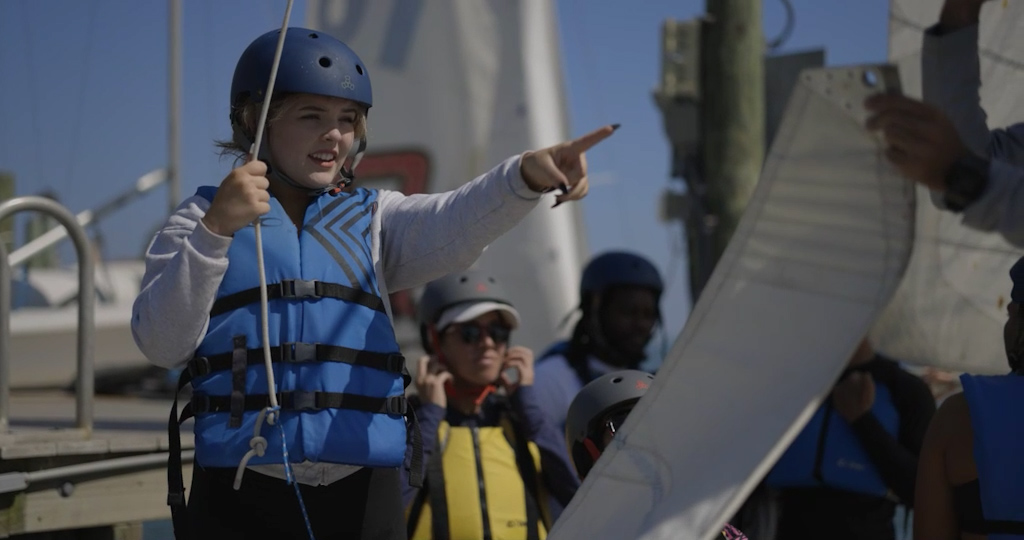
SailFuture Academy in St. Petersburg, a tuition-free high school that leverages project-based learning and apprenticeships to prepare students for college and life, is one of eight schools selected as national finalists for a $500,000 prize.
Arizona’s only public school for students with autism took home the $1 million Yass Prize for innovation, while a Florida private school that seeks to help at-risk youth was among eight finalists that received $500,000 each on Wednesday.
The grand prize recognizes Arizona Autism Charter School’s efforts to expand its unique individualized learning programs, which are rated exemplary by Arizona, and supports the creation of a national accelerator for autism-focused charter schools that will enable similar schools to be established in every state.
Diana Diaz-Harrison explained why she founded the schools during the rigorous Yass Prize competition.
“As an autism mom, I don’t want my kid to be seen as disabled. I want him to be seen as a doer, intelligent, productive and these charter schools that we are starting across America will help our children be neurodiverse, be who they are and be fulfilling, productive citizens,” she said in a news release.
Finalist SailFuture Academy in St. Petersburg, Florida, a school for troubled youth whose founder was incarcerated as a student, is a tuition-free private “entrepreneurship” high school. Prize officials recognized the school for leveraging project-based learning and paid apprenticeships to prepare students in foster care for successful careers by focusing on the maritime business in addition to culinary and construction experiences.
“A lot of our kids have been in many, many different homes. The public education system can work really well for kids who stay in one place, but when you’re moving around so much, you can fall through the cracks,” co-founder Hunter Thompson told ReimaginED in 2021.
Thompson started SailFuture with co-founder Michael Long after the two met while in college.
The seven other finalists for the Prize also were motivated by personal situations or the lack of education opportunities that exist for underserved students.
“We were thrilled to find these education changemakers and are grateful to be able to reward their extraordinary creativity, tenacity and achievements, and to help them build for the future,” Janine Yass, founder of the Yass Prize with her husband Jeff, said in the release. “We should be giving every educator in the nation the freedom the Yass Prize winners have to tailor education to the needs of children, and give every parent the opportunity to choose specialized learning environments like these.
“After 25 years and countless dollars in charitable giving, this is by far the most impactful thing we have ever done with our resources.”
The additional prize winners, each of which will receive a $500,000 prize, include:
Capital Prep Schools, college preparatory charter schools serving students in some of the most dangerous communities in the country - the Bronx, Harlem and Bridgeport, CT - for its efforts to expand its capacity to provide historically disadvantaged students the skills they need to become responsible and engaged citizens for social change.
Northern Cass School District, an innovative public school district in North Dakota, for reimagining rural education and seeking to serve as a model for other districts seeking to implement a transformational, personalized, community-wide education model where other options for students are not available.
Oakmont Education, based in Akron, Ohio and with schools in nine other Ohio cities, for its ability to deliver personalized education and support career advancement for more than 3,000 students who struggle to navigate life with barriers such as poverty, addiction, homelessness, food insecurity, court involvement, mental health issues or raising children of their own.
Rapunzl, a national edtech company based in Chicago, for giving disadvantaged students an innovative and engaging way to learn about personal finance and investing, as well as for providing investment competitions where students compete for scholarships and cash prizes.
Soar Academy in Evans, Georgia, a non-traditional Micro-school for students with ADHD, Dyslexia, Autism, Auditory Processing Disorder and students facing remediation due to academic gaps, for guiding underserved students toward success with a one-on-one project-based learning environment both in-person and online.
unCommon Construction in New Orleans, Louisiana, with expansion into Minneapolis and other cities, for its unprecedented apprenticeship program that offers disadvantaged high-school students earn-while-you-learn opportunities for academic credit and scholarships for trade certifications, all of which are funded by revenue from selling houses participating students build.
Urban Preparatory Academy, in Wichita, the only African American private school in Kansas, for providing every student with an individual learning plan to get them reading on grade level and beyond. Infused with a focus on character and community engagement, the school’s efforts translate into a 100% acceptance rate into private high schools.
The 2022 competition attracted applications from some 2,700 organizations from 49 states, including public schools, private schools, charter schools, micro-schools, learning pods, organizations providing hybrid- and personalized-learning arrangements, and education technology companies.
Four other Florida schools, Hope Ranch Learning Academy, Kind Academy, RCMA Immokalee Community Academy and Colossal Academy also won grants in earlier phases of the competition.
Formally called the Yass Prize for Sustainable, Transformational, Outstanding and Permissionless Education, the annual prize exists to recognize and reward outstanding education providers and to amplify their work through financial support, collaboration, coaching, encouragement and an extensive mentorship network.
The Center for Education Reform (CER), Washington, DC, administers the prize and houses the Yass Foundation for Education.
Jeanne Allen, director of the Yass Foundation and founder and CEO of CER, said the awards program is helping to build a “critical mass of innovation and success” beyond the confines of America’s troubled public-school systems and capturing the attention and interest of thousands of educators and parents who want to be freed from bureaucracy to serve students in unique and innovative ways.
“Through Janine and Jeff’s extraordinary generosity, we can not only reward the best-in-class providers who deliver outstanding education when it is most needed, but provide a benchmark for all to emulate,” said Allen. “We are proud to celebrate the type of innovative work that will chart the future for sustainable and transformational opportunities for students—in permissionless settings.”
 The Center for Education Reform in its annual education choice report has ranked Florida as the country’s No. 1 state for parent empowerment in education.
The center’s Parent Power! Index gave Florida its overall top ranking, also rating the Sunshine State No. 1 for digital and personalized learning and education choice programs. The state received a No. 2 ranking for charter schools, second only to top-ranked Arizona, and ranked third for teacher quality.
Other high spots for the state: leadership, COVID-19 response, and transparency.
The annual Parent Power! Index debuted in 1999 and measures the extent to which states have policies in place that put students first, value the unique needs of every family, and empower parents to oversee their child’s education. Each state was ranked using three criteria: choice programs, charter schools, and innovation.
Overall, Florida scored 94.6%, leading all 50 states and the District of Columbia. For more on the index and its methodology, click here.
“Parental involvement is important to a child’s success both in school and in life, and in Florida we are proud to protect parents’ right to be involved in a child’s education,” Florida Gov. Ron DeSantis said in a news release. “This recognition continues to show that Florida is a national leader in school choice, parent empowerment, and education as a whole.”
State Department of Education Commissioner Manny Diaz Jr. said Florida will always be committed to protecting parents’ rights to raise their children as they see fit.
“We are proud to offer a variety of educational options for parents without limitations due to location or income,” he said. “As the rest of the nation follows the leadership of Governor Ron DeSantis, the Department of Education will continue to support initiatives that uphold parental rights and expand school choice.”
For the full 2022 Parent Power! Index Report, click here.
In addition to today’s recognition, Florida ranked No. 1 in the nation on the Heritage Foundation Education Freedom report card, which analyzes both the quantity and quality of a state’s school choice offerings. You can see the full report here.
Nearly half of Florida students have chosen an educational option outside of their zoned traditional public school, such as open enrollment, Family Empowerment Scholarships, charter schools, virtual education, education savings accounts, and more.
SailFuture in St. Petersburg, Florida, a unique, seafaring educational innovation that helps troubled teens chart new courses for their lives, is a quarterfinalist for a $1 million award powered by the Center for Educational Reform.
Five Florida education providers are among 64 quarterfinalists from 33 states and the District of Columbia who are in the running for a prestigious $1million award for educational excellence.
SailFuture in St. Petersburg, RCMA Immokalee Community Academy, Hope Ranch Learning Academy in Hudson, Colossal Academy in Davie, and Kind Academy in Coral Springs all are vying for the prize that recognizes those providers who strive to offer education that meets the four adjectives whose first letters spell the acronym for the award: Sustainable, Transformational, Outstanding, and Permissionless.
(reimaginED profiled three of the quarterfinalists here, here, and here.)
Yass Prize founder Janine Yass said it was her goal this year to find the best innovators in education in the country.
“Their ideas and enthusiasm are pushing the status quo for children who deserve access to awe-inspiring education,” Yass said.
She and her husband, Jeff, launched the prize, which is powered by the Center for Education Reform, to find and advance the work of education providers who continued to serve children despite the challenges brought on by the COVID-19 pandemic.
Center founder Jeanne Allen, who also serves as director of the Yass Foundation for Education, said she looks forward to getting to know the new quarterfinalists, who deserve recognition for their efforts to transform education.
“If we could just clone them and the thousands more who applied, we could more than make up the deficiencies brought on by years of mediocrity and COVID learning that have wrought havoc on our kids,” Allen said. “This is a start.”
Each of the 64 finalists are guaranteed a STOP award of $100,000. They now move into the next round, where 32 providers will be selected and will have a chance to receive a $200,000 award and take part in a “hybrid accelerator program” that will pair them with technology leaders and investors who could help them expand their ideas and methods.
At the end of the “accelerator process,” seven finalists will be named, one of whom will win the $1 million prize. Each of the other finalists will receive a $250,000 award.
Michael Moe, CER director and founder of Global Silicon Valley, a growth investment platform in California who served as an early adviser to the initiative, cited education entrepreneurs as a critical piece of the country’s continued economic strength and growth.
“The work that all of these quarterfinalists are accomplishing to educate the future generations is truly transformative,” Moe said.

At the start of the pandemic, team members at The Discovery Center opted to serve the community in person rather than wait out COVID-19 at home. They rapidly built out classrooms and turned the center into a COVID-safe, licensed emergency childcare center capable of caring for hundreds of children a day – and then it became so much more.
Two years ago, as the coronavirus pandemic began shuttering childcare centers nationwide, a Springfield, Missouri, center that had been providing STEM education activities faced a critical decision.
Should it close, or should it attempt to fill the area’s childcare gap?
The team at The Discovery Center voted to stay open. Within 48 hours, it transitioned its 60,000-square-foot building into a support center for the children of the area’s essential workers. As the pandemic raged, the center served the educational needs of more than 1,500 students and provided more than 50,000 free meals and snacks.
“In five days, we went from a science center to licensed emergency childcare,” executive director Rob Blevins told OzarksFirst.com. “We took the kids right then and there. It was one of those moments where we felt it was our patriotic duty to take these kids and let health care workers do their job.”
Then The Discovery Center pivoted to become something more.
It poured its 20 years of experience in STEM education into creating hybrid learning support in a student-centered environment to benefit children who struggle in a traditional school setting. The daycare operation expanded to in-person learning pods and donated supervised space for students using the district schools’ remote instruction programs. A preschool was added, along with a science museum for K-8 students.
Combined, these efforts earned The Discovery Center $1 million, the grand prize in the inaugural STOP Awards, created through a partnership between Forbes and the Center for Education Reform. The awards program recognizes education innovators, providers and entrepreneurs who continued to support underserved communities during the pandemic.
The Discovery Center’s efforts aligned with the very essence of the STOP Awards: Sustainable, Transformational, Outstanding, and Permissionless – four words that form the program’s acronym. Four finalists aligned with each of the four pillars.
Louisiana Key Academy in Baton Rouge was recognized for providing a sustainable education during the pandemic to its 441 students with dyslexia. The public charter school uses evidence-based instruction to serve its population, 70% of which are minorities and 60% of which are economically disadvantaged.
Dallas Education Foundation shone in the Transformational category, fighting the impact of COVID with 21st century technology and creating a metaverse of innovations and opportunities for the district’s 145,000 students.
CARE Elementary School in Miami was recognized in the Outstanding category. The no-cost private school reopened quickly to in-person learning, with state-of-the-art technology powering dozens of learning pods.
The entrepreneurial start-up Rock by Rock, developed in partnership with educators nationwide, was the finalist in the Permissionless category. Rock by Rock provided thousands of underserved families whose children lacked effective education during COVID affordable, relevant, and engaging materials in a homeschool environment that made learning come alive.
All four finalists plan to use their award money to continue pushing the envelope, moving forward in even more inventive ways to provide additional education choices for families. But the grand prize winner, The Discovery Center, has especially big plans.
Among them: expanding current offerings to become a full-time school for hundreds of students with the addition of a STEM-themed playground and then scaling and disseminating that model to its network in more than 27 rural counties over 30 states. The center also hopes to expand classes to high school freshmen and sophomores.
“Educators, whether they’re homeschool, public school, charter school, private school or pod school will be able to provide the type of knowledge we want to provide our parents as far as how their kids are attaining grade level in real-time,” executive director Blevins said. “When you get a grade card, that’s a backward look of how things went this semester. We want to provide a real-time look so you can look forward and say, ‘Are we on target to hit our grade-level standards this year?”
Forbes and the Center for Education Reform recently announced a second round of STOP Awards, which will offer more than $10 million in grants.
“In the wake of COVID-19, educational declines and mental health challenges, the 2022 STOP Awards are dedicated to celebrating and expanding the education providers who are going above and beyond for their students,” said Forbes chief content officer and editor Randall Lane. “We’re proud to continue our partnership with the Center for Education Reform and help launch the STOP Foundation 4 Education to honor education innovators who are creating new pathways for underserved students across the country.”
Center for Education Reform CEO founder and CEO Jeanne Allen knows that overcoming education deficiencies wrought by the pandemic will continue to be a huge undertaking.
“While COVID is not nearly the threat it once was, challenges remain,” Allen said. “In 2021, we uncovered hundreds of pioneering education providers who were defying the odds and serving as a beacon for what education can and should look like, and I can’t wait to promote the efforts of more outstanding leaders in 2022.”
Applications, limited to U.S.-based individuals and groups who serve K-12 students, are open through July 15. For more information about the STOP Award, how to apply, and the education providers who made last year’s list, click here.
 'Hope Scholarship': Bullied and abused public school students could be eligible next year for a new school choice program being proposed by Florida House Republicans. Under the program, dubbed the "Hope Scholarship," those students could apply for a transfer to a different public school or for a state scholarship to attend a private school. Nearly 47,000 incidents of bullying, hazing or abuse are reported each year in Florida schools, and most involve violence. The legislation has not yet been written, but House Speaker Richard Corcoran, R-Land O'Lakes, says the scholarship could be set up like the tax credit scholarship program, which provides scholarships for more than 100,000 low-income students to attend private schools. Step Up For Students, which hosts this blog, helps administer that program. Miami Herald. Orlando Sentinel. redefinED. News Service of Florida. Gradebook. Politico Florida. Sunshine State News. WUSF.
Enrollment uncertainty: Legislators say the effects of the hurricane season are causing uncertainty in estimating K-12 enrollment for the next school year. Officials were working off an estimate of an additional 26,764 students for the 2018-2019 school year, but that was before several hurricanes swept through the islands and displaced thousands. “If you have more students (than the estimate), you spread it thinner,” says Sen. Bill Montford, D-Tallahassee, talking about the school funding formula. “If you have less students, you don't get the money.” So far, 12 districts and 19 charter schools are asking the state to delay the usual timetable for counting school enrollment, which is typically this week. If the requests are approved, the counts would have to be done no later than the week of Dec. 11-15. News Service of Florida. Politico Florida. Almost 150 Puerto Rican students displaced by Hurricane Maria already have registered to attend schools in Pinellas, Hillsborough, Sarasota, Manatee and Polk counties. About 440 have signed up in Orange and Osceola counties. Hundreds, if not thousands more, are expected. WMNF.
Local education agencies: Two charter school companies in Florida are applying to the state to be designated as local education agencies, which would allow them to directly receive federal funding for teacher training, supporting low-income students or helping children with special needs, and gives also them greater control over how they use the money. Somerset Academy, which recently took over the Jefferson County School District, and the United Cerebral Palsy schools, which serve special needs students in central Florida, want to join two other state charter school networks in getting the designation. redefinED.
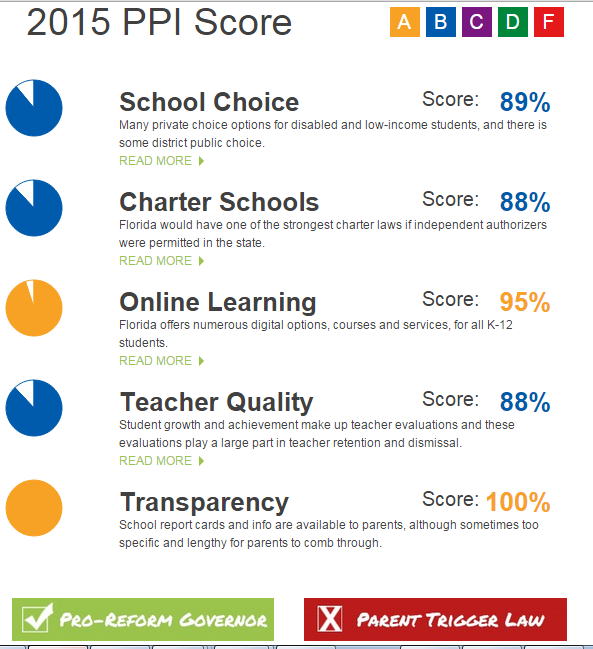
The Center for Education Reform gives Florida's "parent power" policies high ratings.
When groups rank states based on a range of education reforms — school choice, charter schools, teacher quality, transparency, digital learning — it's not surprising Florida lands near the top.
But Indiana continues to eke its way into the no. 1 spot in the Center for Education Reform's "Parent Power Index," despite an ongoing political struggle over education policy in that state.
The latest version of the index, released today, gives Florida high marks for supporting digital learning, giving parents access to school report cards and information about their options, having one of the stronger charter school laws in the country, and embracing private school choice. The main knocks against it include the lack of a "parent trigger" law and the inability to create independent charter school authorizers.
It's worth keeping in mind that giving students more options doesn't lead to improved student performance by itself. Democrats for Education Reform drove that point home in an analysis last year. It lined up advocates' rankings of state charter school laws with charter school performance in each state, and found there wasn't much correlation. "School choice alone does not guarantee success," policy analyst Marianne Lombardo wrote at the time, "but can create the potential for success."
In one Florida city, the push for a charter school came from parents and teachers. In another, from a Democratic mayor. And in yet another, from the commander of one of the nation’s best-known military bases.
Over the past six months alone, at least a half-dozen examples show Florida charter schools picking up enthusiastic support from places that may seem unexpected. In many cases, school boards and teacher unions still oppose charter schools, and there’s no doubt the privatization narrative continues to dog them. But the recent examples suggest parents, local governments and other stakeholders in public education aren’t fazed.
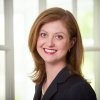
Kara Kerwin
“I definitely think there is a trend,’’ said Kara Kerwin, president of the Center for Education Reform, a Washington, D.C.-based think-tank that is strongly pro school choice. “And I think it’s an eye-opener for local public schools.’’
Florida is a leader in both charter school growth and charter school controversy. It boasts among the highest numbers of charter schools in the nation (more than 600), with the number of students in them nearly doubling in the past five years (to more than 200,000). The rapid growth has fueled constant clashes with school districts, and all the edgy publicity that comes with it.
And yet, the recent examples show no let-up in charter school proposals, and consideration if not support from an increasingly wide array of entities:
Florida’s growing diversity in learning options of all stripes may be fueling further momentum for charter schools, Kerwin said. (more…)
School choice. The Black Alliance for Educational Options draws 650 attendees from 20 states to Orlando for its annual symposium. Check out #SY2013 on Twitter for what's happening. Legendary school choice activist Howard Fuller says attendees shouldn't be knee-jerk about the participation of for-profit companies. Also check out this redefinED podcast with BAEO President Ken Campbell.
 Charter schools. Jeanne Allen, president of the Center for Education Reform, tells SchoolZone Florida needs additional charter school authorizers and that the current system favors charter management companies over mom-and-pop charter schools. The House Appropriations Committee approves a charter schools bill that would tighten accountability and require school districts to share empty classroom space with charter schools, reports The Buzz.
Sequestration. Will take a bite out of already dwindling construction funds. The Florida Current. Gradebook.
Superintendents. The Hernando school board picks Lori Romano, the director of adult, community, secondary and virtual education programs for Martin County Public Schools. Gradebook.
Principals. More than 200 students and parents protest the apparent ouster of a high school principal in Broward. South Florida Sun Sentinel. (more…)
 Grad rates. Not good for Florida, according to this new report from the U.S. Department of Education. In 2009-10, the state’s rate was 70.8 percent, putting it No. 44 among all 50 states and Washington D.C. And unlike other estimates, the federal numbers show modestly improving trend lines rather than strong gains.
For what it’s worth, the U.S. DOE says the formula used for this report isn’t as accurate as others – and, in fact, is being phased out and replaced by a more precise formula. Coverage from Gradebook and StateImpact Florida. Nationally, the rate reached its highest point in decades. Coverage from Los Angeles Times, Washington Post, Huffington Post.
Teacher pay raises. Gov. Rick Scott will seek them in his budget proposal, with an announcement set for today. Karen Aronowitz, president of United Teachers of Dade in Miami, tells the Tampa Bay Times, “Tell him to send the money, but no one is fooled by this. He’s just restoring money that was already stolen from teachers." More from South Florida Sun Sentinel and News Service of Florida.
Teach for America. EdFly Blog: “Teach for America recruits bright, motivated university graduates and puts them in classrooms with low-income, disadvantaged kids. Normally, liberals would latch on to such a notion – think Peace Corps in urban neighborhoods.” But no.
Teacher evaluations. The new system is on the right track, but it needs more work to be meaningful, editorializes TCPalm.com.
Guts. Somehow, Florida’s decision to participate in PIRLS and other international assessments is being spun in some circles as a negative. The Quick and The Ed blog credits Florida for not shying away from what could be unflattering comparisons.
Tony Bennett. He'll be in the spotlight this legislative session. Sunshine State News.
Parent power. Florida still ranks No. 2 in the Center for Education Reform’s revised Parent Power Index. SchoolZone.
Charter schools. After two F's in a row, Lee Charter Academy in Fort Myers will have to close. Fort Myers News Press. (more…)
California: A parents group in Los Angeles is using the state's landmark parent trigger law to force the school district to reform a low-performing school. (Los Angeles Times). More from the Associated Press and Education Week. A national report finds the state continues to lead the nation in charter school growth, despite funding disparities and access to facilities (Huffington Post). Oakland district officials say the American Indian Model Schools, a charter network touted for its academic successes, suffers from "corrupt fiscal practices" and should be shut down (Oakland Tribune).
 Michigan: A new report finds the typical Michigan charter school student school gained more learning in a year than a district school peer, amounting to about an additional two months of reading and math learning (The Detroit News).
Texas: Key state lawmakers are looking at the franchise tax on businesses as a vehicle to fund private-school scholarships for low-income students (Austin Business Journal). Critics of a proposed voucher program say all it will strip the public school system of funding and state leaders should instead restore $5.4 billion cut from education in 2011 (KUT News). Similar arguments in stories from KX11.com and the Associated Press.
Florida: Magnet schools continue to grow on the school choice landscape (redefinED). A new bill would require emergency response agencies to notify private schools just like they do public schools (redefinED). In response to the Newtown tragedy, private schools and charter schools are considering additional security measures too (redefinED).
Georgia: Tax credit scholarships are used at private schools that bar gay students (New York Times). (more…)

