Each school day at 2:35 p.m., Joshua Jones enters a classroom at Crescent City Junior-Senior High School and settles into an agriculture class for eighth graders.
It’s the only class Joshua attends at the school, located about six miles from his home. And it caps the academic portion of his day, which starts at 8:30 a.m. sharp when he and his younger siblings, Jacob (sixth grade) and Kylie (fourth), begin their home education with their mother, Ashley.
The Jones children receive Personalized Education Program (PEP) scholarships available through the Florida Tax Credit Scholarship Program and managed by Step Up For Students. PEP offers parents flexibility in how they spend their scholarship funds, allowing them to tailor their children’s learning to meet their individual needs and interests.
PEP allows families access to services and classes at public, charter, or virtual schools, adding another layer to hybrid learning for those who home educate.
Since the passage of PEP as part of House Bill 1 in 2023, 36 of the state's school districts are offering services to students with education savings accounts, with 12 more in the pipeline, according to Keith Jacobs, director of provider development at Step Up For Students. Those include some of Florida's large districts, such as Miami-Dade, Orange, and Hillsborough, as well as more rural districts such as Baker and Putnam, where the Joneses live.
That’s a welcome addition to the more than 500,000 students who are using state K-12 scholarship programs in Florida, where 51% of all students are using some form of choice.
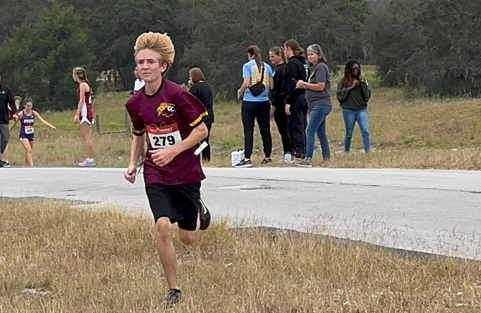
Ashley and her husband, Daniel, use a portion of Joshua’s PEP funds to pay the Putnam County School District for Joshua to take the agriculture class and the fees for him to run cross country and play junior varsity soccer and baseball for the Raiders.
“This is a good opener for this year to figure out how this will work and if he will like it,” Ashley said.
Ashley used to teach elementary school music, art, and physical education. She is currently the girls' varsity volleyball coach at Crescent City Junior-Senior High and runs the local club volleyball program. Three years ago, she and Daniel, the pastor at South Putnam Church in Crescent City and a nurse at a hospital in Palatka, decided to home educate their children.
“The class sizes just were not feasible to me,” Ahsley said. “There were too many kids in the classroom. I love their teachers. I know them personally, but somebody’s going to get left behind. Somebody’s not going to get everything they need.
“Daniel and I decided that since I'm teaching kids anyway, I should be teaching mine. They're going to get so much more out of it, because it's just me and them.”
Joshua said he enjoys learning at home.
“We get done with school a lot quicker and have a lot more time to do things while still being able to learn,” he said.
Ashley teaches her children from 8:30 a.m. until the early afternoon. After that come chores and activities they can do outside in the fresh air and sun.
“My thing is this: I have intelligent children who I can teach, and they can be advanced and do it as fast as they want to, and that’s great. It just makes sense to me. This is the best model for us,” Ashley said. “I know it's not for everyone.”
The children are active in the community, are involved in sports and have a ton of friends, especially Joshua.
“He enjoys his social life,” Ashley said.
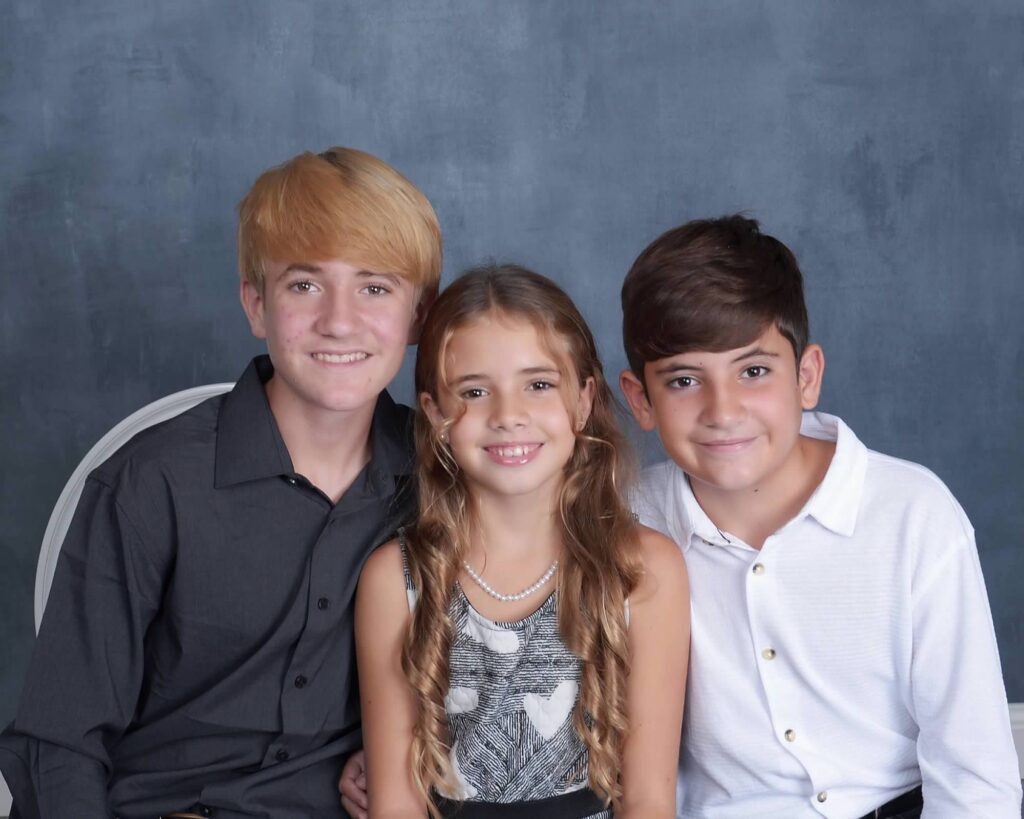
Crescent City is a small community. The city itself is less than three square miles with a population of fewer than 1,700. Ashley said it doesn’t lend itself to home education co-ops and chances for the Jones children to interact with other home-educated students during the day.
“That was the biggest piece that was missing for Joshua, going to school and seeing friends,” Ashley said.
So, when the opportunity was created for Joshua to return to a brick-and-mortar school, even on a limited basis, his parents pursued it. The agriculture class meets during the last period of the day, and Joshua was headed there anyway for sports.
Ashley called it a “great compromise.”
“He's going there to do something that he likes,” she said. “He loves the animals. He loves to learn about them. He’s going there for one of his electives, so that's one less thing that we do at home.
“He's already going to the school at the end of the day anyway, so now he just gets to see his friends and interact with people, and he's in a teacher setting, which I think is a good thing, too. It is hard when it's always mom. So, I think having a teacher also teaches life skills, so I don't think that's a bad thing at all.”
Joshua said he wants to continue with an agriculture class next school year. He would also like to join Future Farmers of America.
“It’s fun,” he said. “I get to go back to the school so I can still hang out with my friends and still get to take a class there.
“I do love learning about animals.”
This school year, 2024-2025, for the first time, Brevard County students using Florida’s education choice scholarship programs will have a new option: the ability to sign up for online courses offered by Brevard Virtual School.
Brevard Public Schools was the first countywide school district in Florida to offer courses to scholarship families through its virtual school. But more are sure to follow.
Florida law allows scholarship students to access services, including classes, from traditional public, virtual, or charter schools. However, families can’t choose this option if a school is not set up to accommodate it.
 The option has historically been underused. This is beginning to change, however, thanks to a growing interest in innovation among public -school leaders and people in their communities.
On Brevard’s heels, the Glades County School District has begun making in-person classes available to scholarship students. Other school districts and charter school organizations are taking similar steps across the state.
History of blurred lines
In Florida, the boundaries between a public school district and the world of parent-directed learning outside the system have long been blurry.
Heather Price, the principal of Brevard Virtual School, has helped lead the charge to make classes available to scholarship families. “I have been immersed in the world of flexible learning since 2008 and am always looking for ways to improve and expand what we can offer to families”, she said.
Brevard Virtual School serves over 5,000 online students, enrolled in approximately 12,000 courses. Some use the virtual option full -time, while others use it to supplement classes at their local public schools. Homeschoolers can also sign up for individual courses.
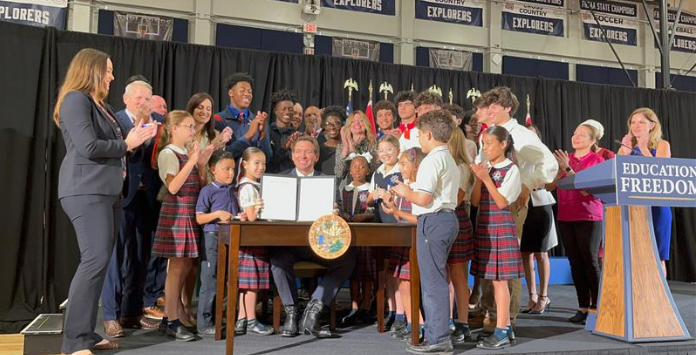
During the 2023 Florida Legislative Session, House bill 1 passed, making parental involvement a priority. It made every family in the state eligible for an education choice scholarship. It also added a new flexible learning option to the mix: the Personalized Education Program (PEP), a scholarship specifically for students who do not attend school full-time.
The first year, the PEP scholarship was capped at 20,000 students. This school year, that cap tripled.
Price heard buzz among parents that many of her existing part-time students were signing up for scholarships.
She wanted to make sure her school was among the available options.
“We knew that our families who have been with us for many years would be the exact same families who would be interested in what the scholarship offers,” Price said. As a result: “We either need to get on board or we’re going to lose folks who love us, and who we love.”
A foundation of diverse online learning options
Florida Virtual School (FLVS) functions as a statewide school district and has offered publicly funded online classes since the late ‘90s. It has long offered classes to students using private school scholarships.
Florida school districts can create online schools that employ local teachers and use FLVS curriculum and technology. These district franchises provide local flavor and opportunities for in-person meetings, while the statewide FLVS option provides a broader selection of courses. It’s common for online students to take a few classes from each.
FLVS partners with school districts, such as Brevard Public Schools, to support the local franchises.
“It’s a local twist on a statewide program,” Price said. “I’m sitting here in an office. Families can come in and get help. They can participate in our local activities.”
Districts build new organizational muscles
Thanks to the state’s long history of virtual schooling, Florida school districts are used to receiving funding for online courses on a per-class basis.
When they sign up as a scholarship provider, they face a new challenge: rather than reporting students to the state for funding, they must invoice students through the scholarship platform.
This requires districts to ensure correct operational systems are in place, from data systems to reporting.
Price said working through the issues required collaboration from every department in the district office.
The virtual school was a logical starting point to start building those organizational muscles. It had a critical mass of scholarship students, and the logistics of adding online students were simpler than at a physical campus.
But the work may not end there.
Many scholarship families are used to participating in public-school sports or extracurricular activities using Florida’s Tim Tebow law. Some of these electives, like band or drama, have classes associated with them, and districts will want to receive funding for students who take those classes. Other students want access to one-off courses or services at their local public school, including AP classes, career education courses, or state assessments.
Over time, more public schools will come up with new ways to meet the needs of students using scholarships, tapping a new revenue stream and expanding learning opportunities for students.
“We want them to be able to have the best of both worlds,” Price said. “So, they’re a scholarship student, but there’s also a lot of good, cool stuff that public school districts do.”
She added: “We want them to be able to have that choice and flexibility in how they educate their kids while taking advantage of all the opportunities that are available.”
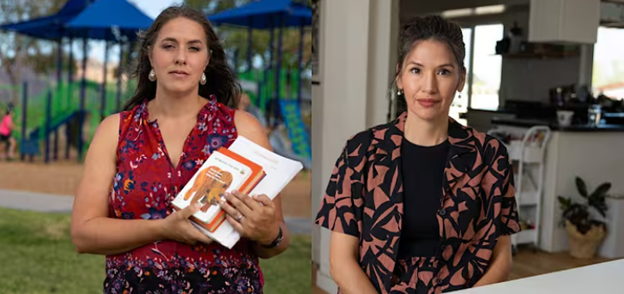
Years ago, education reformers coined the phrase “Big Learning Organization Bureaucracies aka the BLOB” to describe the collection of groups associated with the K-12 status quo. Recently the Arizona blob has tried to slime the ESA program, but ESA parents are fighting back in court. Arizona ESA moms Velia Aguirre and Rosemary McAtee have filed a lawsuit against the state to combat absurd requirements on the ESA program by Attorney General Kris Mayes with the aid of the Goldwater Institute. The case Aguirre vs. Arizona will give Arizona’s courts the opportunity to rein in bureaucratic overreach.
 Some 13 years into the ESA program, which has been administered by both Republican and Democrats, the current Attorney General Kris Mayes reinterpreted the ESA statute to contain previously undiscovered program requirements. Not coincidentally, these new requirements have gummed up the operation of Arizona’s ESA program.
As noted by the Goldwater Institute:
This new glob of bureaucratic goop makes no sense. For one thing, public and private school curriculum documents don’t even necessarily list items like “pencils” and “erasers.” As Velia explains: “No other teacher in the state has to provide curriculum for purchasing things for their classroom.” So, requiring parents to jump through the hoop of documenting a “curriculum” for materials that are obviously educational does nothing to prevent abuse of the program beyond the extraordinary lengths parents already have to go to in submitting expense receipts for every purchase. It does, on the other hand, needlessly exacerbate a backlog of tens of thousands of purchase orders that state officials must now go through to ensure every single book title and school supply satisfactorily appears on a separate curriculum document.
What’s more, the AG’s new mandate simply ignores state law and violates the Department of Education’s own handbook, which safeguards the ESA program by requiring documentation for unusual purchases, but not for common-sense purchases of items that are “generally known to be educational.”
Even as Kris Mayes gums up the program with goop, another Arizona Blob pseudopod is attempting to slime ESA families for not spending ESA funding fast enough. Yes, while the attorney general forces up the unspent balances of ESA accounts by making the program difficult to use, the Grand Canyon Institute criticizes ESA families for (….wait for it…) having too much unspent money! Never mind that these balances would be considerably lower if not for Mayes gumming up the works. Or that Arizona districts have been hoarding resources on a scale far beyond what is happening in the ESA program with no one to blame but themselves.
I’ll be rooting for Mama Bears to maul the Blob in court.
EdChoice retained the polling firm Morning Consult to survey a nationally representative sample of more than 1,500 American parents in early November 2023 about what they want from schools and how they go about finding it. The above figure shows that more than twice as many parents report looking for school information from school ratings websites as from state report cards, and exactly twice as many report seeking information from friends and neighbors as from state report cards.
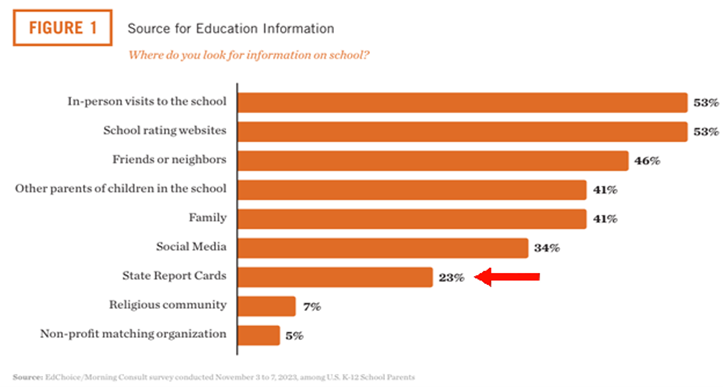
This finding reinforces previous research showing that parents value school reviews (which state report cards do not typically collect) and trust non-profit information sources more than government ratings. While mileage may vary by state, the public’s preference for private rating websites and informal networks strikes me as entirely appropriate given the presence of many state rating systems on a three-dimensional spectrum of convoluted, deceptive and/or more difficult to decipher than Mayan hieroglyphics. Some systems manage to earn a hat-trick on these dimensions (I’m looking directly at you Arizona).
Non-profit organizations run private rating systems, and delightfully have proven much more resilient to district industrial lobbying complex influence than state bureaucracies. If anything, your author can’t help to wonder if those 23% were just being, well, polite.
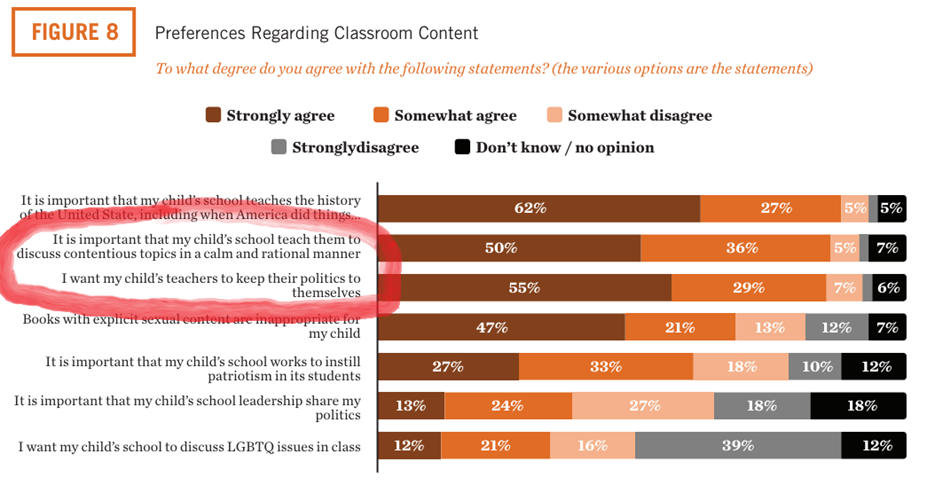
The survey also asked about what parents want from schools in terms of dealing with contentious issues. 86% of parents agreed with wanting students to learn to discuss contentious issues in a calm and rational manner, and 84% agreed with wanting teachers to keep their politics to themselves. Public school teachers posting political manifestos on social media looks bad for business. You don’t forfeit your First Amendment rights because of little things like blue-colored hair and/or a portrait of Pennywise tattooed on your forehead, so you do you. Likewise, however parents don’t forfeit their free association rights

In terms of what parents are looking for from school, it certainly varies (thus the need for pluralism) but it is not terribly hard to decipher.
On this episode, reimaginED senior writer Lisa Buie talks with Doug Tuthill and Amy Graham of Step Up For Students, the nation’s largest K-12 education choice scholarship funding organization. Tuthill is president of Step Up, and Graham is vice president of policy, innovation and empowerment for the Florida-based organization. Step Up For Students administers most of the education choice scholarships in Florida and hosts this blog.
“The fantastic thing about (education savings accounts) is they're very flexible, and we're all about customization. And this whole ed choice movement is about giving families more flexibility to be able to customize an education for their child. And I think the ESA piece, as well as universal eligibility, are really game changers.” – Doug Tuthill, president, Step Up For Students
Tuthill offers an overview of the 40-year history of education choice in the Sunshine State and how district magnet schools gave rise to more options such as charter schools, virtual schools and scholarship programs that allowed parents to decide the best learning environment for their children. Tuthill also discusses the details of the newly signed law HB 1 and how the conversion of traditional scholarship to education savings accounts will give families even greater flexibility in customizing their children’s education. He also clears up misinformation about the expanded program regarding eligibility, costs and equal opportunity. Tuthill also talks about how HB 1 will open up opportunities for educators to start their own innovative programs, further expanding options for students.
Graham discusses regulatory accountability and guardrails built into the bill as well as a new personalized education plan classification for homeschool families who choose to use state funds to completely customize their child’s education. (The law exempts homeschool families who do not wish to accept state funds from certain accountability rules that apply to those in the personalized education program.)
Graham offers details on the new purchasing guide under development that will list pre-approved goods and services to make it easier for families to manage their funds. She also discusses how HB 1 will simplify the evaluation process for non-public school students to qualify for funding through the state’s education savings account program for students with unique abilities. That program also received expanded funding through HB 1 to eliminate a wait list.
Graham also outlines how HB 1 is intended to aid school districts by providing relief from some of their most burdensome regulations so district schools can be competitive options.
EPISODE DETAILS:
RELEVANT LINKS:
https://www.fldoe.org/schools/school-choice/k-12-scholarship-programs/fes/
https://www.stepupforstudents.org/
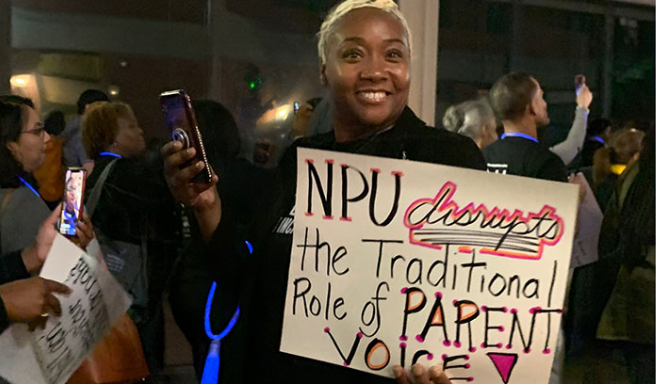
The ethnically, racially and political diverse National Parents Union, brainchild of two Latina mothers, represents 100 organizations in 50 states, the District of Columbia and Puerto Rico.
A new poll from a national grassroots education choice group indicates strong support among parents for schools to move away from a one-size-fits-all approach to education after a year of unprecedented disruption due to COVID-19.
Eighty-six percent of respondents to a survey launched by the National Parents Union agreed that schools should provide individualized learning plans for each student based on his or her specific needs.
The poll also found that parents want options for their child’s learning both this year and next year, with 58% saying they want the opportunity to choose between in-person and remote learning options for the remainder of the 2020-21 school year. Nearly as many – 56% – said they want that option for the next school year.
With release of the survey results, National Parents Union co-founder and president Keri Rodrigues underscored the organization’s mission to amplify the voices of individual parent groups and to push for changes in education nationwide.
“Throughout the pandemic, parents have been entrepreneurial in their approach to ensuring their children are educated, and it is long past due that schools begin reimagining their approach to education as well,” Rodrigues said. “However, the only way that will work, and the only way to move forward, is for parents to have a seat at the table, and not just any seat, but the seat at the head of the table.
More than three-quarters of survey participants expressed the desire for schools to provide more summer school programs in 2021 to counteract learning loss due to the pandemic. Interest also was high for after-school tutoring programs.
Opinions regarding the continuation of statewide testing were divided. Fifty-one percent of parents said testing should continue while 40% said there should be a break from statewide testing this year. Fifty-eight percent of parents said they will have their child take state tests if they are administered in their school.
The survey was conducted March 11-23 and included 1,029 parents of children in K-12 public schools.
 Editor's note: During this holiday season, redefinED is republishing our best articles of 2019 – those features and commentaries that deserve a second look. This article from Step Up For Students’ executive director for advocacy and civic engagement Catherine Durkin Robinson was another in our “Education Revolution” series marking the 20th anniversary of the far-reaching K-12 changes Gov. Jeb Bush launched in Florida. Robinson's first-person commentary originally published Aug. 6.
Back in 1999, when Florida Gov. Jeb Bush and the Legislature decided to put the A+ Plan into effect — thereby increasing accountability for schools, rewarding them for improved outcomes and creating options for families – I was living in Boston and working on presidential visits and various campaigns for Young Democrats of America.
I knew my former home state was going through some changes, but I didn’t pay much attention.
That changed when my sons were born in 2000 and my husband and I decided, as much as we loved Boston, we would raise our children in the Tampa Bay area, surrounded by family and loved ones. At that point, education in Florida became my primary interest.
We returned to Florida and looked around. The academic landscape had changed from when I was a student in the ‘80s and a young teacher in the ‘90s.
In 1981, I rode a bus for 45 minutes (one way) from a middle class neighborhood in North Tampa to a struggling, low-income area in order to attend Young Junior High (now Young Middle Magnet) for seventh grade.
This was not my family’s choice.
Children of different ethnic backgrounds were bused to Young from all over Hillsborough County. Ours was a truly integrated school, filled with black, white and Hispanic students.
It was also a culture shock.
We all went from a neighborhood elementary school to this strange set of buildings in a part of town regarded as hostile and dangerous. Weird characters wandered on to our campus and routinely had to be escorted away. I remember feeling like the area around the school should have been made safe before bringing in children for schooling.
None of us felt a connection to the school or each other. We couldn’t put on plays or performances in the evening because it was too far a drive for almost everyone’s parents.
It didn’t seem to make much sense.
I returned to my neighborhood schools for the rest of junior high (eighth and ninth grade back then) and on to high school for 10th-12th. We all knew which schools were good and which were not, but only through word of mouth. Nothing official. And no accountability for the children who suffered through a substandard education.
After graduating from the University of South Florida, I taught at an alternative high school.
Our students were overwhelmingly poor, minority, and male.
They came to our school one of two ways. They were either arrested and the Department of Juvenile Justice sentenced them to our program, or they were expelled, and the school district sent them to us.
Students could learn at their own pace and in a setting that encouraged their thoughtful participation. In the morning they took core academic classes, leaving the afternoon open for a marine-based curriculum. Students learned how to operate a boat or become SCUBA and lifeguard certified.
This was the first time I saw disadvantaged youth thrive and do well. As teachers, we visited each student’s home and talked with their families. We learned about who they were and where they came from, rather than trying to help them simply based on their age, socioeconomic status, and alleged crime.
I was allowed to teach interesting social studies classes, such as Religions of the World and Politics and Government. Local field trips involved taking students to a synagogue, mosque, and church. We had lunch with Hare Krishnas in Ybor City. We also secured grants that funded field trips to Washington, D.C.
Our students saw a whole world outside the one in which they lived. I often wondered if at-risk youth might actually avoid arrest or expulsion if this type of learning environment were offered before it was almost too late.
Ours wasn’t a school of choice, since the students were assigned to it. But it showed me how developing a curriculum based on the needs and interests of the students in my classroom was a step in the right direction.
By the time we returned to Florida and started looking at schools, my kids had a lot more options than I ever did. Thanks to the A+ plan, scholarships to attend private schools were available, and magnet programs were created that expanded students’ knowledge and prepared them for high school and beyond. Advanced Placement classes and dual enrollment got them ready for college. Virtual classes allowed for flexible schedules and off-site learning activities.
When my children were ready for preschool, I also returned to the classroom and had more options as well.
Charters and magnet programs were able to do what busing never accomplished – probably because parents respond better when presented with choices, rather than something compulsory. I noticed this in other areas, too. Parents who bitterly complained about the Florida Comprehensive Assessment Test never showed a resistance to AP testing. Both were rigorous and challenging, but only one was seen as a choice.
I am dismayed when my friends on the left act as if there haven’t been any improvements these last twenty years. There is still work to be done — too many children are still trapped in substandard learning environments.
But there is no denying the improvements that have benefited all of us. Maneuvering my children through the educational system was eye-opening, in more ways than one. Any parent who has options owes a debt of gratitude to Gov. Bush and the lawmakers who created this system of choice and accountability.
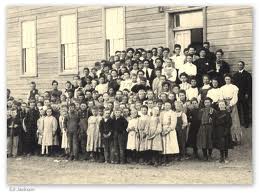
Georgia's first compulsory school attendance law was passed in 1916. Photo from georgiainfo.galileo.usg.edu.
For the last 150 years, we have assumed “public education” meant publicly funded education, but in this new age of customized teaching and learning this definition is too narrow. Today, it’s more useful and accurate to define public education as all learning options that satisfy mandatory school attendance laws, including those that don’t receive public funding, such as private schools and home-schooling.
Education - especially public education - has taken many forms in the United States over the last 300 years. According to Pulitzer Prize winning education historian Lawrence A. Cremin, in the 1700s education encompassed institutions “that had a part in shaping human character - families and churches, schools and colleges, newspapers, voluntary associations, and … laws”, while public education referred to formal instruction in public settings outside the home.
Public teaching became increasingly common in the latter half of the 18th century, and by the early 19th century most communities had at least one free school open to all white children. These free schools, which operated independently much like today’s charter schools, became known as common or public schools. They combined with religious schools receiving public funding to educate the poor to comprise public education. As Cremin notes, in 1813, most New Yorkers saw publicly-funded religious schools “as public or common schools.”
Over the next few decades, public funding for religious schools - most notably Catholic schools - became more contentious and rare. By the mid-1800s, free public schools and public education had become synonymous. Schools not receiving public funds were called private schools, even though they provided public instruction outside the home.
The birth of public education as we know it today occurred during the 1840s and ‘50s. (more…)
Some charter schools aim to save kids. Some aim to save cultures – and the kids along with it.
A new report from Harvard education researchers highlights three charter schools that offer cultural immersion for Native American students, including a K-8 charter on a Seminole Indian reservation in Glades County, Fla. The school’s name, Pamayetv Emahakv, means “our way,” which sums up the school’s goal: Preparing more than 200 students for the higher education they’ll need to succeed anywhere in the 21st century while at the same time holding on to Seminole culture and values.
“We turned our back on our way to go and learn the other way,” Michele Thomas, a school administrator and parent, told the researchers when they visited earlier this year. “So, now with this school we have to look back this way now. We have the education down, we have lots of college education in this community, but our language has suffered, our young people are not fluent speakers.”
Some education researchers think the approach of the Seminole charter and the two others in the report could help Native American students elsewhere who are not faring well in traditional public schools. According to the report, which was prepared for the National Indian Education Association, American Indian students have the highest absentee rate among minority students and the second-highest suspension and dropout rates.
“These three schools … all share a broader vision of transformative community change,” wrote the Harvard researchers, Eve L. Ewing and Meaghan E. Ferrick. “The establishment of a school serves as a means for mobilizing and empowering the local communities to assess their own needs and determine their own solutions. By doing so, community members not only improve educational outcomes for their children – they are also making a profound expression of self-determination and tribal sovereignty.”
The motto of the Seminole school boldly echoes that: “Successful learners today, unconquered leaders tomorrow.” (The Seminoles call themselves “the unconquered” because even after three wars with the federal government, over half a century, they never surrendered.)
The charters in the Harvard report are part of a national movement by Indian and other native communities to use charter schools to help resurrect and maintain their indigenous cultures. (more…)

