New research by the American Federation for Children found that scaling Florida’s Tax Credit Scholarship Program over 15 years improved public school student achievement.
The report published March 4 by AFC senior fellow Patrick Graff, a former Florida Catholic school teacher, compared two leading peer-reviewed studies of each approach that used Florida data: a 2023 study of Florida’s Tax Credit Scholarship Program over 15 years and a 2024 analysis of the effects of additional school spending on student achievement.
Key findings
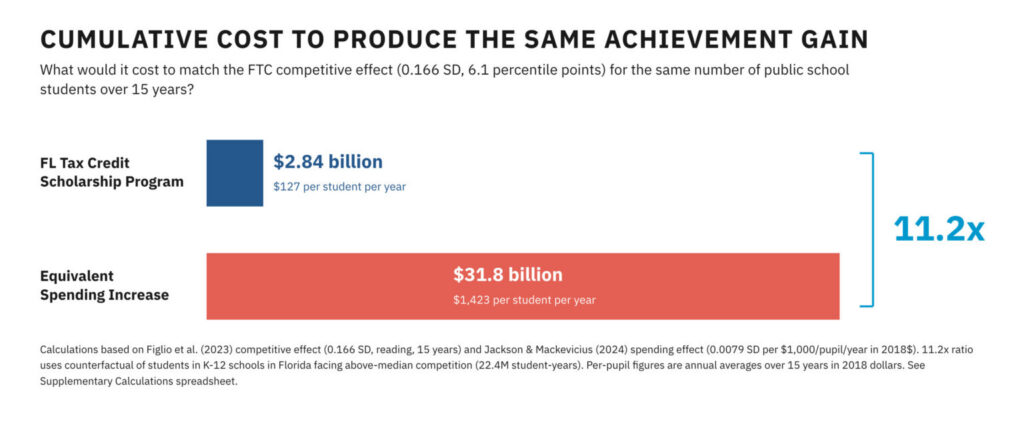
Not a zero-sum game: Florida’s experience shows that school choice can benefit students, no matter where they learn, families, and taxpayers at the same time. Florida now enrolls over half a million students in private school choice programs, and its public school students still outperform students in most states while spending less.
Read the full report here.
Updated Feb. 27, 2026
Record breaking interest continues with more than 400,000 students who have applied for Florida’s K-12 education choice scholarships for the 2026-27 school year.
Step Up For Students, the nonprofit organization that administers 98% of the state’s scholarships, opened applications for the 2026-27 school year on Feb. 1. A record 200,000 applied during the first three days.
By mid-day Feb. 10, a total of 300,106 students had applied for scholarships, which represents an 11.7% increase over the same 10-day period last year. By Friday morning, Feb. 27, a total of 401,507 students had applied.
Step Up For Students CEO Gretchen Schoenhaar said last week that the organization’s team and systems were ready for the surge of interest. Step Up’s technology systems processed 15% more applications on the first day this year than at the same time last year. Of the families who called for assistance, more than 90% reported being “satisfied” or “very satisfied” with the support they received.
“Another record number of applications on our opening weekend shows that Florida families increasingly value options in their children’s education,” Schoenhaar said. “Step Up For Students smoothly processed the higher demand and is prepared to support families every step of the way.”
During the 25-26 school year, more than 525,000 students have been funded on Florida’s K-12 scholarship programs to access learning options of their choice. If these students were counted as a single school district, it would be the largest in the state and third largest in the country. That makes Florida the national leader in education options.
However, not all students whose families apply end up being awarded or funded.
Step Up is focused on supporting growth. By the end of the year, Step Up expects to process 3 million reimbursements and a total of 3 million MyScholarShop e-commerce transactions.
Current scholarship families have until April 30 to renew their scholarships for the next school year. All families who want a PEP scholarship must also apply by April 30.
Private School and Unique Abilities Scholarship applications will be available through Nov. 15 for families who want a new scholarship.
Applications and more details are available here.
We will continue to update the numbers in this post until applications close.
If anyone needs more proof that the future of education is in Florida, take a look at the winners of Thursday night’s Yass Prize Awards. Seven Florida-based providers, including two finalists who took home $250,000 each, were among the 23 honored for their innovative and scalable programs.
One of the finalists, Pepin Academies, is a charter school network with three campuses in the Tampa Bay area. It offers students with learning disabilities in grades three through 12 an inclusive environment where academics and essential therapies happen together in real time.
“I have always rejected the principle that we have to think outside the box for students with disabilities,” said Jeff Skowronek, executive director of the 25-year-old network. “A truly inclusive society is one that understands how to make the box bigger.”
Pepin stands out for its small class sizes, ESE-certified teachers, and onsite specialists, including mental health counselors, social workers, speech-language pathologists, occupational therapists, ESE specialists, and registered nurses, according to Yass Prize offices. This ensures their children receive individualized attention throughout the entire school day. In addition to its schools, Pepin operates a transition program for young adults ages 18-22.
According to Yass Prize officials, the award empowers Pepin Academies to serve students earlier, expand their transition program, and bring their therapeutic model to more families seeking a school that understands and supports exceptional learners at every stage.
The other finalist, WonderHere, is a network of child-centered microschools that focus on play-driven, project-based learning and personalized education to let children learn at their own pace.
“We are so excited and grateful to the Yass family and the Center for Education Reform for selecting WonderHere as a finalist,” said Tiffany Thenor, who opened the first campus in Lakeland after spending seven years in the public education system. She opened WonderHere to challenge the norms of schooling and prove that learning can be more joyful, flexible, and deeply human. A second location opened later in Anderson, South Carolina, and a third is planned for Davenport, Florida, near the original location.
Thenor said the prize money will help her find a permanent location for the Davenport campus and create more space for families to experience the “project-based, family-centered, wonder-filled learning environment” that WonderHere offers.
The following Florida providers were named semi-finalists and received $100,000 each: Archimedean Schools of Miami; Space Florida, Merritt Island; Ecclesial Schools, Oviedo; American High School, a national online program headquartered in Plantation that serves youth in the justice system, and GuidEd, a Tampa-based bilingual program that provides free, unbiased information about educational choices to help families determine the best fit for their children.
“GuidEd looks forward to using our Yass award money to enhance our call center capabilities to provide more sophisticated and personalized 1:1 support for families and to reach new families who may be entering the education freedom marketplace for the first time," said Kelly Garcia, who founded GuidEd with her brother-in-law, Garrett Garcia.
The Yass Prize, often called the “Pulitzer of Education Innovation,” began in 2021 to recognize innovative educators who delivered top-tier learning during the COVID-19 pandemic. Philanthropists and education choice champions Jeff and Janine Yass established the award and continue to fund the program.
The top winner takes home a $1 million prize. This year, it went to Chesterton Schools Network, a national network of classical high schools rooted in Catholic values. Though headquartered in Minnesota, Chesterton has Florida schools in Orlando, Pensacola, Sarasota, and Vero Beach, with a fifth set to open in 2027 in Melbourne. Primer Microschools, which began in Florida and has expanded to other states, won the grand prize in 2024. That year, it announced the establishment of Primer Fellowship, which provides paid training for edupreneurs seeking to open Primer Microschools in their communities.

Jordan Glen School started in 1974 on 20 acres of woods in the small town of Archer near Gainesville. Owner Jeff Davis, a former public school teacher, moved to Florida from Michigan to start a school that allowed students more freedom. Today it continues to thrive, thanks in part to education choice scholarships. Photo by Ron Matus
ARCHER, Fla. – Archer is a crossroads community of 1,100 people 15 minutes from the college town of Gainesville, but far enough away to have its own quirky identity. It’s surrounded by live oak-studded ranch land but calling it a “farm town” doesn’t ring right. When railroads ruled the Earth, Archer was a whistle stop on the first line connecting the Atlantic to the Gulf. In the late 1800s, T. Gilbert Pearson, co-founder of the National Audubon Society, roamed the woods here as a kid, skipping school to hunt for bird eggs. A century later, rock ‘n roll icon Bo Diddley spent his golden years on the outskirts.
So, let’s just say Archer is a neat little town. And maybe it’s fitting that for half a century, it has been home to a neat little private school that doesn’t fit into any boxes, either.
Jordan Glen School got its start in 1974, when former public school teacher Jeff Davis moved down from Michigan. In the late 1960s, Davis became disillusioned with teaching in traditional schools. In his view, students were respected too little and labeled too much.
“Back in the day, I would have been labeled ADHD. I hated school,” he said. “I never met a teacher that took a personal interest in me.”
As a teacher, he saw a system that was “too constricting.”
“There was just a general distrust of children, like they were going to do something bad,” he said. Education “doesn’t have to be rammed down your throat.”
Davis migrated to what was, more or less, a “free school,” with 50 students on a farm near Detroit. Today we’d call it a microschool.
In the 1960s, hundreds of these DIY schools emerged across America, propelled by an upbeat vision of education freedom inspired by the counterculture. Davis said the Upland Hills Farm School was a free school, more or less, because while its teachers were “long-haired” and “hippie-ish,” the school had more structure and rigor than free school stereotypes would suggest.
Davis thought the Gainesville area would be a good place to start a similar school. It had a critical mass of like-minded folks. So, in 1973, he and his family bought 20 acres of woods off a dirt road in Archer. Not long afterward, they invited a little school called Lotus Land School, then operating out of a community center in Gainesville, to move to their patch in the country. Today we’d call Lotus Land a microschool, too.
It was also, more or less, a free school. Davis described the teachers and families as “love children” and “free spirits,” but in many ways, their approach to teaching and learning was mainstream. A decade later, he changed the name. “I thought people would think it was a hippie dippy school, and I knew it was more than that,” he said.
Lotus Land became Jordan Glen. The school was named after the River Jordan, after some parents and teachers suggested it, and after basketball legend Michael Jordan, because Davis was a fan.
Fast forward a few more decades, and Jordan Glen School is thriving more than ever.
It now serves more than 100 students in grades PreK-8, some of whom are the second generation to attend. Nearly all use Florida’s education choice scholarships. Actor Joaquin Phoenix is among Jordan Glen’s alums. So is CNN reporter and anchor Sara Sidner.
Jordan Glen is yet more proof that education freedom offers something for everyone and that its roots are deep and diverse. Ultimately, the expansion of learning options gives more people from all walks of life more opportunity to educate their children in line with their visions and values.
“There is something about joy and happiness that makes people uneasy and a bit insecure,” Davis wrote in a 2005 column for the local newspaper, entitled “Joyful Learning is the Most Valuable Kind.” “If children are enjoying school so much, they must not be doing enough ‘work’ there.”
“Children at our school,” he wrote, “love life.”

A peacock, one of two dozen that roam the Jordan Glen School campus, watches students at play. Photo by Ron Matus
The Jordan Glen campus includes a handful of modest buildings. It’s still graced by a dirt road and towering trees. It’s also home to two dozen, free-roaming peacocks. They’re the descendants of a pair Davis bought in 1975 because they were beautiful and would eat a lot of bugs.
Given that backdrop, it’s not surprising that many families describe Jordan Glen as “magical.”
Alexis Hamlin-Vogler prefers “whimsical.” She and her husband decided to enroll their children, Atticus, 14, and Ellie, 8, in the wake of the pandemic.
“They’re definitely outside a lot,” she said of the students. “They’re climbing trees. They’re picking oranges.” When it rained the other day, her daughter and some of the other students, already outside for a sports class, got a green light to play in it and get muddy.
Another parent, Ilia Morrows, called Jordan Glen a “little unicorn of a school.”
Like Hamlin-Vogler, Morrows enrolled her kids, 11-year-old twins Breck and Lucas, following the Covid-connected school closures. She thought they’d stay a year, then return to public school. But after a year, they didn’t want to go back. “They had a taste of freedom,” she said.
For many parents, Jordan Glen hits a sweet spot between traditional and alternative.
On the traditional side, Jordan Glen students are immersed in core academics. They take tests, including standardized tests. They get grades and report cards. They play sports like soccer and tennis, and they’re good enough at the latter to win the county’s middle school championship. Many of them move on to the area’s top academic high schools.
But Jordan Glen also does a lot differently.

Students spend a lot of time outdoors at Jordan Glen School. Activities include archery, gardening and sports. Photo by Ron Matus
The students are grouped into multi-age and multi-grade classrooms. They choose from an ever-changing menu of electives. Many of those classes are taught by teachers, but some are taught by parents (like archery, gardening, and fishing), and some by the students themselves (like soccer, dance, and book club). The youngest students also do a “forest school” class once a week.
The school also emphasizes character education.
The older students serve as mentors for the younger students. They’re taught peer mediation so they can settle disputes. Every afternoon, they clean the school, working as crew leaders with teams of younger students. Their “Senior Class Guide” stresses nothing is more important than “caring about others.”
“The way the older kids take care of the younger kids, it’s very noticeable. They are genuinely caring,” Morrows said. At Jordan Glen, “they teach community. They teach being a good human.”
“My favorite thing is that most kids really get a good sense of self and self-confidence at this school,” Hamlin-Vogler said. “Some people say, ‘Oh, that’s the hippie school.’ But the students have a lot of expectations and personal accountability put on them.”
Hamlin-Vogler said without the education choice scholarships, she and her husband wouldn’t be able to afford the school. Hamlin-Vogler is a hairdresser. Her husband is a music producer. Before Florida made every student eligible for scholarships in 2023, they missed the income eligibility threshold by $1,000. Her parents were able to assist with tuition in the short term, but that would not have been sustainable.
Her family harbors no animus toward public schools. Atticus attended them prior to Jordan Glen, and he’s likely to be at a public high school next fall. Ellie, meanwhile, thinks she might want to try the neighborhood school even though she loves Jordan Glen in every way, and Hamlin-Vogler said that would be fine.
After Ellie described how much fun she had playing in the rain, though, Hamlin-Vogler had to remind her, “You might not get to do that at another school.”
The future of education is happening now. In Florida. And public school districts are pushing into new frontiers by making it possible for all students, including those on education choice scholarships, to access the best they have to offer on a part-time basis.
That was the message Keith Jacobs, director of provider development at Step Up For Students, delivered on Excel in Education’s “Policy Changes Lives” podcast A former public school teacher and administrator, Jacobs has spent the past year helping school districts expand learning options for students who receive funding through education savings accounts. These accounts allow parents to use funds for tuition, curriculum, therapies, and other pre-approved educational expenses. That includes services by approved district and charter schools.
“So, what makes Florida so unique is that we have done something that five, 10, even, you know, further down the line, 20 years ago, you would have never thought would have happened,” Jacobs said during a discussion with podcast host Ben DeGrow.
Jacobs explained how the process works:
“I’m a home education student and I want to be an engineer, and the high school up the street has a remarkable engineering professor. I can contract with the school district and pay out of my education savings account for that engineering course at that school.
“It’s something that was in theory for so long, but now it’s in practice here in Florida.”
It is also becoming more widespread in an environment supercharged by the passage of House Bill 1 in 2023, which made all K-12 students in Florida eligible for education choice scholarships regardless of family income. According to Jacobs, more than 50% of the state’s 67 school districts, including Miami-Dade, Orange, Hillsborough and Duval, are either already approved or have applied to be contracted providers.
That’s a welcome addition in Florida, where more than 500,000 students are using state K-12 scholarship programs and 51% of all students are using some form of choice.
Jacobs said district leaders’ questions have centered on the logistics of participating, such as how the funding process works, how to document attendance and handle grades.
Once the basics are established, Jacobs wants to help districts find ways to remove barriers to part-time students’ participation. Those could include offering courses outside of the traditional school day or setting up classes that serve only those students.
Jacobs said he expects demand for public school services to grow as Florida families look for more ways to customize their children’s education. That will lead to more opportunities for public schools to benefit and change the narrative that education is an adversarial, zero-sum game to one where everyone wins.
“So, basically, the money is following the child and not funding a specific system. So, when you shift that narrative from ‘you're losing public school kids’ to ‘families are empowered to use their money for public school services,’ it really shifts that narrative on what's happening here, specifically in Florida.”
Jacobs expects other states to emulate Florida as their own programs and the newly passed federal tax credit program give families more money to spend on customized learning. He foresees greater freedom for teachers to become entrepreneurs and districts to become even more innovative.
“There is a nationwide appetite for education choice and families right now…We have over 18 states who have adopted some form of education savings accounts in their state. So, the message to states outside of Florida is to listen to what the demands of families are.”
When I think about the state of public education in Florida, I recall a song from “The Wiz,” the 1978 film reimagining of “The Wizard of Oz,” where Diana Ross sang, “Can’t you feel a brand new day?”
It’s a brand new day in our state’s educational history. Parents are in the driver’s seat deciding where and how their children are educated, and because the money follows the student, every school and educational institution must compete for the opportunity to serve them.
Public schools are rising to meet that challenge.
For the past year, helping them has been my full-time job.
Today, 27 of Florida’s 67 school districts have contracted with Step Up For Students to provide classes and services to scholarship students, and another 10 have applied to do so.
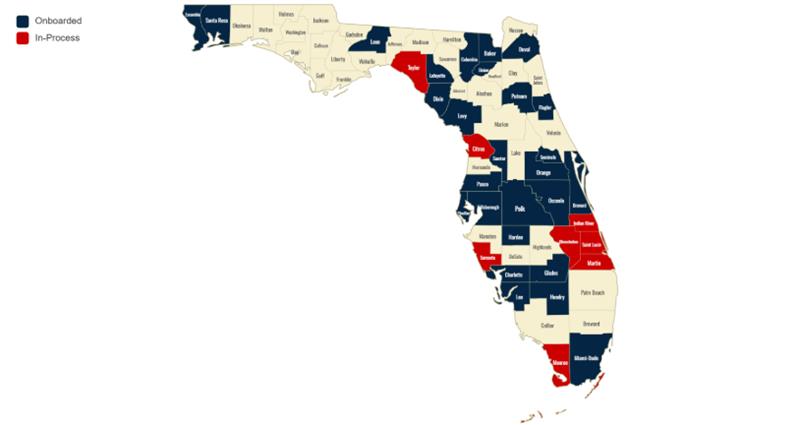
That’s up from a single school district and one lone charter school this time a year ago.
This represents a seismic shift in public education.
For decades, a student’s ZIP code determined which district school he or she attended, limiting options for most families. For decades, Florida slowly chipped away at those boundaries, giving families options beyond their assigned schools.
Then, in 2023, House Bill 1 supercharged the transformation. That legislation made every K-12 student in Florida eligible for a scholarship. It gave parents more flexibility in how they can use their child’s scholarship. It also created the Personalized Education Program (PEP), designed specifically for students not enrolled in school full time.
This year, more than 80,000 PEP students are joining approximately 39,000 Unique Abilities students who are registered homeschoolers. That means nearly 120,000 scholarship students whose families are fully mixing and matching their education.
Families are sending the clear message that they want choices, flexibility, and an education that reflects the unique needs and interests of their children.
Districts have heard that message.
Parents may not want a full-time program at their neighborhood school, but they still want access to the districts’ diverse menu of resources, including AP classes, robotics labs, career education courses, and state assessments. Families can pay for those services directly with their scholarship funds, giving districts a new revenue stream while ensuring students get exactly what they need.
In my conversations with district leaders across the state, they see demand for more flexible options in their communities, and they’re figuring out how to meet it.
For instance, take a family whose child is enthusiastic about robotics. In the past, their choices would have been all-or-nothing. If they chose to use a scholarship, they would gain the ability to customize their child’s education but lose access to the popular robotics course at their local public school. Now, that family can enroll their child in a district robotics course, pay for it with their scholarship, and give their child firsthand technology experience to round out the tutoring, curriculum, online courses and other educational services the family uses their scholarship to access.
Families can log in to their account in Step Up’s EMA system, find providers under marketplace and select their local school district offerings under “contracted public school services.” School districts will get a notification when a scholarship student signs up for one of their classes. From large, urban districts like Miami-Dade to small, rural ones like Lafayette, superintendents are excited to see scholarship students walk through their doors to engage in the “cool stuff” public schools can offer. Whether it’s dual enrollment, performing arts, or career and technical education, districts are learning that when they open their arms to families with choice, those families respond with enthusiasm.
Parents are no longer passive consumers of whatever system they happen to live in. They are empowered, informed, and determined to customize their child’s learning journey.
This is the promise of a brand new day in Florida education. For too long, choice has been framed as a zero-sum game where if a student left the public system, or never even attended in the first place, the district lost. That us-versus-them mentality is quickly going the way of the Wicked Witch of the West. What we are witnessing now is something far more hopeful: a recognition that districts and families can be partners, not adversaries, in building customized learning pathways.
The future of education in Florida is not about one system defeating another. It is about ensuring families have access to as many options as needed, regardless of who delivers them.
As Diana Ross once sang, “Hello world! It’s like a different way of living now.” It has my heart singing so joyfully.

States with recent education choice lawsuits involving EdChoice Legal Advocates and the Institute for Justice.
As education choice options expand for families across the nation, opponents are stepping up their fight to preserve the status quo.
Observers say these conflicts are examples of growing pains that come when a society undergoes transformational change.
 “It’s just part of the cost of doing business,” said Michael Q. McShane, director of national research at EdChoice, a national nonprofit think tank. “Educators are not alone in challenging policies they don’t like. New laws get passed; people who can’t do things democratically try to do things through the courts.”
Michael B. Horn used a famous quote (often misattributed to Mohandas Gandhi) to describe the spate of lawsuits: “First they ignore you, then they laugh at you, then they fight you, then you win.”
“I think we’ve entered the fight stage,” said Horn, the co-founder, distinguished fellow, and chairman of the Clayton Christensen Institute and an author of several books on disruptive innovation. “Education choice has gotten big enough that the entrenched interests dedicated to preserving the status quo are starting to see it as a threat.”
Legal fights over education choice began in the 1800s when Catholic families opposed the Protestantism taught in public schools. In 1925, the U.S. Supreme Court ruled in Pierce v. Society of Sisters that parents had the right to put their children in private schools. In 2002, the high court issued another landmark decision, Zelman v. Simmons-Harris, which upheld an Ohio scholarship that allowed parents to spend the money on religious schools. The high court found that when the parent controls the expenditure, the state has no role in determining whether the parent will choose to use funding at a religious or secular school.
With the Zelman ruling settling that question, choice opponents began trying to insert race-based arguments using the language of state constitutions. Michael Bindas, a senior attorney at the Institute for Justice who argued the landmark case Carson v. Makin before the U.S. Supreme Court, outlined that shift in a paper published in the Syracuse Law Review. According to Bindas, common arguments center on education clauses requiring states to maintain uniform or common public school systems. Education choice opponents, he said, take that a step further and claim that private scholarship programs could upset racial balances that state constitutions require state governments to maintain. They also argue that the requirements that states maintain public school systems bar them from establishing concurrent private education choice programs. Lower court judges in Ohio and Utah recently cited this argument in striking down choice programs. Ohio plaintiffs also raised the issue of racial balance argument, which the judge rejected.
McShane and Horn say the spate of lawsuits won’t stop education choice programs from becoming the norm in public education. However, they will delay the transition.
“Yes, these cases are a headache and can delay implementation, but school choice has a good track record,” McShane said. “It will take numbers and time, and it’s going to tip over into a different mindset.”
Where things stand
Montana: Families are waiting on a judge to rule on a lawsuit brought by opponents of a 2024 education savings account program for students with special needs. Plaintiffs argue that the law allowing reimbursements for $6,800 per child violates several provisions of the state constitution and redirects tax dollars to private institutions at the expense of students with special needs who remain in public schools. The judge denied the plaintiff’s motion for a temporary halt to the program, allowing families to continue using their ESAs while the case is pending.
Ohio: The state has appealed a lower court’s ruling that declared the state’s $700 million Educational Choice Scholarship Program (EdChoice) unconstitutional. In siding with the coalition of school districts and other choice opponents, the judge said that the program was not a subsidy program, as the state argued, but a separate system of schools in violation of the state constitution. However, the judge rejected the plaintiffs’ argument that the program violated the state constitution’s education clause by creating racial imbalances in the district schools. The 10th District Court of Appeal is expected to hear the case in 2026.
Utah: Families are continuing to receive funds from the Utah Fits All scholarship program while a district court ruling in favor of a teachers union-backed lawsuit is under appeal to the state Supreme Court. A district judge ruled that the state constitution prevents lawmakers from using tax revenue to fund education programs other than public education, higher education, and services for people with disabilities. The judge rejected the state’s argument that it had met its funding obligations to public education and that nothing in the law prohibited it from funding a separate program to support families choosing private or home education.
Wyoming: Families seeking to use Steamboat Legacy Scholarship ESAs had to find other options for the 2025-26 school year after a trial judge blocked the state from distributing funds in July at the request of the Wyoming Education Association and other plaintiffs until the judge rules on their lawsuit against the program. The judge recently denied a motion by state officials and attorneys for two families to dismiss the lawsuit based on their argument that the plaintiffs lacked legal standing.
Missouri: Education choice advocates scored a win last month when a judge denied the teachers union’s request to freeze payments to the MOScholars K-12 scholarship program as their lawsuit continues. MOScholars began in 2021 as a tax credit program supported by private donors. Earlier this year, the state allocated $51 million to the program, prompting the Missouri Education Association to file the complaint, which contends that the allocation unconstitutionally diverts taxpayer funds to private schools.
Arkansas: The state’s Education Freedom Account program is being fought on two fronts. In June 2024, opponents sued in state court, arguing that the program illegally diverted tax dollars from the public school system to benefit private schools. The judge denied the state’s motion to dismiss the complaint, so state attorneys are appealing to the state Supreme Court.
The same plaintiffs filed another lawsuit a year later in U.S. District Court. It argues that the program violates the Establishment Clause of the First Amendment because “it aids in the establishment of religion” by providing state funding to private schools operated by religious organizations. The state refutes that by arguing that the money can go to schools representing a wide variety of faiths, as well as secular schools.
They also argue that the program violates the Equal Protection clause of the 14th Amendment because it discriminates against low-income families, families in rural areas where there are fewer private schools and students with disabilities, because private schools are exempt from the federal Individuals with Disabilities Education Act. The program is also discriminatory, according to the complaint, because private schools are not held to the same standards as public schools. The state attorney general has filed a motion to dismiss the case, arguing that the plaintiffs lack standing.
Kentucky: The Kentucky Supreme Court heard arguments on Sept. 11 about whether the state’s charter school funding law violates the state’s constitution. Charter schools have been legal in the Bluegrass State since 2017, but there was no state funding mechanism. Lawmakers passed House Bill 9, which allocated money to charter schools, which are publicly funded but independently managed. A trial court judge ruled in 2023 that the law violated the state constitutional ban on the use of tax dollars to support non-public education and the constitutional requirement for “an efficient system of common schools.”

The EdChoice blog recently delivered some good news, specifically that the number of students using private choice programs increased by 25% last year. In fact, if you cobble together some previous years' data from the EdChoice ABCs of School Choice reports, the trend looks like:

Overall, a doubling of private choice participation since Arizona and West Virginia adopted universal policies in 2022 is looking like a good start. It is worth keeping in mind that surveys show that parents prefer private schools at approximately four times the rate that they enroll in them, and there are many miles to go on that front. The new program in Texas and the federal tax credit will provide additional sources of growth in the years ahead.
Meanwhile, over at Charter Folk, the not-so-good news. Jed Wallace has a striking post on the bifurcation of American education. Disadvantaged students have suffered the lion’s share of the decline in achievement since the pandemic struck.
This is your author’s observation rather than Wallace’s, but authorities adopting policies that teens can readily interpret as “attending school is not terribly important” have extremely negative consequences on absenteeism. Moreover, as best your humble author can tell, the “plan” for the public schools to do anything about it involves aging/dropping the academically damaged students out of the system.
In any case, Wallace puts his hammer on the head of an important nail regarding different reactions across red and blue states:
“It comes down to a topic I have written about several times here, which is whether teacher unions think they have overplayed their hands since the pandemic.
“My answer has been that in red states the answer is undoubtedly yes. Teacher union recalcitrance since the pandemic has sparked the Republican party to embrace private school choice, and that is resulting in seismic change happening in those states.
“In blue contexts, though, I have said that it’s a very different story. Thus far, Dems’ calculation has been that their hold on power is so unquestioned in blue states that they don’t really need to pivot on issues. They’ll be able to keep winning without making any adjustment at all.”
Ohio State University political scientist Vladimir Kogan, in his book “No Adult Left Behind,” argues: “We need a public school system that serves students, but we have created one that is governed at the behest of adults. We should not be surprised when it puts the interests of those adults first.”
Wallace is, correctly, I fear, noting that the politics of blue states lend themselves to more of the same on K-12. Wallace notes that this means more of this in Illinois:

If spending $93,787 per student at a high school with 0% proficiency in reading to go along with 0% proficiency in math is not your personal cup of tea, you might want to consider moving out of Illinois. It does not seem likely that you could find such a thing in any of the nearby states, two of which offer their citizens universal access to private choice programs:

Federalism allows people of divergent views to effectuate different policy goals, a healthy design feature of the American Constitution. If your state uses their monopoly on force to require you to pay for the schools like those listed above, opting out sounds like a splendid idea. Finding yourself forced to pay for those schools is far more than anyone should tolerate. Finding oneself forced to pay for them and being required to send your children to them is far, far worse. Illinois policymakers would never inflict this on their own children but seem entirely content to do so on thousands of their fellow citizens.
Depeche Mode once sang about “the grabbing hands grab all they can” but the same song noted “everything counts in large amounts.” For example, within the lifetimes of many reading this post, Illinois will have gone from having twice as many seats in Congress as Florida, to half as many (see below).
 Everything counts in large amounts, indeed. The grabbing hands will be grabbing all they can, but your interests, dear reader, lie in putting yourself beyond their reach.

During a 1916 football game between Georgia Tech and Cumberland, Georgia Tech coach John Heisman famously urged his players on to victory- “You're doing all right, team, we're ahead. But you just can't tell what those Cumberland players have up their sleeves. They may spring a surprise. Be alert, men! Hit 'em clean, but hit 'em hard!” Cumberland committed 15 turnovers in the game and had one of their players getting tackled for a six-yard loss on an attempt at an offensive rush declared their “play of the game.” Georgia Tech won the game 222 to 0.
This story has repeatedly come to mind repeatedly over the last decade while reading stories about the competition between surging Florida and floundering New York.
The New York Post reports that New York City Schools will spend $42,000 per student this year. Spending $840,000 on a classroom of 20 fourth graders might seem a bit pricey, especially given that judging on their 2024 NAEP performance, nine of them will be reading at “below basic.” New Yorkers must pay sky-high taxes to support the world’s most expensive illiteracy generator/job programs, which is one of the reasons so many New Yorkers keep becoming Floridians. Now, however, it isn’t just people and companies migrating from New York to Florida; New York’s Success Academy schools are also heading south.
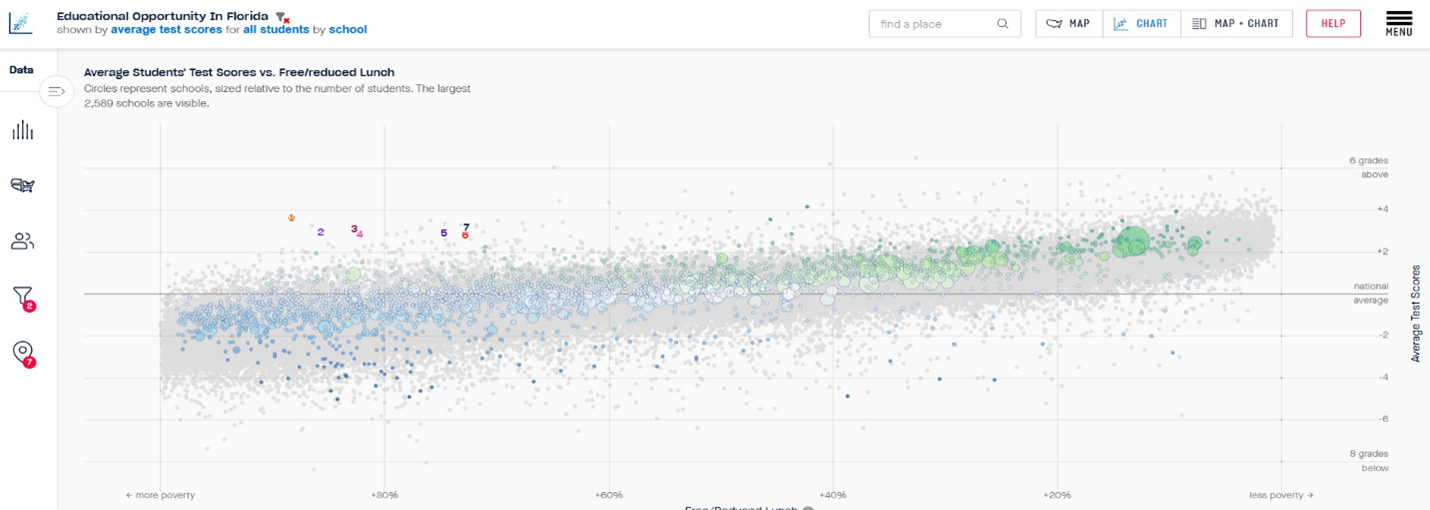
Through the wizardry of Stanford’s Educational Opportunity Project graph generator, I’ve placed New York Success Academies (Marked 1-7) in the graph for the overall state of Florida for academic proficiency. Schools are dots; green dots are higher than average, blue below average, etc.
You don’t see many high-poverty schools (graph runs from low poverty on the right to high poverty on the left) with students scoring 3ish grade levels above average, but that is exactly what Success Academy has consistently delivered in New York.
Being a rational human, you might think that New York policymakers would be falling over themselves to get as many Success Academies operating as possible, but that is just you being silly again. New York lawmakers maintain a statewide cap on the number of charter schools. Apparently, New York lawmakers feel the need to keep safe from, well, learning.
Florida, on the other hand, does not have a cap on charter schools. Rather than treating highly successful schools specializing in educating disadvantaged students as a public menace, Florida is rolling out the red carpet for highly effective school models. Success Academy plans to open 40 schools in Florida over the next 10 years, something which New York law prohibits.
Is it too much? Too much winning? No, Florida, you have to win more! Or to paraphrase Coach Heisman “You're doing all right, Florida; you’re ahead. But you just can't tell what those New Yorkers have up their sleeves. They may spring a surprise. Be alert, men! Hit 'em clean, but hit 'em hard!” Capitalizing on the abject folly of New York policymakers is hitting both clean and hard.

Saltwater Studies in South Florida was founded by education entrepreneur Christa Jewett. It is among the growing number of a la carte providers in Florida made possible by the state's education savings account programs.
Every state’s public education system is a market with supply (i.e., instruction) and demand (i.e., students needing instruction). These markets function as the operating systems for public education. Unfortunately, since the mid-1800s, these markets have been poorly designed and managed. As a result, every state’s public education operating system is deeply flawed.
Just as digital applications fail when their underlying operating systems malfunction, public education programs fail when the market mechanisms beneath them are ineffective. This helps explain why nearly every major reform initiative since "A Nation at Risk" (1983), from site-based decision-making and outcome-based education to teacher empowerment and regulatory accountability, has failed to deliver sustained, systemic improvement.
Public education will not realize sustainable improvement until each state’s public education market becomes more effective and efficient.
Public education’s primary problem is that the supply side of each state’s market is dominated by a government monopoly that also controls most demand side funding. A necessary correction is giving families greater control over a significant portion of the public funds allocated for their student’s education. Thanks to decades of advocacy by the education choice movement, families in 18 states may now use public funds to purchase education services and products from government and nongovernment providers.
But family-controlled funding alone is not enough. Every aspect of the design and management of public education markets must be improved, not just their demand side.
In high-performing markets, supply and demand are in sync; transactions are easy, and transactional costs low; information to guide decision making is transparent and accessible; resource allocation is effective and efficient; risks are managed appropriately, and customer satisfaction is consistently high.
The education choice movement has historically focused on increasing the number of families who control a portion of their students’ education funding while putting less emphasis on ensuring the market’s supply side grows in tandem. This imbalance often causes demand to exceed supply, driving up costs without improving quality and leaving families unable to access the best educational environments for each child. A recent study in Florida found that 41,000 students were awarded education choice scholarships last year but never used them, in part because there was no space in their desired schools.
Policymakers can help by enacting policies that better align supply with demand, ensuring students have access to the options they need.
During the 2025-26 school year, families nationally will spend about $6.75 billion in public funds customizing their children’s education. Emerging Artificial Intelligence tools are already showing promise in streamlining compliance, verifying transactions in real time, and safeguarding public dollars. By adopting these technologies wisely, states can protect taxpayers while reducing bureaucratic burdens on families and providers.
Families shape public education markets through their purchasing decisions. When those decisions are well-informed, they drive higher quality and better prices. Yet in every state, families lack easy access to reliable information about provider performance and pricing. To support better choices, states should create user-friendly tools that provide transparent, trustworthy information. Without this transparency, families are navigating markets in the dark.
Every market decision carries risks and consumes resources. For example, when states implement policies that drive high demand without growing supply, costs rise, and families lose access to the best options for their children. Effective markets require careful regulation and risk management to balance innovation with accountability while ensuring resources are allocated efficiently.
States are responsible for the design, implementation, and ongoing management of public education markets. Their goal should be market optimization, with family satisfaction as the ultimate indicator of success. An optimized market is one where all components function well together, and widespread family satisfaction suggests that children’s needs are consistently being met.
Public education markets are interdependent ecosystems and must be managed as such. When states align supply and demand, reduce friction, expand transparency, and manage risk wisely, they create conditions where every family can access instruction tailored to their child’s needs.
Lasting improvement will not come from the next reform fad. It will come from building healthy markets that empower families and unlock the full potential of every student.

