Florida continues to be a national leader on college-caliber Advanced Placement exams, fueled by the success of growing numbers of low-income students.
The Sunshine State ranks No. 4 in the nation in the percentage of graduating seniors who have passed at least one AP exam, according to 2016 data released in a new report from the College Board, the nonprofit that administers the AP program.
At 29.5 percent, Florida outpaces the national average of 21.9 percent and trails only Massachusetts, Maryland and Connecticut, states with far fewer low-income students and far better academic reputations.
AP exams are standardized tests that correspond with dozens of college-caliber high school courses. They are widely viewed as a good gauge of a student’s college readiness and, in some credible quarters, as a good indicator of a state’s educational quality.
The latest results aren’t a fluke. The percentage of graduating seniors passing AP exams in Florida shot up 11 percentage points between 2006 and 2016, putting the state No. 3 in progress over that span. In raw numbers, 47,242 graduating seniors from the class of 2016 had passed at least one, nearly double the number from a decade ago.
Florida’s outcomes are even more impressive given its demographics. Florida has the highest rate of students eligible for free- and reduced-price lunch among states in the AP Top 10, and in most cases, a far higher rate. No state has a bigger differential between the relative poverty of its student body and its overall performance on AP exams. (See chart at the bottom of the post.)
Additional AP numbers from the Florida Department of Education show low-income students are leading the charge. The percentage of low-income graduating seniors who passed an AP exam climbed more than 500 percent between 2006 and 2016, and that group made up more than 60 percent of the total growth in AP-passing graduates, according to DOE figures.
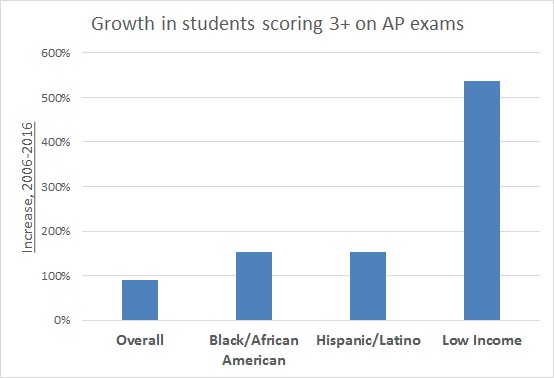
The number of low-income Florida students who passed at least one AP exam grew by more than 500 percent between 2006 and 2016. Source: Florida Department of Education data.
Over at Dropout Nation, RiShawn Biddle has explored how school choice activists, particularly those on the left, can re-energize the legal case for equity in education spending. He writes, "If choice activists and civil libertarian groups such as the American Civil Liberties Union successfully take up such moves, it would lead to another round of school choice efforts that would provide more poor and minority children with opportunities to get the high-quality education they deserve."
Biddle has done more than any journalist to highlight the egregious symptoms of what he calls zip code education, notably pointing to the criminal prosecution of a homeless mother in Connecticut and a low-income parent in Ohio who sent their children to schools outside their assigned districts. He sees relief in the very state constitutional provisions that give most choice advocates heartburn: the idea that states must provide uniform systems of public schools. The language differs depending on the state, but the same barriers exist for voucher or charter school expansions. Or do they?
"Practices that have led to zip code education, including the concept of zoned schools, are essentially unconstitutional; and thus, inter-district choice of the kind encouraged by otherwise foes of choice such as Richard Kahlenberg of the Century Foundation would be allowable," Biddle writes.
Before readers roll their eyes, they should know there is precedence in Biddle's contention, namely in two of the most stalwart advocates for equity, John E. Coons and Stephen D. Sugarman of the University of California at Berkeley. Coons and Sugarman first struck at the inequalities in school spending between rich districts and poor districts in the 40-year-old California case known as Serrano v. Priest. The case led the California Supreme Court in 1971 to establish the concept of "fiscal neutrality," which recognized that the quality of a child’s education should not be a function of a district’s wealth or poverty. The way to equalize education for rich and poor, Coons and Sugarman eventually argued, was to enact a system of choice.
A commitment to family choice in education, Coons would later write, "would maximize, equalize and dignify as no other remedy imaginable." And, notably, this comes from a progressive voice that Biddle believes is critical to this enterprise. While it's unlikely that any grassroots or parent-led effort can soon convince the ACLU to drop its opposition to the choice policies that Biddle and Coons would promote, Biddle is right to argue that it will take a left-of-center effort to quarterback this challenge.

