
Editor’s note: fact-checkED is an occasional feature that brings precision to complex education issues that are easily misunderstood, aiming to counteract incorrect information.
 Giant snails are one of hundreds of invasive species that now call Florida home. They damage homes, threaten crops, smell terrible – and carry a parasite that can cause meningitis in humans.
They’re also impossible to wipe out. If it gets too dry, the snails just bury themselves until the rains return. Then they emerge “like zombies clawing their way out of a grave.”
Kind of reminds me of …. myths about education choice.
Legislative sessions are to ed choice myths what rainy season is to invasive snails.
With lawmakers considering choice bills in 23 states and counting, the myths are on the march. Especially the Terminator of all school choice myths (see here, here, here, here, here … ) that choice scholarships drain money from public schools.
In Florida, choice opponents are re-surfacing the myth (see here, here, here and the tail end of this here) to slime Senate Bill 48. That’s the bill that would convert Florida’s school choice scholarships into education spending accounts.
A little math can temporarily dispel this myth as well as a little salt can, well, dispatch a snail. (Not that we’d support that.)
When choice opponents in Florida make the drain claim, they’re referring to the two biggest scholarship programs. The Florida Tax Credit Scholarship now serves about 100,000 students each year. The Family Empowerment Scholarship serves about 36,000 students. The value of both scholarships is roughly the same – and so much less than per-pupil funding in district schools.
All-in per-pupil spending in Florida in 2017-18 was $10,856, according to a 2019 analysis by Florida Tax Watch. The average value of the tax credit scholarship that year was $6,447.
That’s 59 percent of the district cost. That’s why when you extrapolate scholarship spending over thousands of students, you don’t get a drain on public schools. You get taxpayer savings that can be invested in public schools.
To date, eight independent analyses of the Florida Tax Credit Scholarship have come to this conclusion. To date, not a single study has concluded otherwise.
The Florida findings are not an outlier. EdChoice has tallied 55 fiscal impact studies on choice scholarships. Forty-nine found savings for taxpayers. Two found net costs.
For the definitive busting of the siphoning myth, we suggest the chapter by Martin Lueken and Benjamin Scafidi in the indispensable “School Choice Myths.”
Sadly, media coverage of any of this evidence is, like a snail in dry season, rarely seen.
For Floridians, here’s one more bit of remedial math. In 1999, when Florida awarded its first K-12 scholarship, average per-pupil spending was $4,804 for operational costs. (This operational figure is routinely cited as Florida’s per-pupil figure. In truth it’s a portion, but it still works as a comparison.) Choice opponents declared the apocalypse was upon us.
Two decades later, that per-pupil figure is $7,786 – or nearly $300 more than in 1999, once adjusted for inflation.
That’s with 180,000 students using K-12 scholarships.
Meanwhile, Florida’s academic outcomes now earn the Sunshine State a No. 3 ranking in K-12 Achievement from no less a fair arbiter than Education Week.
Choice opponents still say the end is near. They always will.
Even invasive snails won’t outlive the myths about school choice.
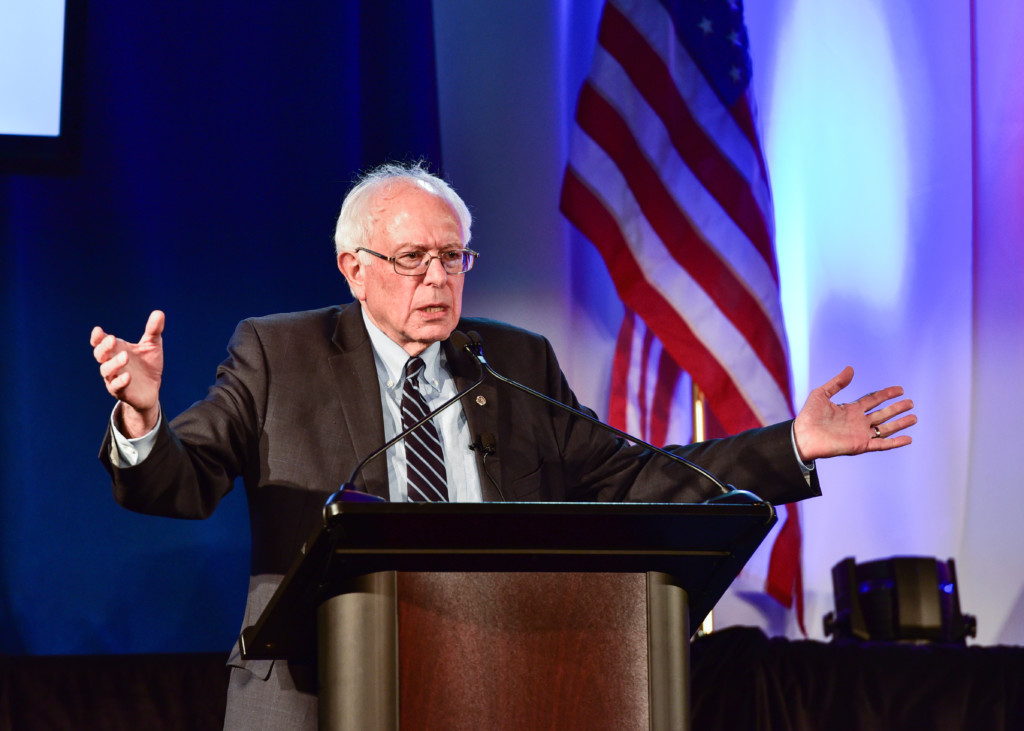 With the presidential primary election in delegate-rich Florida just two months away, Democratic candidates are beginning to knock on the door.
In a Monday column in the South Florida Sun-Sentinel, Vermont Sen. Bernie Sanders found little to like about Florida’s public education system. But our focus is on educational choice and three assertions he made while insisting that “Florida is ground zero of a school privatization movement intent on destroying public education.”
“Each year almost $1 billion in state money goes to private schools instead of public schools.”
“These private schools operate with little to no accountability.”
“In many cases, their students’ math and reading skills have declined.”
These claims are misleading, at best.
Claim No. 1: The $1 billion citation draws attention but does not prove Sanders’ point. He implies that private school voucher and scholarship programs harm public schools financially, which is a longstanding and erroneous argument advanced by the Florida Education Association (FEA) that we have dealt with previously in this space. There is simply no evidence to support it.
Eight different independent financial studies all have concluded the scholarships, which cost less per student than the total amount spent in a traditional public school, save tax money that can be used to enhance public schools. Florida TaxWatch weighed in last year, finding existing scholarships cost 60 cents on the public school dollar. And the FEA lost its legal challenge to the 19-year-old Tax Credit Scholarship program in part because the trial and appellate courts summarily rejected its argument that public schools “have been and will continue to be injured by the scholarship program’s diversion of resources from the public schools.”
Claim No. 2: The qualifier in this assertion – that private schools operate with “little to no” accountability – gives Sanders some wiggle room in part because accountability is hard to objectively measure. But Sanders seems to dismiss entirely the accountability that is inherent with any school that survives only if parents choose it for their children.
That market concept may not appeal to a self-professed socialist but does have real-world consequences and, in the case of the state’s two scholarships for underprivileged students, gives genuine educational power to parents who typically have little.
As to the regulatory oversight, Florida’s largest program, the Tax Credit Scholarship serving 108,570 economically disadvantaged students this year, is ranked among the nation’s most aggressive. The students, schools and scholarship organizations are subject to roughly 17,000 words of statutory and agency regulations.
Among those requirements: scholarship students must take state-approved standardized tests; those test results are reported publicly every year; schools must submit annual financial reports by certified public accountants; and scholarship organizations must be audited each year by the state Auditor General and independent accounting firms.
Sanders is entitled to believe the program is not subject to sufficient regulation, but we rate his claim of “little to no” accountability as misleading.
Claim No. 3: Once again, Sanders uses an interesting qualifier – “in many cases” – in his assertion that scholarship students’ “math and reading skills have declined.” Eleven years’ worth of standardized test reports refute his claim.
Students who receive the Tax Credit Scholarship must take a nationally norm-referenced test each year approved by the state, and most take the Stanford Achievement. The test scores are sent to Florida State University’s Learning Systems Institute, which is paid to aggregate and report them publicly.
For the most recent year, 2017-18, scholarship students scored on average at the 47.4 percentile in reading and 45.2 percentile in math. That’s basically average, which is encouraging given that these scholarships students are among the poorest in the state and were among the lowest-performing students in the public schools they left behind.
More to the point, their annual gains have been remarkably consistent. The scores reflect that these low-income students have achieved the same annual gains as students of all income levels nationally.
In other words, they have increased, not declined.
Certainly the average doesn’t reflect every student. In the most recent report, about as many students – 0.6 percent – achieved extraordinary gains of more than 40 percentile points as those who dropped an equivalent amount. But Sanders’ qualifier that “many” students declined seems intended to distort the overall test findings. We rate it mostly false.
 A story in Sunday’s Lakeland Ledger about a union-sponsored public education summit in Polk County included a chart of “Quick Facts” that bears scrutiny. One of them, about the financial impact of Florida Tax Credit Scholarships, is false.
The statement: “In 2018, tax-credit scholarship programs totaled $1.058 billion, money that went to private and religious schools that could have gone to public schools.”
First, the total dollars are off. According to the state Department of Revenue, which tracks tax credits awarded under the scholarship law, companies received permission in 2018-19 for tax-credited contributions of $689.3 million. Those dollars translated into scholarships for 104,091 lower-income and working-class children to attend 1,825 private schools in that same year, according to the Department of Education.
The $1 billion figure may well include money spent on two voucher programs – McKay and Gardiner Scholarships – for students with special needs that are funded directly from the state treasury, but it is nonetheless misleading.
The more substantive claim, though, is that the money “could have gone to public schools.” This is at the core of a longstanding and erroneous argument – that vouchers harm public schools financially – offered by the Florida Education Association. In fact, FEA lost a 2014 legal challenge to the Tax Credit Scholarship in large part because it could prove no such harm.
In that case, McCall v. Scott, the FEA argued that public schools “have been and will continue to be injured by the scholarship program’s diversion of resources from the public schools.” The Leon Circuit judge who heard the case, George Reynolds, offered union attorneys the chance to amend their complaint to provide facts that bolstered that claim.
They declined, and Reynolds dismissed the case, writing: “Whether any diminution of public school resources resulting from the Tax Credit Program will actually take place is speculative, as is any claim that any such diminution would result in reduced per-pupil spending or in any adverse impact on the quality of education.”
On appeal, the union lawyers went a step further and asserted the scholarship program cost public schools $300 million in 2013-14. But the state education budget that year increased by $1 billion and per-student funding went up by 6.3 percent, leading First District of Appeal Judge Lori Rowe, during oral arguments, to ask: “But exactly what is the special injury you are articulating here? You haven’t alleged that any individual student is suffering. You haven’t alleged that per-student funding has been reduced. You haven’t even alleged that the education budget has been reduced.”
Outside the courtroom, eight different independent financial studies have all concluded the scholarship saves tax money that can be used to enhance public schools. That’s because the state spends less to educate these students on the scholarship than it otherwise would spend in a traditional public school.
In March, Florida TaxWatch added to that body of research with a report on what it called the “true cost” of education in 2017-18. TaxWatch went beyond the basic operating formula used to fund public schools and added all the other appropriations as well. It found the state spent $10,856 to educate the average student in public school, and contrasted that amount with $6,447 spent on the average Tax Credit Scholarship student. In other words, the scholarship cost 60 cents on the public school dollar.
One final note: Amid the lawsuit challenging the Tax Credit Scholarship in 2014, Nan Rich, a former state senator, made a similar claim about scholarship programs pulling money out of public schools, and PolitiFact Florida rated it “mostly false.”
We rate this “quick fact” to be false.
When Florida Gov. Rick Scott unveiled his education agenda last week, he threw out a potentially far-reaching idea: Allowing districts to open their own charter schools.
The proposal could address a common complaint among traditional school districts - that federal and state bureaucracies prevent their schools from being as innovative as charter schools. But how would these District Charter Innovation Schools, as Scott called them, actually work? Would they truly be as flexible as independent charter schools?

Gov. Scott
We’re waiting to hear more. Scott didn’t spell out specifics, beyond saying the schools would operate with the same funding levels as other charter schools. His press secretary, Jackie Schutz, told redefinED she couldn’t provide any more details.
In the meantime, there may be clues in the handful of district-run charter schools that already have been approved by the state Department of Education. They don’t look like typical charter schools. But in some respects, they do veer from the framework of more traditional public schools.
The Academy for International Education Charter School in Miami Springs is a year-old “hybrid’’ school that offers a curriculum based on magnet and charter school programs, with students learning second and third languages.
The principal is a 30-year district employee who left the traditional public realm for the charter. The academy has a nonprofit board that is technically independent from the district, but has contracted with the Miami-Dade district for services, including custodial and cafeteria workers. The school also leases space from the district, significantly reducing facility expenses. Miami-Dade district and school officials did not return calls for comment.
In Polk County, DOE approved another district-run, charter endeavor, Step Up Academy, in August. (more…)

