TRINITY, Fla. – Noah Allen was in middle school when he began to teach himself Latin. College-level Latin. He did that for two years.
He also taught himself Japanese. And Korean.
“It’s his superpower,” Noah’s mom, Josie, said. “He loves to learn.”
Noah, 16, is inherently curious. Theater, art, and music are a few areas that pique his interest. Also, the periodic table of the elements.
When he was 8, he wanted to be a nuclear physicist and work with a cyclotron. Later, he thought of a career in linguistics.
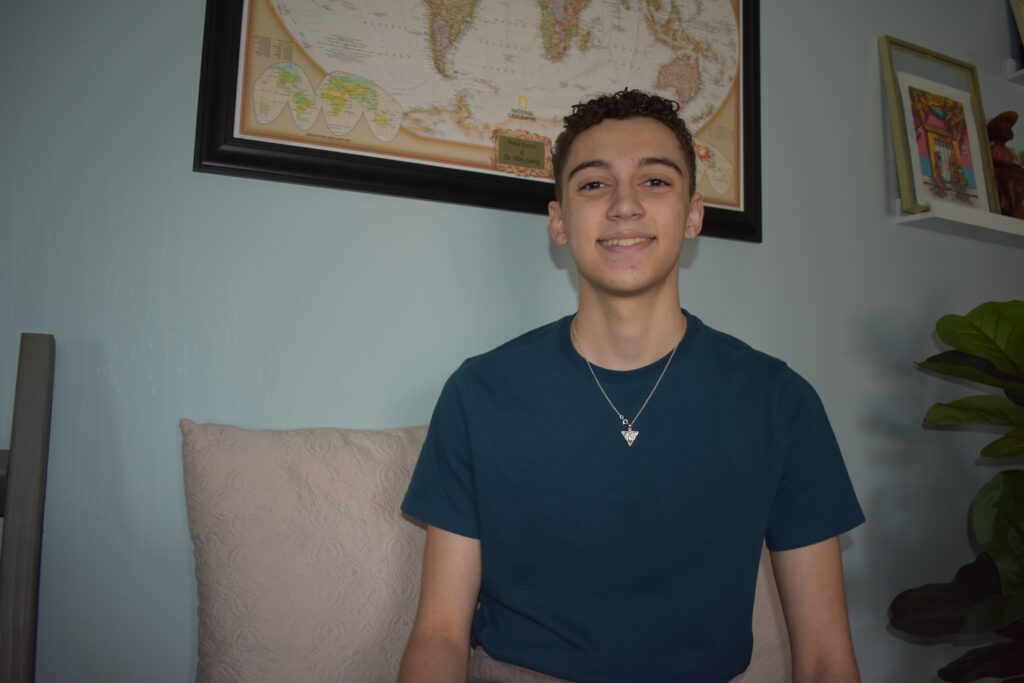
Now, as he completes the final semester of high school, Noah wants to study global law.
In Italy.
At Bocconi University in Milan.
To gain admission, he needs at least a 1340 on his SAT, which he has, and a 4.0 GPA, which he also has.
Noah is interested in law. He likes to help others. He has a passion for connecting with people from other cultures. He sees a career in global law as the perfect blend of those interests. He could work for an international organization or practice immigration law.
“I think he has a really bright future,” Josie said. “Noah is going to do amazing things.”
***
Noah, who was diagnosed with attention deficit hyperactivity disorder, receives the Family Empowerment Scholarship for Students with Unique Abilities. Step Up For Students, which manages the scholarship program, said that 140,147 students received the scholarship during 2025-26. The average scholarship is worth about $10,000.
He is home educated and learns online through the Florida Virtual School. He also uses the funds from the scholarship to cover the cost of his tutoring, SAT prep classes, and exam fees, and his registration for the Melanated Homeschool Cooperative, which provides field trips, program days for middle and high school students, a graduation ceremony and banquet, and a prom.
The scholarship also pays for his dual enrollment to Pasco-Hernando State College, where he has completed college-level courses in math, psychology, government, and humanities.
“I have been really grateful for the opportunities that the scholarship has given me,” Noah said, adding that having the SAT prep classes and exams paid for was beneficial since he took the test three times to achieve his high score.
“The scholarship helps fund his academic health and his social health,” Josie said, “which, I guess, is his mental health.”
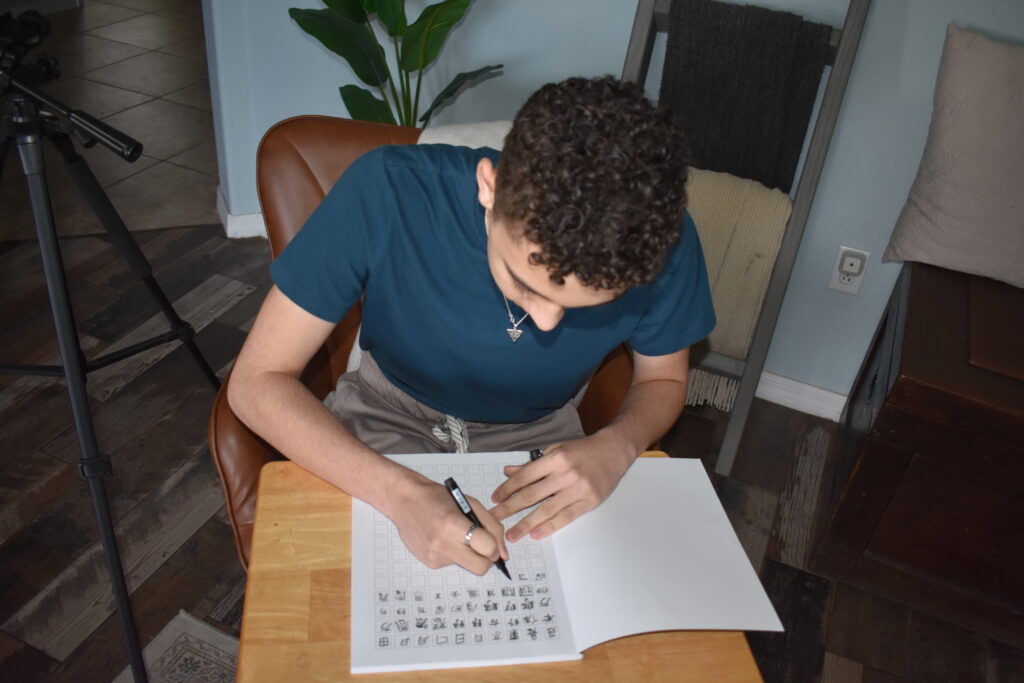
Josie, who has a degree in early childhood education, and her husband, Aaron, who owns a construction company, realized their son was academically gifted at an early age. He was reading by age 4.
“I thought, he’s going to go to school, and all the other kids are going to be learning their alphabet, and he's already reading. He's going to be bored,” Josie said. “We're going to have to figure something else out. We’re going to have to do something different with him.”
Learning at home allowed Noah to move at his own pace, accelerated in most cases, and make accommodations for his ADHD. He could schedule his schoolwork around his therapies and the family's active travel schedule.
Josie is a travel tour guide who writes a travel blog, Traveling in Spanglish.
The family, who lives north of St. Petersburg in Trinity, frequent Europe, especially Italy, where Josie and Aaron met.
Noah has traveled to Mexico, England, Scotland, Ireland, France, Spain, Canada, St. Martin, and Haiti. He has done schoolwork on trains traveling between European cities and logged into an SAT prep course at 10 p.m. local time from Venice, Italy.
His time abroad fueled his passion to learn other languages and cultures, and the customs of the people he met during his journeys.
He said he couldn’t have done that if he attended a traditional school.
“I wouldn't have been able to have those experiences,” he said, “and I might be in a completely different spot than I am now.”
***
Noah has acted in plays and musicals at the Center Stage Youth Theater near his home and the Stageworks Theater in Tampa. He recently appeared in “Hadestown.” He was Eugene in “Grease” and Wally Webb in “Our Town.” He’s also appeared in “Les Misérables.”
“I really like doing theater,” he said. “I like singing, and dancing, and acting.”
For his 16th birthday, Josie treated Noah to a weekend in New York City, where they visited the Museum of Modern Art.
“We had a blast,” he said. “I do love a good art museum.”
He can gaze for hours upon Claude Monet's “Water Lilies” or Vincent van Gogh's “Starry Night.”
“I love impressionist paintings,” Noah said. “They're really beautiful. I just like capturing the vibe of something, or the feeling of something. Not necessarily what it looks like, but how it feels to you.”
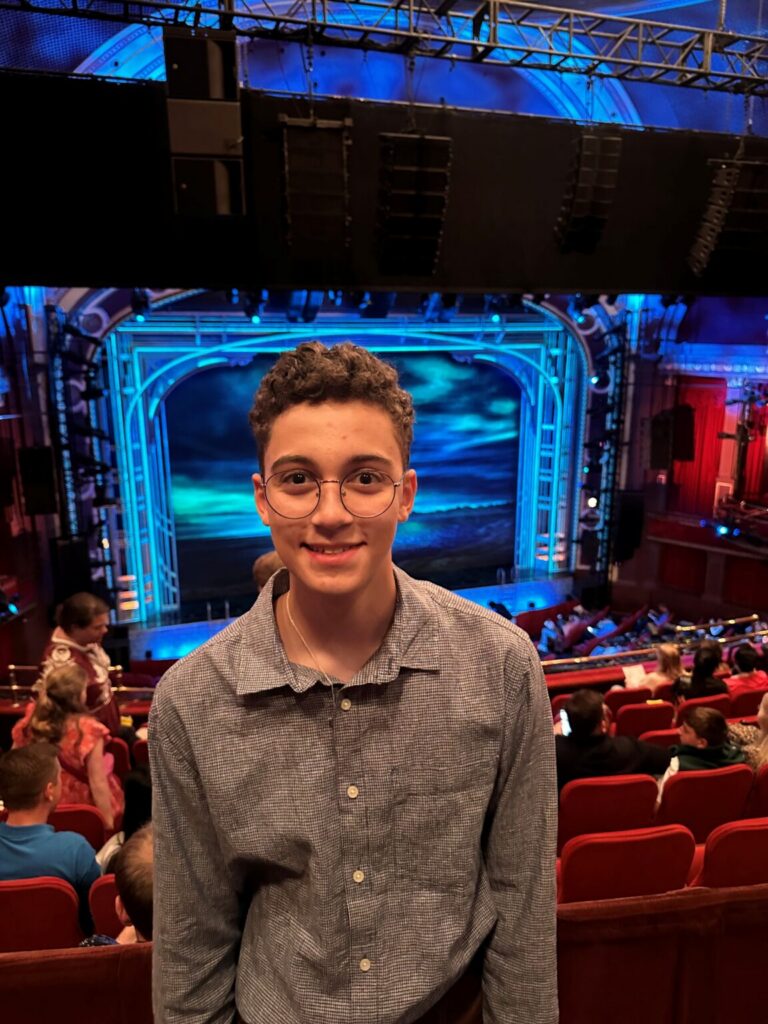
For Noah, to be immersed in a painting is the only way to see art.
That’s similar to the reasons why he wants to attend Bocconi University in Milan. He can also begin studying law as a freshman, and the tuition of $15,000 per semester is almost laughable compared to the cost of a college education in the United States. (Tuition for international students at the University of Bologna in Italy, another school that has Noah’s interest, is $2,000 a year.)
Those two are certainly perks, but global law will require Noah to interact with clients from around the world. He’ll need to learn their customs, their methods of communication, and the idiosyncrasies familiar to their culture.
Attending classes with students from Europe will give him a head start.
“I want the experience of studying abroad,” he said. “It's really helpful to be able to experience living in another culture. It really helps you integrate and maybe connect yourself with the world in a way that you can't get by going to school in a place that has a similar culture to you.”
He will be able to communicate with most of his classmates, since there is a chance he speaks their language. He is fluent in Spanish (his mom’s native language), and he’s becoming more conversational in Italian, Japanese, and Korean.
Noah’s dream is to live in Japan and practice global law. That’s where he said he sees himself in five years.
As for Josie, she sees her son doing whatever he puts his mind and heart into.
“He’s going to be a justice-seeker,” she said. “He’s going to bring changes. He’s going to help people. There’s no doubt in my mind that’s going to happen.”
The future of education is happening now. In Florida. And public school districts are pushing into new frontiers by making it possible for all students, including those on education choice scholarships, to access the best they have to offer on a part-time basis.
That was the message Keith Jacobs, director of provider development at Step Up For Students, delivered on Excel in Education’s “Policy Changes Lives” podcast A former public school teacher and administrator, Jacobs has spent the past year helping school districts expand learning options for students who receive funding through education savings accounts. These accounts allow parents to use funds for tuition, curriculum, therapies, and other pre-approved educational expenses. That includes services by approved district and charter schools.
“So, what makes Florida so unique is that we have done something that five, 10, even, you know, further down the line, 20 years ago, you would have never thought would have happened,” Jacobs said during a discussion with podcast host Ben DeGrow.
Jacobs explained how the process works:
“I’m a home education student and I want to be an engineer, and the high school up the street has a remarkable engineering professor. I can contract with the school district and pay out of my education savings account for that engineering course at that school.
“It’s something that was in theory for so long, but now it’s in practice here in Florida.”
It is also becoming more widespread in an environment supercharged by the passage of House Bill 1 in 2023, which made all K-12 students in Florida eligible for education choice scholarships regardless of family income. According to Jacobs, more than 50% of the state’s 67 school districts, including Miami-Dade, Orange, Hillsborough and Duval, are either already approved or have applied to be contracted providers.
That’s a welcome addition in Florida, where more than 500,000 students are using state K-12 scholarship programs and 51% of all students are using some form of choice.
Jacobs said district leaders’ questions have centered on the logistics of participating, such as how the funding process works, how to document attendance and handle grades.
Once the basics are established, Jacobs wants to help districts find ways to remove barriers to part-time students’ participation. Those could include offering courses outside of the traditional school day or setting up classes that serve only those students.
Jacobs said he expects demand for public school services to grow as Florida families look for more ways to customize their children’s education. That will lead to more opportunities for public schools to benefit and change the narrative that education is an adversarial, zero-sum game to one where everyone wins.
“So, basically, the money is following the child and not funding a specific system. So, when you shift that narrative from ‘you're losing public school kids’ to ‘families are empowered to use their money for public school services,’ it really shifts that narrative on what's happening here, specifically in Florida.”
Jacobs expects other states to emulate Florida as their own programs and the newly passed federal tax credit program give families more money to spend on customized learning. He foresees greater freedom for teachers to become entrepreneurs and districts to become even more innovative.
“There is a nationwide appetite for education choice and families right now…We have over 18 states who have adopted some form of education savings accounts in their state. So, the message to states outside of Florida is to listen to what the demands of families are.”
MELBOURNE, Fla. – When it comes to her son’s education, Denice Santos always thinks about the big picture.
“What can we do to merge his goals?” she said. “Education, and then, of course, becoming a pilot.”
Her son, William, 12, has wanted to fly airplanes for half his life. He took control of a plane for the first time when he was 8. He’s nearly halfway to the required 51 hours of flight time needed to earn a pilot’s license.
A Florida education choice scholarship is helping him reach that goal.
William receives a Personalized Education Program (PEP) scholarship available through the Florida Tax Credit Scholarship Program managed by Step Up For Students. PEP provides parents with flexibility in how they spend their scholarship funds, allowing them to tailor their children’s learning to meet their needs and interests.

William Santos stands in front of a two-engine airplane that he has flown during his training flights.
For his needs, William attends Florida Virtual School, where he is a straight-A student.
For his interests, William heads to Melbourne Flight Training twice a month for flight lessons. Both are paid for with his PEP scholarship, with the flight lessons covered under enrichment courses.
“I’m not just thinking about right now, his education experience right now. I’m thinking long term,” Denice said. “What’s after school? What’s school building to?”
William said he is thinking about attending the United States Air Force Academy. Or maybe a career in law enforcement where he could put his flying skills to use. Border patrol? Possibly.
He’s recently developed an interest in flying helicopters, which could open another career avenue. The family lives in Melbourne Beach, located in Brevard County, and the Brevard County Sheriff's Office has an aviation unit with four helicopters.
He could also become a commercial pilot and fly for an airline or fly charters for a private company.
“The sky is the limit,” said Denice, who chuckled at her choice of words.
***
William was 6 when he attended the Cocoa Beach Air Show with his mother and father, Kevin. There were flying machines everywhere – F-22s and F-35s, F-16s and B-52s. They screamed overhead and rested majestically on the ground.
He was hooked.
When they were leaving, William said, “Mom, when I grow up, I’m going to be a pilot.”
“He’s always been super decisive,” Denice said. “I knew he wasn’t kidding.”
Denice checked for the minimum age requirement needed to begin flying lessons. Turns out, there is none. You do have to be between 8 and 17 to participate in the nationwide Young Eagles program, which offers free introductory rides for youngsters interested in flying. William was in the air as soon as he turned 8.
“They take kids up for 30 minutes with the pilot, and they get a little taste of it to see if they like it. Is this something? Are they afraid, or does it spark something? William did 10 of those, and we said, ‘OK, this is a thing.’”
Soon, Denice and Kevin were searching for a flight school. They settled on Melbourne Flight Training, which is 20 minutes from home.

William poses in front of the wall containing pictures of all the pilots who earned their license after training at Melbourne Flight Training.
“When I was a kid, I always liked planes,” William said. “Even when I would go on flights as a baby, I would never cry. I would love it, every minute. It was the best thing ever. And I was never really afraid of heights. It didn't bother me much.”
That’s good, because his first flight with Young Eagles was in a BushCat Light Sport Aircraft, a small plane that has non-traditional doors – they are clear plastic and can be removed. You can fly with or without them.
“It was kind of ever so slightly scary,” William said. “Since I was young, I was like, ‘Uh, am I sure about this?’ And many, many flights later, I'm here.”
He has flown 25 times with an instructor and has nearly 20 hours of flight time. He will need to turn 17 and have a minimum of 51 hours before he’s licensed. He will also need to be medically certified to fly and pass a written exam that covers weather, navigation, flight regulations, and aerodynamics.
Dr. Tracey Thompson, the student advisor at Melbourne Flight Training, said it’s not uncommon for someone as young as William to take lessons.
“But,” she added, “he’s been up 25 times, and for someone his age to be up that many times, that’s phenomenal. His consistency, his passion, he wants to do this all the time.”
Jonathan Gaume is William’s instructor. He said he’s never worked with a student this young and is impressed by William’s interest and enthusiasm.
While he’s on pace to reach his 51 hours when he’s 17, William would like to accelerate his training and reach those hours when he’s 16.
Why?
“Because I find this fun,” he said.
As for being one of the youngest pilots training at Melbourne Flight Training, “You know, it's been really the only thing I’ve done since I was 8. It’s been the thing I've always looked forward to.”
***
William has trained several times in a four-seat plane, and Denice has accompanied him during those flights. She said she’s noticed a level of peace when William is flying.
Gaume noticed it, too. He said William’s confidence spikes as they climb into the aircraft.
“He has key elements to being a good pilot: calm, confident and in control,” Gaume said.
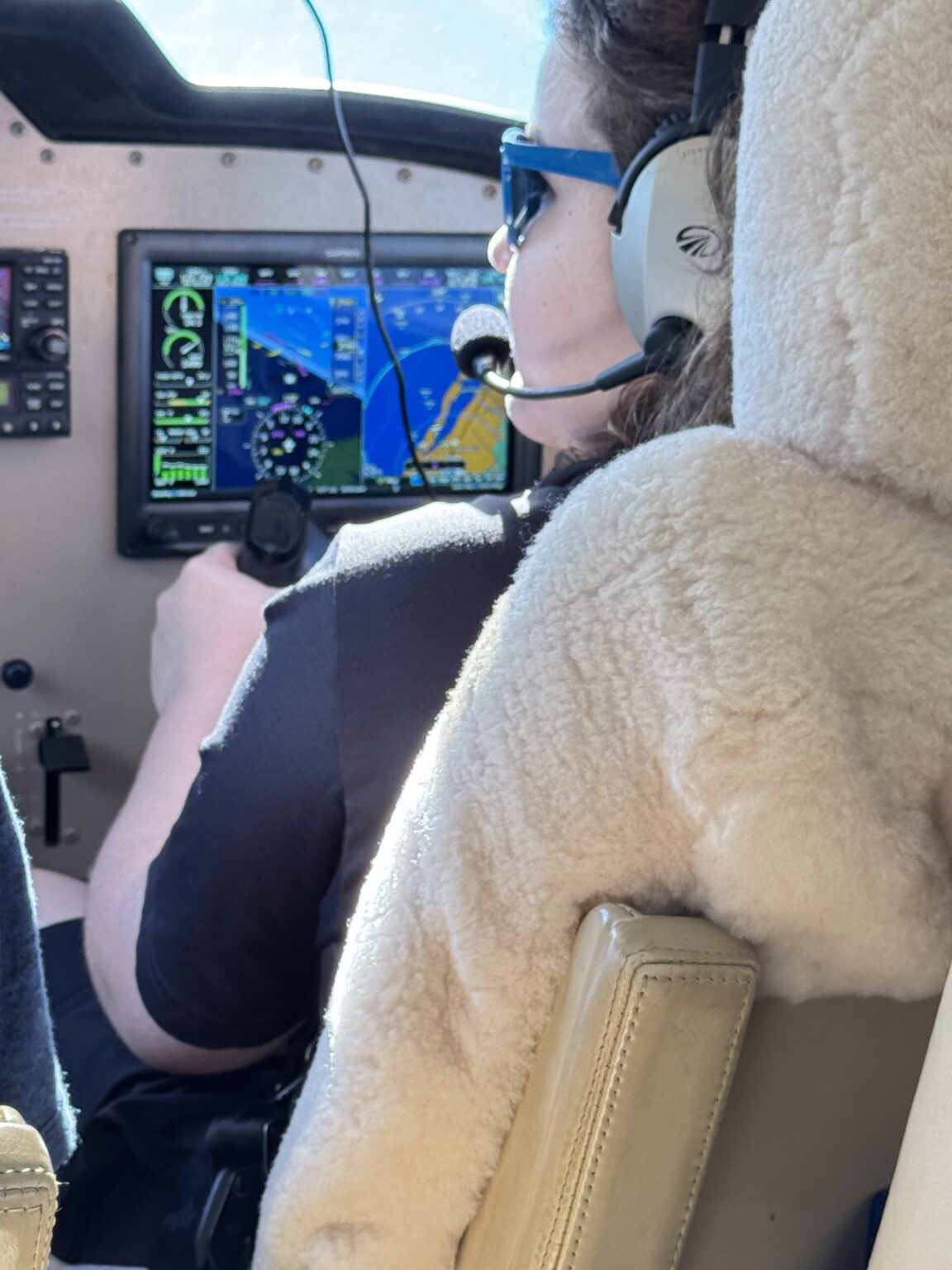
William at the controls. (Photo courtesy of Denice Santos)
The flight path takes William over the Atlantic Ocean, where they sometimes fly around thunderstorms. A recent lesson took place in a twin-engine plane. Gaume killed one of the engines, and William had to keep the plane flying. Confident and in control, William did just that.
“We’re just so thrilled, just so happy to plug him into his dream,” Danica said. “To be in the plane with him, seeing him flying, just seeing him totally locked in, that's all a parent can wish for.”
Flying lessons cost between $300 and $500 depending on airtime, and William averages about two lessons a month. That can strain the family budget for Denice, a teacher at Florida Virtual School, and Kevin, who is retired after 22 years in the U.S. Army.
“It’s not like we’re rolling in the dough,” Denice said. “The scholarship makes this possible. If we didn't have that scholarship, how many flights would he get? Probably not as many as he's getting now.
“I'm thrilled to be in Florida, because there's so much parental choice here. Not only do parents have choices, but then they can branch out and get some financial support from the state for those choices. Amazing. It's awesome.”
Every family in Florida that receives an education choice scholarship uses it in their own, unique way. Denice encourages parents to be as forward-thinking as possible, to merge education and interests and work toward a goal.
“I would like more people to think beyond where their kid is right now, but what are they good at. Really invest in that and tune in and give them the most experience as you can,” she said. “To me, that's what the scholarship money is for, branching out, tap into your kids’ interests because you never know what can happen.”
As Denice said, the sky is the limit.

Ronald Hamilton shows off the medal he received at Step Up For Students' annual Rising Stars Awards event in February.
TAMPA, Fla. – The poem is a father’s message to his son, that everything they do together will be a memory someday.
"I’m going to love and hold you until you’re grown
for in a blink you'll be on your own."
Barbara Hamilton wrote the poem for her son, Ronald, when he was in the seventh grade. He recited it at the end-of-the-school-year celebration for homeschoolers. It’s based on Ronald’s interactions with his dad, Ron Sr. Everything the Hamiltons have done for their only son has been to prepare him for the time he will be off on his own, and that included his education.
Unhappy with his treatment by a classmate and what Barbara said was a lack of concern from administrators at his assigned district school near the family’s Tampa home, Barbara began homeschooling Ronald when he was in the second grade.
“Homeschooling wasn't good only for him, it was great for us because it exposed us to a totally different world and allowed us to think outside of the box,” Barbara said. “We don't have to go with the status quo. Yes, the government says your child must be educated, but there's another way you can do it.
“It just opened up a different world for us, and I have no regrets.”
Now a high school senior, Ronald, 17, uses a Personal Education Program (PEP) scholarship that comes with the Florida Tax Credit Scholarship (FTC), managed by Step Up For Students.
The scholarship is an education savings account (ESA) for students who are not enrolled full-time in a public or private school. It allows parents to customize their children’s education by allowing them to spend their scholarship funds on various approved, education-related expenses.
Barbara is thankful for the scholarship, which was created in time for the 2023-24 school year. But, like many parents who have homeschooled their children for years, she wishes it had been created a few years earlier.
“(Homeschooling) can pinch your wallet,” she said.
Yet, she is 100% confident that homeschooling was the right educational choice for Ronald. They tried traditional schools for kindergarten and first grade, but Ronald was bullied.
He also had a hearing impairment that went undetected until the fifth grade, when a homeschool evaluator raised her suspicion to Barbara. Barbara and Ron Sr. had suspected this for years, but doctors couldn’t find a defect. A hearing specialist in Colorado did, and Ronald now wears an ear filter that buffers loud sounds.
“Ronald’s hearing developed a little differently,” Barbara said. “Sound to him was extra loud. I noticed he covered his ears every time there was a loud noise.”
This made it difficult for Ronald to correctly hear what was being said in class. Barbara said the teacher, in a sign of indifference to Ronald’s struggle, moved his seat away from the other students, isolating him from his classmates, and adding to his trauma.
“He would come home, and his spirit would be downtrodden,” Barbara said. “So, I took it upon myself and pulled him out of that school. The Lord didn’t give him to you. He gave him to me, so I took the chance of educating him myself.
“We started on our journey, and it was peaceful. The house was happy. Ronald was happy.”
“Well,” Ronald said. “I'm going to be honest, it was kind of hard at times, but I got through it, and long term, it was actually beneficial.”

Ron Sr., Barbara and Ronald
The hard times, Ronald said, came from the textbook Barbara initially used for her lessons. It was big and somewhat intimidating.
“It was gruesome,” Ronald said.
Barbara made the switch to Florida Virtual School. Ronald enjoyed the interaction with other homeschoolers. In the fifth grade, Ronald was introduced to the world of robotics.
“That motivated me to learn more about technology,” he said.
Ronald joined Tampa Bay HEAT (Homeschool Education Activities Team), where he met fellow homeschoolers and participated in sports and extracurricular activities.
He also became a member of a storytelling group in Hillsborough County. Barbara and Ron Sr. saw that as another step in their son’s development, because it allowed him to build the confidence that comes with speaking in front of groups.
So, when the Tampa Bay HEAT was looking for a student to speak at the end-of-year event, the coordinator, aware of Ronald’s storytelling ability, asked Ronald to be the guest speaker. After looking through family photos that reminded her of the interactions between Ron Sr. and Ronald, Barbara decided to write the poem, "A Father's Eyes."
“It dawned on me that Ronald is going to be mimicking with his children everything he does with his dad, and I was like, ‘Man, I need to capture that.’ So, I captured it,” Barbara said.
Ronald can still hear the reaction of those at the event.
“Everyone cheered,” he said.
And he can still recite some of the lines.
"Now, catch the ball. Run, jump, laugh, & play
for this will be a memory one day."
Ron Sr. said the extra time he spent with Ronald is one of the benefits of homeschooling. For the physical education requirement, Ron Sr. taught Ronald how to play golf and tennis. In their spare time, the two searched the ponds, lakes, and streams near their home for the perfect fishing spot.
“We haven’t found it yet,” Ronald said.
“I can say this,” Ron Sr. said, “the more time with his family gave us more time to teach him family values and the in-between things about school, how to live, how to treat other people.”
PEP allowed Ronald to dual enroll at Hillsborough Community College. He will explore further education options once he completes his liberal arts degree. Right now, Ronald is leaning toward a career as an electrician. Ron Sr. thinks his son will one day own his own business.
Ronald said it’s possible that he could start his own business as a side hustle.
“That way I’ll have active and passive income,” he said.
James Herbert, Ronald’s eighth-grade science teacher from the Florida Virtual School, wrote a recommendation for Ronald to receive the Super Senior Award at Step Up For Students’ annual Rising Star event.
He wrote that Ronald has an “exemplary work ethic,” “high moral character,” and is “driven to succeed.”
“I am confident Ronald will continue to uphold these values as he takes on new challenges and opportunities,” he wrote.
This is what the Hamiltons wanted when Barbara exercised her right to education choice and homeschooled Ronald.
"I’m amazed at whom you’ve become,
Simply viewing life from the eyes of my son."
Gov. Rick Scott signed a major education bill last week that, in addition to equalizing funding for Florida charter schools, also removes the state's last remaining restrictions on virtual education eligibility for elementary school students.
HB 7069 also eliminates geographic boundaries for virtual education and creates statewide open enrollment for virtual charter schools.
Florida Virtual School functions like a statewide school district, enrolling students in online classes full and part-time.
Under existing laws, students in second through fifth grades can’t enroll in virtual courses part-time. Children in middle and high school can only take certain part-time courses if they were enrolled in public schools the previous years. (more…)
Two years ago, Jordan Hamilton was looking for an artistic outlet.
She'd been taking classes at Florida Virtual School's Escambia County franchise for two years, and after some searching, she found her way to Virge, the virtual school's student-run literary magazine. She said that at the time, she thought it might offer a forum for her artwork and digital photography, and a way to connect with fellow students. Before long, though, she began submitting her writing, too, and became one of its most prolific contributors. Now in her senior year of high school, she's among the de facto leaders of a group of students — including some from other states and countries — who assemble the biannual digital publication each semester.

"Spring Cleaning," one of Hamilton's contributions to the latest issue of Florida Virtual school's student-created literary magazine, which centered on the theme "Two Cups of Tea."
"It's all coordinated online," Hamilton said, though "there are opportunities where we can all meet in person."
Clubs are part of the experience at most schools. They're where a lot of learning goes on, and they give students places to tap their creativity in ways that aren't always available during a normal school day.
As it grew to become the largest public virtual school in the country, Florida Virtual School started trying to replicate those experiences for thousands of students online. Its clubs are open to all students who take FLVS classes, including those enrolled in its district franchises and FLVS Global, which caters to students outside Florida.
Each issue of Virge features student artwork, photography and creative writing, organized around a theme. To solicit submissions, plan each issue, and lay out pages, Hamilton works with students in different parts of the state — and in places like California, Kentucky and Malaysia.
Distance has kept her from meeting her collaborators face-to-face, though others have gathered in Central Florida for FLVS's annual club days. It also means she and her fellow students have to coordinate online conferences across multiple time zones. In between virtual meetings, they share ideas and edits in online wikis.
The credits on the latest issue show the breadth of Hamilton's contributions, from editing and graphics to a host of submissions.
"If we had an editor-in-chief, it would be her this year," said Cindy Knoblauch, Virge's faculty sponsor, who also helped launch some FLVS clubs. (more…)
 Tax credit scholarships. The Miami-Dade school board declines to hold a debate on the program and the lawsuit challenging it. Miami Herald. redefinED. Step Up For Students' Doug Tuthill responds to criticism of the program in the Sun-Sentinel. The organization co-hosts this blog.
Virtual school. The director of FLVS Campus, Florida Virtual School's new blended learning initiative, explains why one of the country's largest virtual schools is creating a physical learning space. Virtual Voice.
Teacher evaluations. The Palm Beach County school district proposes an evaluation system that would give all teachers positive evaluations. Palm Beach Post.
School grades. A survey finds parents in Jacksonville rely on things like test scores and school grades to judge schools, but don't understand all the changes to the system. Florida Times-Union.
School info. Design can increase parents' ability to get information about their schools, Omid Jahanbin writes on the EdFly.
Testing. The Lee County school board takes aim at testing with its legislative platform. Fort Myers News-Press.
Teacher pay. Bay County teachers are in for a raise. Panama City News Herald. Pasco teachers may be, as well, after protracted contract negotiations finally close. Tampa Bay Times.
Florida Virtual School has the authority to sue to protect its trademarks, the state Supreme Court ruled Thursday.
The decision is the latest twist in a long-running legal battle between FLVS and online education company K12, Inc., Florida's two largest players in online education.
FLVS sued its rival provider for trademark infringement in 2011.
The suit argues K12 used names like Florida Virtual Academy and Florida Virtual Program, which were too similar to Florida Virtual School and caused "confusion" in the online education marketplace. As noted in this summary of the case by Education Week, however, K12 uses the name "virtual academy" in other states.
K12 argued the state virtual school did not have the authority to sue to protect its trademarks, since Florida law gives that authority to the Department of State. A federal appeals court asked the state Supreme Court to resolve that issue.
In Thursday's unanimous opinion, justices said Florida Virtual School has the power to sue to protect its trademarks and other intellectual property because, unlike some other government entities, state law gives FLVS all the powers of a corporation.
Florida's virtual education system could see more funding changes under one of the competing spending plans proposed by lawmakers.
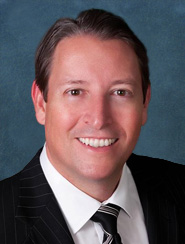
Sen. Bill Galvano
The House and Senate last week released rival budget proposals that would increase funding for K-12 public schools.
The Senate plan would alter the way Florida funds its virtual education programs, including Florida Virtual School, FLVS's local school district-run franchises, and the state's virtual charter schools.
The plan released this week by Sen. Bill Galvano, R-Bradenton, would do away with the virtual education contribution, a $27 million slice of the education budget that pads funding for virtual schools.
Instead, it would allow virtual schools to receive portions of state funding that have not been available to them in the past.
Galvano said the proposed revamp of the funding formula is intended to push virtual schools to offer more courses that lead to college credit or industry certifications.
The virtual education contribution supplants some of the funding streams that flow to brick-and-mortar schools, including the extra funding that gets attached to students in Advanced Placement and career education courses. It is intended to keep virtual school funding at about $5,200 per full-time student.
Without the virtual education contribution, per-student funding for many courses could fall below that amount. But funding could increase for courses that carry extra weight in the state's funding formula - such as AP and career education courses - which Galvano said is part of his goal. (more…)

