TALLAHASSEE, Fla.– Amanda Thompson said she will be the president of the United States.
Not wants to be or hopes to be but will be.Amanda Thompson said she will be the president of the United States.
Not wants to be or hopes to be but will be.
Just like she will be the attorney general of Florida, the governor of Florida, and the United States attorney general before reaching the Oval Office.
“That’s the plan,” she said. “I’m going to get there.”
Of course, there is some prep work to be done before she begins a career of service to her state and country.
First, Amanda, 17, is set to graduate this May from St. John Paul II Catholic High School (JPII), where she will be class valedictorian. She attends the parochial school in Tallahassee with the help of a Florida education choice scholarship managed by Step Up For Students.
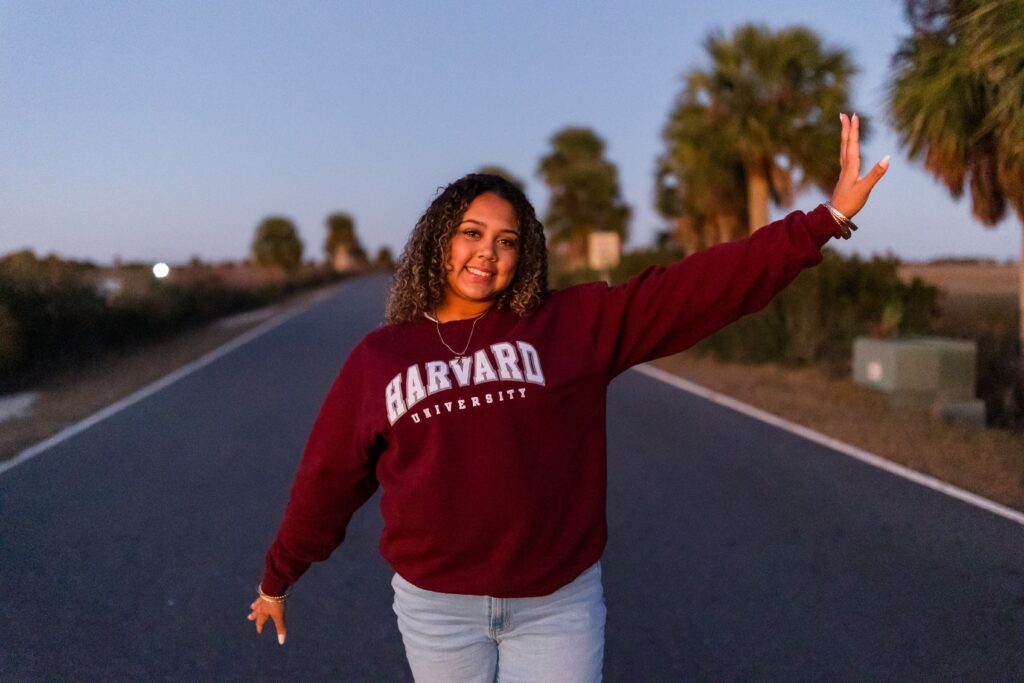
Then it’s off to Harvard University, where she plans to double-major in government and history and earn a degree from its prestigious law school. Along the way, Amanda will pitch for the Crimson softball team with designs on leading the program to its first appearance in the Women’s College World Series.
As that unfolds, Amanda is determined to play softball in the Olympics. She has attended tryouts for Team USA and is a member of the United States Virgin Islands national team.
Taken separately, any one of her goals is ambitious.
But combined?
“She has very, very high expectations,” said JPII Principal Luisa Zalzman. “She’s a go-getter, a high achiever. She has a drive that is very mature for her age.”
“She's done everything she's ever put her mind to,” said Amanda’s mother, Ashley Williard. “She said she wanted to be valedictorian, and I said, ‘OK, go be valedictorian.’ And she did it.”
Amanda is a bundle of energy and confidence. On the softball field, she has a running dialogue with everyone – teammates, opponents, coaches, umpires. In the classroom, she’s involved in every class discussion.
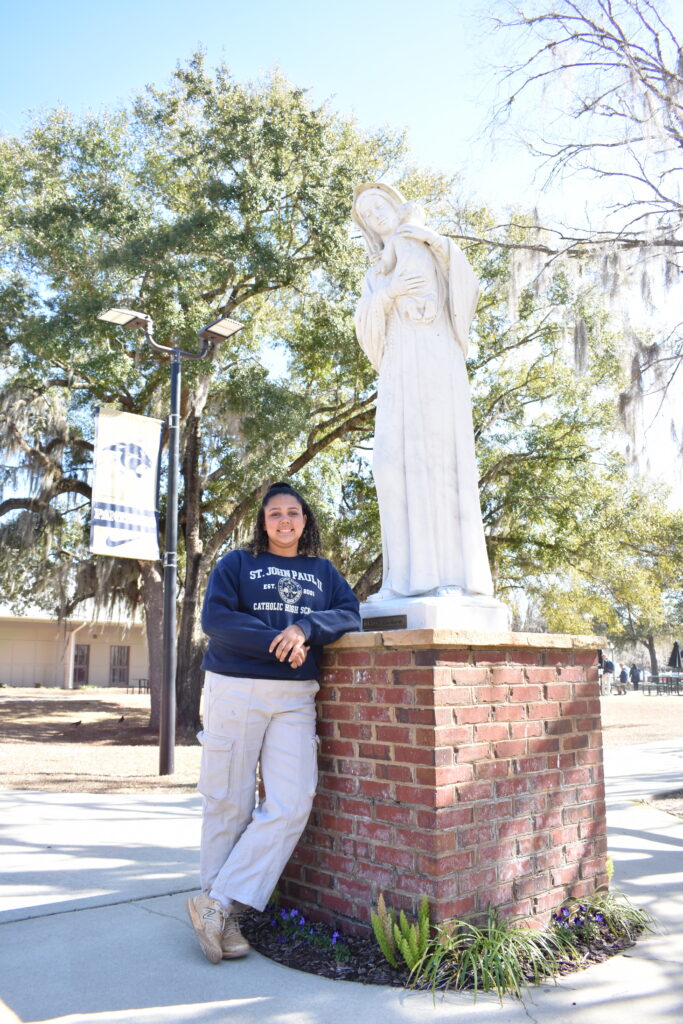
If you had approached her in August 2022 as she took the initial steps of her high school journey and told her she would graduate first in her class and be a member of Harvard Class of 2030, she would have been stunned.
“I would have said, ‘You got the wrong person.’ The difference between me then and me now is astronomical, and I think it’s because I attended this school,” she said. “It has to be.”
Amanda was a star as she rose through the ranks of the Tallahassee youth softball programs. Her parents, Ashley and James Thompson, envisioned their daughter earning an athletic scholarship to college. They were thinking of a high-end academic university like Duke or Notre Dame. That’s how Amanda, who attended her district schools until eighth grade, landed at JPII.
“We wanted a high school that was college-focused,” Ashley said. “Education is what we were looking for, and we could not have done it without Step Up For Students. No way could we afford to put her in that situation.”
There were “little things,” Amanda said, that shaped her academic future.
Her freshman English teacher encouraged her to write outside the margins during tests and essays.
“He said, ‘You don’t have to stay within this box. If you know more, write more on the paper.’ That stuck with me,” Amanda said.
Her freshman world history teacher announced to the class that Amanda scored the highest on the first test of the year.
“He congratulated me,” she said. “I thought that was insane.”
Midway through that semester, Amanda realized she had A’s in all her classes. That’s when she began to believe in herself as a student. Future valedictorian?
“Why not?” she said.
Amanda took AP World History as a sophomore and aced the AP test.
“That’s the class where I learned to learn,” she said.
Also, her love of history and government was born in that class, Amanda said. She can name all the countries of the world, tell you where they are located, and identify the flags.
“I’m working on my capitols,” she said. “It’s my hobby.”
Amanda took Spanish I and II in middle school and passed each, but not with grades that would stand out on a high school transcript. Sara Bayliss, JPII’s college advisor, suggested that Amanda retake those courses.
“She said the grades weren't good enough, that I could do better,” Amanda said.
Amanda retook both classes. She asked Principal Zalzman, a native of Venezuela, for tutoring help. The result was a pair of grades that fit proudly on the transcript Amanda sent to Duke. Duke was her dream school for education and softball.
And then Harvard called.
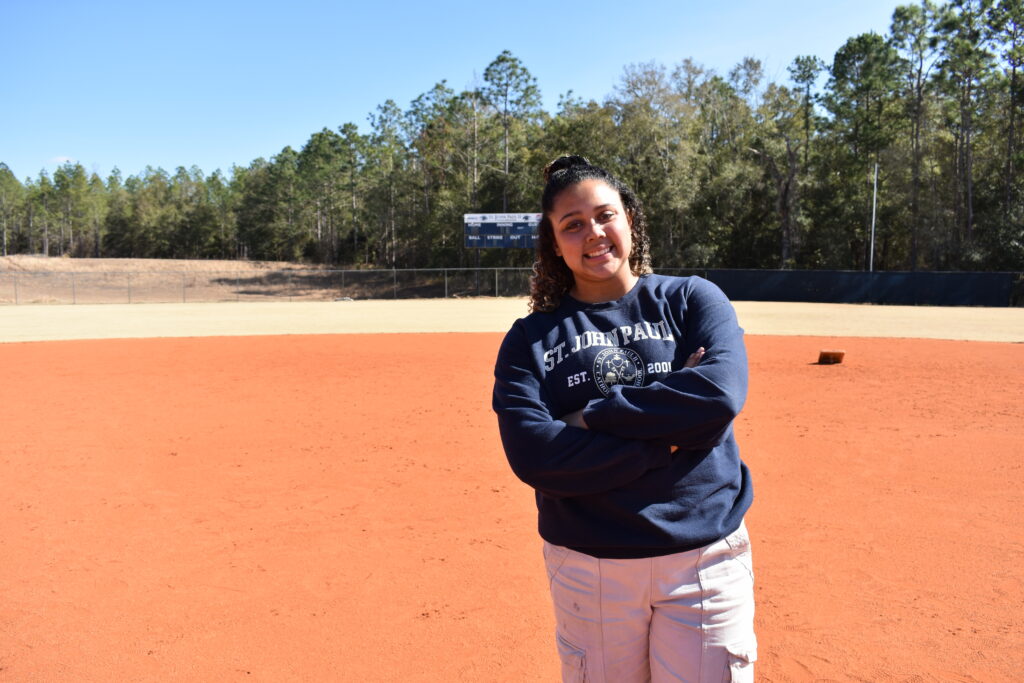
At midnight on Sept. 1 of her junior year – the first day college coaches can contact 11th graders – Amanda received a phone call from the Harvard softball coach.
“I didn’t even know they had a softball program,” Amanda said.
Intrigued, Amanda accepted a recruiting visit to the university located just outside of Boston. That trip marked the end of her Duke dreams.
“I want to make a difference in this world, and I think Harvard is the perfect school for me,” she said.
Terrence Brown, JPII’s softball coach, has watched Amanda emerge as an Ivy League student and a Division I softball player good enough to attend Team USA tryouts and earn a spot on the national team of a small territory with Olympic ambitions.
“She’s goal-oriented, and she doesn’t let anything get in the way of achieving those goals,” he said. “She’s worked very hard to get to where she’s going.”
Ashley and James are proud parents, but Ashley said they won’t take too much credit for Amanda’s success.
“We have nothing but pride,” Ashley said. “She is self-driven, self-motivated. We try to provide motivation. She’s missed proms and dances because of softball travel and schoolwork, and that was all her decision.
“There are a lot of sacrifices made to go along with this. She’s not afraid of hard work. She says she’s going to do something, and she goes out and does it.”
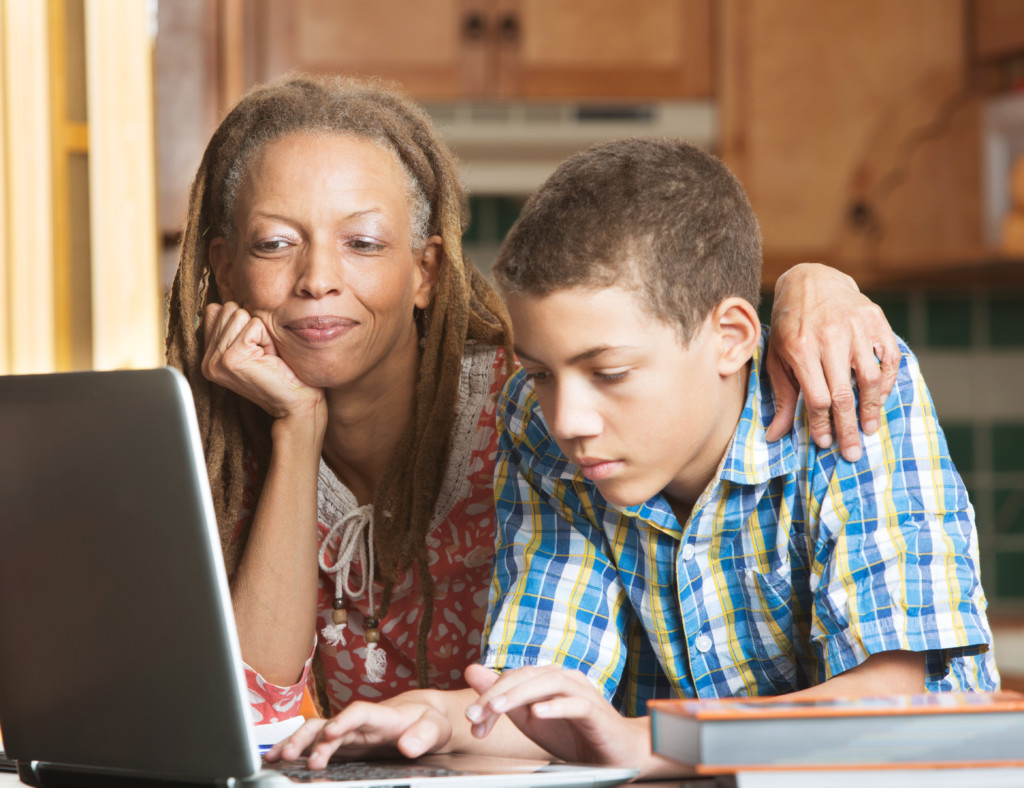 Homeschooling’s moment has arrived.
Surveys and media reports demonstrate a surge of interest in learning at home. Now is a critical time to consider how this once-marginalized option may hold answers to recurring questions about the roles played by generational poverty, access to human capital, and parent choice in education – and when it does not.
This spring, the pandemic left parents with only one option: to educate their children at home. COVID-19 gave 97 percent of K-12 students formerly in school buildings a unique opportunity to see what the other 3 percent were experiencing.
As if that wasn’t enough to get people’s attention, Harvard’s law school made the inexplicable decision to promote a conference that claimed “problems of educational deprivation and child maltreatment…too often occur under the guise of homeschooling.” The pandemic was a bad time to do many things that were otherwise unremarkable, such as getting on an airplane or buying toilet paper – or hosting a conference about why homeschooling is harmful for children. After criticism of the law school’s scheduled event poured in from traditional and social media, Harvard postponed the conference.
The ubiquity of students learning at home, paired with the collapse of an anti-homeschool conference at a high-profile institution, surely quickened the pulse of existing homeschoolers. A USA Today/Ipsos poll finding that nearly 60 percent of respondents are considering homeschooling in the fall was yet another signal of a seismic shift in the education landscape, even if uncertainty over the arrival of a COVID vaccine and school re-openings inspired some of the respondents.
If just a fraction of these families choose to homeschool, the number of homeschooling families would skyrocket. My Heritage Foundation colleague Dr. Lindsey Burke says that if the 60 percent figure dropped to just 6 percent, it would still double the number of children homeschooled in the U.S.
Amid all this excitement, take time to pause: Smaller adjustments may be more likely to last.
Years before the pandemic, NPR reported that more African-American families were choosing to homeschool, a previously under-represented demographic among homeschoolers. If we look closely, researchers said that the new entrants were more likely to be intact, married parents with significant motivations, such as safety-related issues in their child’s assigned school. These families had the same opportunity as many others, but more importantly, they had compelling reasons.
If these descriptions are accurate, where does that leave children in single-parent families, perhaps also living in poverty, and attending failing schools? Reports from areas such as these indicated that many students were not logging on to virtual instruction or accessing any learning content. A student’s motivation to learn at home is harder to measure than a parent’s desire to homeschool when a physical school may not re-open in the fall. Remember, the ability to homeschool exists in families regardless of income or social strata, but those with pressing incentives, such as safety, are more likely to persist.
For some, then, homeschooling will not be the answer now. As with any other learning option, parents should be able to choose the best situation for their child. When traditional homeschooling or assigned schools do not fit, parents need other choices regarding how and where their children learn – choices created by state and local policies – such as open enrollment in traditional schools in another district, charter schools, private school scholarships, and education savings accounts.
These options have been relegated to the sidelines for years as education interest group opposition has forced limited eligibility in the laws. New limits on charter schools in Los Angeles and Chicago, along with narrow eligibility in most private school choice options nationwide, demonstrate that union interests have convinced policymakers to allow parent choice in education to separate families into haves and have nots: Those that have opportunity and those that do not.
No parent or student should feel trapped because assigned schools are closed or because no other options are available. The spotlight on homeschooling suggests more families see potential here for their student. But to prevent scenarios in which parents and students are divided by the options available to them, those from the public and private sectors will need to create quality solutions for the rest.

