Editor's note: This guest post is from Jesse L. Jackson, superintendent of Lake Wales Charter Schools in Lake Wales, Fla.
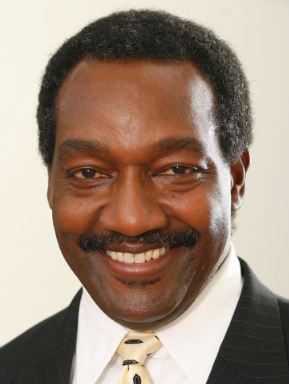
Superintendent Jackson
By early 2000, the once great tradition of outstanding local schools for Lake Wales’ citizens had reached a point of decline. It was at that time when concerned citizens, with the support of the Lake Wales Area Chamber of Commerce education committee, decided to do something to reverse that trend. What emerged was not only an accountability driven charter school system, but, unexpectedly, the town’s biggest employer.
Since 2004, when five Lake Wales’ public schools were converted to public charter schools, and with the addition of Bok Academy charter school and the International Baccalaureate program to Lake Wales High School, a significant reversal has taken place in terms of quality and participation in our local schools. Many families that had previously decided to seek other opportunities to educate their children outside Lake Wales have found favor in our system, which now serves approximately 4,000 students. While the majority live in Lake Wales, many come from surrounding towns. Lake Wales Charter Schools pioneers such as Robin Gibson, Clint Horne, David Ullman and many others could feel quite satisfied when reflecting on the impact of their effort.
However, when the details are analyzed, it becomes quite clear the system offers more than just a great education for this community. The mere shift of the schools’ management from district headquarters in Bartow to Lake Wales has profoundly impacted Lake Wales’ economy.
Our principals are chief executive officers. They have the autonomy and responsibility to make decisions regarding the most effective way to run their schools, including financial matters. With each school’s annual budget ranging from roughly $2.5 million to $6 million, managing the operations of our charter schools is a huge responsibility. The autonomy provides our principals the freedom to make decisions regarding their engagement with businesses. Along with this freedom, they and other members of our leadership team have the responsibility and are compelled to adhere to the strictest finance and accounting principles to ensure our system’s finances are managed properly.
Our success as an effective school system has enabled us to evolve into a locally based multi-million dollar enterprise with an annual budget of more than $30 million. (more…)
Graduation requirements. Gov. Rick Scott signs into law the bill that creates additional diploma options that emphasize career education. Coverage from Tampa Bay Times, Orlando Sentinel, Associated Press, News Service of Florida, Northwest Florida Daily News, Tallahassee Democrat, Sarasota Herald Tribune, StateImpact Florida, WFSU.
 Magnet schools. Parents are pushing the Palm Beach County school district to expand a popular arts magnet. Palm Beach Post.
IB. Largo High in Pinellas gets official certification for its IB program. Tampa Bay Times.
Students with disabilities. StateImpact Florida writes up the bill that would give parents more power over their child's IEP. Some experts say the Hillsborough school district is unique in not allowing parents to make an audio recording of IEP meetings, reports the Tampa Bay Times.
Teacher pay. Palm Beach County teachers and district official remain skeptical about potential raises coming from the state, reports the Palm Beach Post. Gov. Scott says he's going to the mat for his proposal for across-the-board raises, reports the Tampa Tribune.
Teacher evals. Hernando Teacher of the Year highlights flaws in the new system. Tampa Bay Times. (more…)
Frank
When people hear the term “school choice,” they usually don't think about it in a traditional public school setting, said Joy Frank, general counsel for the Florida Association of District School Superintendents. But public school districts offer students a growing array of choice programs, too, from online classes to career academies to International Baccalaureate programs.
“We have embraced choice,” Frank told members of the Florida House Choice & Innovation Subcommittee during its first meeting this week.
Frank’s comments are another sign of evolving perceptions regarding parental school choice. She and others who are grounded in the traditional public school camp may not embrace publicly funded private options such as vouchers and tax credit scholarships. But it wasn’t long ago that even public options such as IB and magnet schools were considered controversial. Implicit in her remarks is an acknowledgement that giving parents more choice for their children is a worthy goal.
Frank went on to tout public school choice programs across the state, including Polk County’s Central Florida Aerospace Academy, which has a high school at the Lakeland Regional Airport. She also lauded the phenomenal growth of school choice in Miami-Dade County, which opened its first magnet school in 1973 and now offers some 340 choice programs serving 43,000 students. (Coincidentally or not, the Miami-Dade school district also has among the highest rates of students enrolled in charter schools and private schools via tax credit scholarships.)
Traditional school leaders in Florida are increasingly making similar statements. (more…)
Hillsborough school district must fix its problems with special education students in the wake of a student’s death, editorializes the Tampa Bay Times. It suggests an outside inquiry would be more appropriate and says of Superintendent MaryEllen Elia, “If there are larger problems with the special needs program, Elia needs to address those too. The review board she empaneled is full of insiders who hardly have an interest in exposing training or operational policies as deficient. Both clearly are.”

Podesta
Podesta to headline Jeb conference. John Podesta, former chief of staff under President Clinton, will be the keynote speaker Nov. 27 at the fifth annual national conference put on by Jeb Bush’s Foundation for Excellence in Education. He chairs the Center for American Progress, widely considered to be a progressive think tank.
Charter school performance. University of Central Florida professor Stanley Smith says his analysis shows charter performance as a whole isn’t so hot compared to district schools, reports StateImpact Florida.
Much anticipated charter in Palm Beach County. After parents clamored for it, construction is set to begin, reports the Palm Beach Post.
Charter dispute in Polk County. The school district and the charter schools in Lake Wales are tussling over student records and recruitment for IB, reports The Ledger.
Florida DOE makes changes to contracting procedures after problems surface in the Division of Blind Services. Tampa Bay Times.

Sen. Simmons
Big payout to charter school principal. The principal of a failed charter school gets a $519,453 check from the school’s board, reports the Orlando Sentinel, prompting outrage from Orange County school district officials and a call for an investigation from state Sen. David Simmons: “There's no room for abuse by charter or traditional schools," Simmons, a strong supporter of school choice, told the paper. "All it does is hurt children."
Lax oversight of charter school funding. An audit finds the U.S. Department of Education did not properly monitor how states were spending hundreds of millions of federal dollars for charter schools, reports the Associated Press. The audit also looked at charter funding oversight in Florida, California and Arizona. In Florida, according to the story, “state officials had no records of which schools received federal grant money nor which schools received on-site monitoring and audits.”
Charters, IB and a level playing field. The charter school system in Lake Wales complains the Polk County school district isn’t playing fair in recruiting students to the district’s IB programs, reports The Ledger.
Tax credit scholarships helping private schools. Growth in Florida’s tax credit scholarship program is giving private schools a boost, reports the Daytona Beach News-Journal.
Teacher who likes Mitt Romney. StateImpact Florida interview here.
Lesson from Miami-Dade. In winning the Broad Prize, the Miami-Dade school district showed “poverty does not have to be an obstacle to success,” editorializes the Miami Herald.
Pick up the pace. Florida needs to put even more focus on education and accelerate improvement, editorializes the Fort Myers News Press.
A closer look. Pinellas Superintendent Mike Grego says the district’s state-directed teacher evaluation system, which has caused widespread frustration, needs a review, reports the Tampa Bay Times.
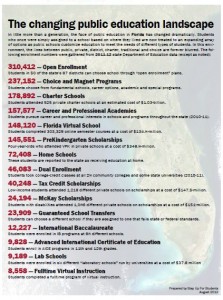 Though we know little about the parents who long have chosen their school through where they decide to live (or to pretend to live), Florida keeps count of those who no longer want their neighborhood school. And here's some data to chew on: In a state known for its breadth of learning options, that number last school year reached 1.2 million.
In other words, using a conservative approach with new 2011-12 enrollment records, 43 of every 100 students in Florida public education opted for something other than their zoned school.
This number is produced largely from state Department of Education surveys required of the 67 school districts and reflects, not surprisingly, surging growth for choice options. Though total public school enrollment grew by only 1 percent last year, reaching 2.7 million, charters grew by almost 16 percent, online by 21 percent, private scholarships for poor children by 17 percent. (See an enrollment compilation of 2011-12 options here.)
Granted, Florida is not like most other states in this regard. A combination of educational, budgetary and political factors, including the gubernatorial tenure of Jeb Bush, has put the Sunshine State on an accelerated path of parental empowerment. That said, it is a diverse, highly populous state with national political significance, and this kind of transformation is central to the new definition of public education.
The national education debate is still absorbed by adults who grew up with a pupil assignment plan built almost entirely on geography. Many of them went to the same schools as their parents and even their grandparents, and it’s natural they would define public education that way. That may help explain why parent activists or groups such as the PTA continue to oblige the teacher unions that pressure them to resist laws giving parents more options. The union message – that traditional public schools are endangered – plays to the parents’ natural fears.
That’s why these numbers are worthy of pause. (more…)
Editor’s note: Doug Tuthill responds today to a post I wrote yesterday about the failure of school districts and teachers unions to enact meaningful differential pay plans for teachers – and how that’s indicative of a bigger failure to help low-income students.
Ron, you raised some excellent points in your blog post about the unwillingness of the Pinellas County, Fla. school district to provide each student with equal access to a quality education. For nine years, I received supplemental pay to work in a magnet program that served the district’s academic elite, and for 11 years I was a leader in the local teachers union, which was complicit in the district’s refusal to provide equal opportunity. So your criticisms stung, but they were accurate.
This may be self-serving, but I’m convinced the cause of this leadership failure is not bad people, but an organizational structure and culture that favors the politically strong over the politically weak.
Growing up in Pinellas, I attended segregated public schools. When the federal courts finally forced the school district to desegregate, the focus was on ratios and not learning. The district closed most of the black neighborhood schools and bused those children to schools in the white neighborhoods because busing white students into black neighborhoods was too politically difficult. But white flight meant some forced busing of white students was necessary, so the district created a rotation system that bused low-income/working class white students every two years to schools where the black population approached 30 percent. (The court order said no Pinellas school could be more than 30 percent black.)
While working-class white neighborhoods lacked the political clout to prevent their children from being bused every two years, their protests were loud enough to force the school board to look for alternatives. In the early 1980s, the district started creating magnet programs to entice white families to voluntarily attend schools that were in danger of exceeding the 30 percent threshold.
These magnet programs were designed to provide white students with a superior education. Class sizes were small, textbook and materials budgets seemed unlimited, professional development opportunities were extraordinary and special pay supplements to attract the best teachers were impressive. In my case, when I quit my job as a college professor to teach in the International Baccalaureate (IB) at St. Petersburg High School (SPHS), my annual salary increased 28 percent.
The magnet strategy worked - especially the IB program. Affluent white families began voluntarily busing their children to attend our program, and in many cases students got on buses at 5 a.m. and rode over 50 miles per day to attend.
Unfortunately, desegregation via magnet schools increased the resource inequities that desegregation was suppose to reduce. (more…)
Bruce Baker at School Finance 101 offered a calibrated analysis Tuesday on how neighborhood and charter schools differ in the public education arena, but his distinctions miss the larger point. The current expansion of K-12 educational options cuts across all the traditional boundaries in ways that make public and private less relevant.
Take his assertion that charter schools are “limited public access.” Two of his supporting claims are that “they can define the number of enrollment slots they wish to make available” and that “they can set academic, behavior and cultural standards that promote exclusion of students via attrition.” In truth, these two descriptions could just as easily apply to many, if not most, district-operated public schools. All schools, including virtual schools, generally base enrollment on capacity, which has the effect of allowing some students in while excluding others. Of greater relevance is that many district schools now admit students based on test scores or other screening factors. Magnet schools and programs such as International Baccalaureate typically use grades and test scores and conduct to determine eligibility. Many district choice schools, notably the back-to-basics fundamental programs, remove students who don’t meet behavior standards or whose parents fail to meet participation requirements.
While individual district schools may select and reject students, Dr. Baker is right that a public school district must generally take all comers at any time of the year. But it is also true that parents in charter schools can simply leave whenever they are dissatisfied, a powerful tool that is not typically available to them in their assigned district school. Further, his failure to note the similarities in admission policies between many charter and individual district schools ignores the extent to which this remarkable transformation is blurring the lines between public and private. After all, a waiting list for a magnet school is no less disappointing to an eager parent than one for a charter school. Not surprisingly, a recent academic report on low-income students who choose the Florida Tax Credit Scholarship found that students in districts with few district school options were more likely to choose the non-district option.
Sherman Dorn, himself an astute academician who is a professor of education at the University of South Florida, reacted to Baker's post by placing the common school in historical context. Dorn correctly asserts that charter schools and vouchers and tax credit scholarships have “chipped away at the multi-level meaning of ‘public’ that had mostly consolidated by the end of the 19th century.” But this is nothing to rue. It speaks to an educational evolution that is strengthening public education by recognizing parents indeed have unique insights into which learning environments work best for their children.
In this emerging world of educational choice, parents simply want a school that turns on the light for their children. In that most personal of calculations, school governance is unlikely a significant factor.
Some of us at redefinED will be at the American Federation for Children summit tomorrow and Friday, where there will be lots of discussion about school choice and education reform. As good a time as any, we thought, to offer a snapshot of where Florida stands. Check out these numbers, which Doug Tuthill, the president of Step Up for Students and a redefinED host, shared last week with business leaders at a Leadership Florida event:
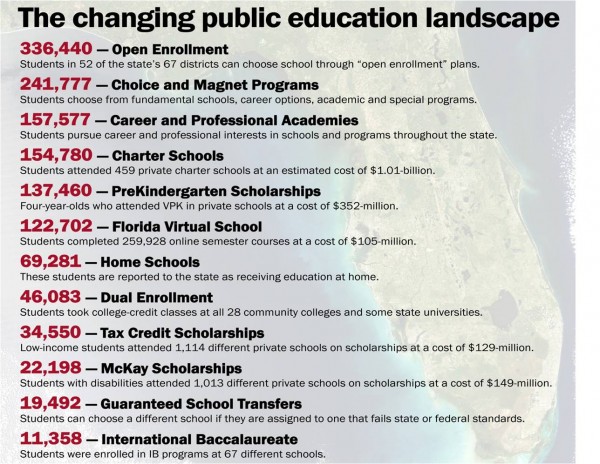
The numbers (carefully compiled by Jon East, vice president for policy & public affairs at Step Up) are from 2010-11 and we know in many cases the current figures are even higher. Charter school enrollment, for example, topped 175,000 this year, and the tax credit scholarship program serves more than 39,000 students. Altogether, the numbers underscore two things we emphasize at redefinED: School choice - the kind that allows parents to go beyond their neighborhood school - is becoming mainstream in Florida. And the lines between "public" and "private" are more blurred here than in any other state.
The AFC conference agenda includes Louisiana Gov. Bobby Jindal, New Jersey Gov. Chris Christie, Newark Mayor Cory Booker and an all-star line up of choice experts and advocates. We're hoping to have a little time to update you on what's going on with blog posts and tweets. For the latter, follow us at @redefinEDonline.
RedefinED editor Adam Emerson’s blog entry on Tuesday about the importance of teacher ownership reminded me of an experience that has informed my approach to improving education for the last three decades.
In 1983, I moved back to St. Petersburg, Fla., to help start an International Baccalaureate (IB) program at St. Petersburg High School (SPHS). I bought a small house in a transitional neighborhood near downtown and began meeting my new neighbors. After a few months I noticed a pattern. About half my neighbors owned their homes. The other half was mostly renters. When I took friends through the neighborhood they could accurately identify which homes were occupied by renters and owners. It was obvious because the owners, with few exceptions, did a better job taking care of their property.
I observed a similar pattern when I walked the halls of SPHS and met my new colleagues. The faculty was comprised of "owners" and "renters." The owners were hard working, conscientious, and passionate about teaching, while the renters were just going through the motions. Most teachers go into education with a sense of ownership and passion about teaching, but large school districts often crush this passion and turn many teachers into renters. At SPHS, the renters included younger teachers who wanted to leave but couldn’t find another job as well as burned-out veterans who were not yet eligible for retirement benefits and were running out the clock.
I decided public education needed to be transformed so that more teachers and students owned their work. I also concluded that how a reform is implemented is as important as the initiative itself. A brilliantly designed merit-pay plan, for instance, will fail if teachers don’t own it.
Failure to understand the power of ownership has undermined many of the education improvements I’ve worked on over the last 33 years, and education reformers today continue to repeat this mistake. Too often we erroneously assume that getting input from a small group of teachers or inserting a provision in a collective bargaining agreement means we’ve got teacher buy-in.
I support well-regulated school choice programs because they tend to foster greater teacher, student and parent empowerment and ownership. Empowerment and ownership are not panaceas, but sustainable improvements in teaching and learning are impossible without them.

