 Zika rules: Broward County school officials are considering changing district policy to fight the spread of the Zika virus. Under the emergency rules, students would be permitted to bring certain insect repellent wipes and lotions to school. The school board will vote on the measure Sept. 7. Sun-Sentinel.
Retention venue: The state and six school districts being sued over the state's third-grade retention policies have until 3 p.m. today to file arguments to the First District Court of Appeal for a change of venue. The defendants want the case to be decided locally, not in Leon County. Leon Judge Karen Gievers has presided over two hearings, and is expected to rule soon. The parents who brought the suit are arguing that whether a student passes or takes the state test should not be the primary criteria for promotion to the fourth grade. Gradebook.
Corporal punishment: More than 109,000 U.S. students were physically punished at school in 2013-14, according to an Education Week Research Center analysis of federal civil rights data. Twenty-one states, including Florida, still allow corporal punishment. About 2 percent of Florida's students attend a school that uses physical punishment. Education Week. WTSP and the Associated Press.
Pledge form: Florida Department of Education officials say the Leon County School District went "above and beyond" the legal requirements to notify students that they can opt out of saying the Pledge of Allegiance at school. Tallahassee Democrat.
Closed captioning: The Florida Department of Education will begin offering closed captioning on the Florida Standards Assessments language arts tests for deaf and hard-of-hearing students. starting with the make-up exams in October. Orlando Sentinel. (more…)
While charter schools have proliferated in Florida, nearly a third of of the state's school districts, most of them rural, don't have one — a fact that got attention from members of a state House panel discussing charter school legislation.
State Rep. Dennis Baxley, R-Ocala, wanted to know whether home education and virtual schools were more popular with parents who had fewer charter schools available (maps of state data support this idea in some places; in others it's less clear).
Since districts without charters tend to be rural, parents looking for other options could face a long drive to a neighboring county, said state Rep. Janet Adkins, R-Fernandina Beach. She wanted to know if the state could use one of its grant programs to lure charter schools to communities where none exist.
“We’ve got 22 counties that don’t have their first charter school," she said, and then asked "if there's a way that we tailor something for those counties... so that we can incentivize and grow choice in counties where there is none." (more…)
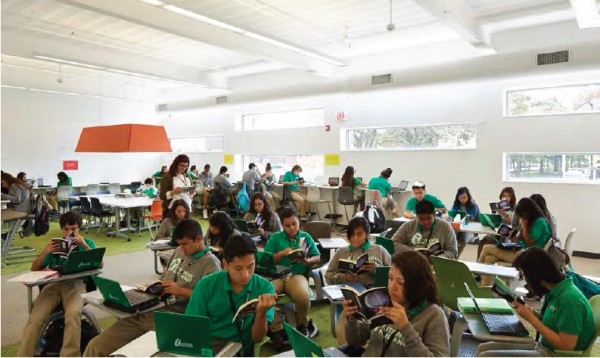
A picture from Chicago's Intrinsic Schools, from a blended-learning presentation given to a state House panel. Do regulations bar Florida schools from building a classroom like this?
Blended learning is beginning to change the way schools are run, and even the way they're built. But Florida schools may be hamstrung by building codes, class-size penalties and outdated teacher-preparation programs, members of a state House panel said Thursday.
"I think our role is to get the roadblocks out of the way," said Rep. Manny Diaz, R-Hialeah, who chairs the House education panel on school choice and innovation.
The panel heard from Michael Horn of Clayton Christensen Institute, who has studied blended learning around the country. He told the panel via Skype that combining virtual education with in-person instruction can allow students to learn at their own pace, and give educators more flexibility.
School buildings designed with blended learning in mind often include open floor plans that cost less to build, slash energy costs and create more engaging learning environments, Horn said. They also lend themselves to different staffing models. In some cases, he said, teachers eschew traditional classes and work together in teams, allowing experienced "master teachers" to work with larger numbers of students. (more…)
Florida's charter schools have complained for years that funding to pay for their school buildings is not guaranteed. That would change under a plan approved by a state House panel on Thursday.
The proposal, added to a larger charter school bill, would create a funding backstop. Each year, if the Legislature didn't fund the state's charter school capital outlay at a certain level per student, charters would receive a share of local construction funding from school districts' property taxes.
The bill, HB 7037, passed the House Education Committee with bipartisan support. Several members who supported the overall package said they had concerns about potentially requiring districts to share local construction money with charters. Districts face "too many unfunded mandates," said Rep. Joe Geller, D-Aventura, and some struggle to pay for their own building needs.
Charter school advocates said the measure is needed. Jim Horne, a former state education commissioner and lobbyist for several charter school and business groups, said the shortage of construction money is a big reason for the funding gap between charters and traditional schools.
Right now, charters school facilities funding depends on annual appropriations by the Legislature. The House's plan would give them guaranteed funding per student based on a fraction of the state's estimated cost of school construction, which would be drawn from whatever the Legislature appropriates, and topped off with local property tax revenue.
Some of Florida's top policymakers have for the past few years been looking for ways to attract more high-performing charter school operators to the state's inner cities. But apart from KIPP Jacksonville and a few newcomers like the SEED School of Miami, they have few high-profile efforts to point to. And attempts to change state law to help recruit well-regarded operators have faltered in the Legislature.
Rep. Adkins
Now one of the top state lawmakers on education policy, Rep. Janet Adkins, R-Fernandina Beach, says she wants lawmakers to try a different approach next year.
The state creates special provisions for charter schools designated "high-performing." Why not do something similar for charters that want to open in "high-needs" areas, helping them with issues from accountability to financing for their buildings?
"We need to have a whole new set of criteria," said Adkins, who currently chairs the House subcommittee dealing with K-12 policy. "I'm envisioning a whole new set of statutes dealing with high needs."
The idea came up during a recent gathering of charter school and district officials in Fort Lauderdale. Richard Moreno, who works with organizations that provide financing and other business services to charter schools, said one major barrier keeping organizations like KIPP and Uncommon Schools from Florida is the state's stringent "double-F" rule.
State law requires most charter schools that earn F's two years in a row to close. As a result, Moreno said, philanthropists and well-known charter organizations run a risk that they could sink resources into an area with high need, only to see their school shut down a few years later. "They're not touching Florida because of this," he said.
Adkins said she wants the state to emphasize learning gains when holding these new high-needs schools accountable so they aren't penalized for taking on low-proficiency students and/or ensnared by the double F rule. But right now, she said, proposals are in the "idea stage" and details would still need to be worked out.
Robert Runcie, the schools superintendent in Broward County, said he could envision school districts and other community groups vetting competing proposals from charter operators looking to move into struggling schools, creating "a very structured way of bringing a high-quality solution into a community." (more…)
School choice legislation that would expand eligibility for the country's largest tax credit scholarship program and create new personal learning accounts for special needs students is ready for a final vote in the Florida House.
Lawmakers on Wednesday removed a $30 million increase on the caps that limit the growth of the tax-credit scholarship program, though the state's current law would still allow the program to grow by as much as 25 percent a year.
Rep. Erik Fresen
The change did little to tamp opposition among House Democrats.
They proposed a series of contentious changes during nearly two hours of floor discussion on Wednesday, including a proposed requirement that schools participating in the tax credit scholarship program administer state's standardized tests. The Democrats' amendments were defeated, largely along party lines.
Rep. Matt Gaetz, R-Fort Walton Beach, broke with his fellow Republicans to vote in favor of the testing requirement, which also would have required schools with scholarship students to participate in the state's A-F grading system for schools. His father, Don Gaetz, is the Senate President, and has called for requiring state assessments for scholarship students, an idea that remains controversial among some school choice supporters.
The House voted down other Democratic proposals, which among other things would have required private schools with scholarship students to hire state-certified teachers, mandated that they teach the state's education standards and restricted the way scholarship funding organizations that administer the program can use their revenue. Step Up for Students, which co-hosts this blog, is a scholarship funding organization.
Requiring state standards in private schools "would ensure private schools are going to be accepting public money, that they do something similar to the public schools and reach the same standards that we have for those schools," said Rep. Richard Stark, D-Weston.
Rep. Janet Adkins, R-Fernandina Beach, said parents chose private schools for a host of reasons, including the kind of learning environment they offer.
While the full House could approve the school choice bill as early as Friday, the Senate has so far taken a different approach to school choice legislation after withdrawing its original tax credit scholarship bill from consideration earlier in the session.
Florida is one of seven states where lawmakers this year have considered creating education savings accounts for special-needs students, and competing proposals have gained traction in both chambers.
"It allows incredibly more flexibility to the parents' use for specific services that they know their child needs," he said.
Additional coverage: Post on Politics, Central Florida Political Pulse, Associated Press, Tampa Bay Times.
Can giving low-income families more access to private schools spur the growth of more school choice options in the public school system?
The question came up during the most recent debate over legislation that would accelerate the growth of Florida's tax credit scholarship program. Rep. Janet Adkins, R-Fernandina Beach, asked whether the bill could help spur "school boards and school districts to create more options for magnet schools."
Pointing to the growth of magnet programs and other public school choices in his hometown, the chair of the House Education Appropriations panel, Rep. Erik Fresen, R-Miami, said he believed it could.
"I don't think it's a coincidence that the explosion of magnet schools and of schools of choice within the public school system happened at the exact same time that options outside of the conventional public school system were happening,” he said.
The New York Times recently highlighted the growth of Miami-Dade's magnet programs in a story about the revitalization of magnet programs in urban districts around the country. Originally conceived as a way to increase demographic diversity in the era of racial integration, the Times observed magnet programs have seen renewed growth "as traditional public schools come under increasing pressure from charter schools and vouchers for private schools."
The number of children in Miami-Dade County attending magnet programs — which admit students from anywhere in the district and focus on themes like art, law or technology — has grown by 35 percent in the past four years. These children now account for about one in six students in the district.
The pattern is similar across the country. There are now about 2.8 million students attending magnet schools — more than the nearly 2.6 million enrolled in charter schools, which are publicly funded but privately operated.
"That’s what we’ve always theorized from the moment that we started talking about choice and choice options was that, not only would it lift all ships," Fresen said, but it would also spur school districts to create new programs "to meet different needs of students."
"I do think that the more that you expand choice options outside of the conventional public school system, the more the conventional public school system will innovate itself, and start responding to those demands and those changes,” he said. (more…)
 Editor's note: Another year, another legislative session, another stack of school-choice bills in Florida. Here's a roundup of choice legislation that lawmakers will consider in the annual session that begins today.
Career Academies:
SB 1076 by Sen. John Legg, R-Lutz. Expands the "Career and Professional Education Act (CAPE)," revising requirements for high school graduation and accelerated high school graduation, and allowing students to earn and substitute certain industry certifications for certain course credits. Also requires districts to make digital materials available to students and to use the Postsecondary Industry Certification Funding List in determining annual performance funding distributions to school districts and Florida College System institutions, etc.
Charter Schools:
HB 373 by Rep. Joe Saunders, D-Orlando. Provides that a contract for a charter school employee or service provider may not extend beyond the school’s charter contract, and that the employee or service provider is not entitled to compensation after the school’s closure. (Identical to SB 780 by Sen. Geraldine Thompson, D-Orlando.)
HB 453 by Rep. Victor Torres, D-Orlando. Requires the compensation and salary schedules for charter school employees to be based on school district schedules. (Identical to SB 784- Charter Schools by Sen. Geraldine Thompson, D-Orlando.)
SB 744 by Sen. David Simmons, R-Altamonte Springs. Requires charter school applications to demonstrate the applicant is financially qualified to open and maintain a high-quality charter school, requires the charter to set forth detailed reporting of the financial operations of the school to ensure employees are not paid unreasonable compensation, and requires that the term of the charter must provide for cancellation of the charter if the school becomes insolvent, fails to provide a quality education, or does not comply with applicable law. The bill also clarifies that a charter school system shall be designated a LEA solely for the purpose of receiving federal funds if certain criteria are met.
SB 828 by Sen. Rene Garcia, R-Hialeah. Grants school districts the ad valorem tax exemption given to charter schools, and restricts the use of capital outlay funds for property improvements if the property is exempt from ad valorem taxes. It restricts charter schools or technical career centers having financial problems from certain activities, and grants flexibility to high-performing school choice districts.
HB 1001 by Rep. Karen Castor Dentel, D-Maitland. Prohibits charter schools from requiring, soliciting, or accepting certain student information before student's enrollment or attendance. Also requires charter schools to submit attendance plans to the school district for students enrolled in school; provide funding to the school district in event of student transfers; and report to the school district certain student enrollment and wait-list information.
SB 1092 by Sen. Geraldine Thompson, D-Orlando. Requires charter school to submit attendance information for each student to the school district, and requires the charter school to provide a prorated portion of per-student funding to the school district if a student transfers to another public school in the school district before the last day of the school year.
SB 1164 by Sen. Kelli Stargel, R-Lakeland. Revises the eligibility criteria for extracurricular activities to include students in charter schools, and revises the criteria for bylaws, policies, or guidelines adopted by the Florida High School Athletic Association. (Compare to HB 1279 by Rep. Larry Metz, R-Groveland.) (more…)
Tutoring oversight. In the first part of a two-part series on a requirement initially mandated by No Child Left Behind, a Tampa Bay Times investigation finds at least 36 of 456 tutoring companies in Florida are headed by people with criminal records. In part two, the Times traces last year's last-minute legislative push to keep the mandate in place.
Educator oversight. Sarasota Herald Tribune: "As Bradenton police investigate allegations that a Manatee High School assistant football coach groped a female student, they are also trying to determine who knew about the girl's claims and why no one notified law enforcement as required by law."
Teacher bashing? A StateImpact Florida story headlined "Teachers Question Why Proposed Pay Raises Come Before Teacher Evaluations" quotes a single teacher who says, “For a while now we’ve been hearing how bad we are. [That] we need to weed out bad teachers, there’s so many bad teachers.” Ocala Star Banner editorial page editor Brad Rogers writes in this column: "There are so many wildly talented, caring and dedicated teachers in Marion County’s schools that unfairly take abuse and blame and criticism for what is wrong with our schools and our society, when in truth they represent what is most right and bright and promising about our schools and our society."
Teacher pay. Sen. Bill Galvano, chair of the Senate Education Appropriations Committee, suggests Gov. Rick Scott's proposal for across-the-board raises clashes with performance pay, reports the Florida Current. The South Florida Sun Sentinel also writes up the debate over proposals for higher teacher pay.
Strange bedfellows. The Florida Education Association plans to join the Florida Department of Education in fighting the Florida Times-Union's request for teacher evaluation data.
Tony Bennett. He talks to North Florida superintendents about teacher evals and notes he encouraged his daughter to become a teacher: "“I don’t want it written on my headstone: ‘Here lies the man that ruined the career his daughter chose.’ ” Tallahassee Democrat.
Teachers unions. The United Teachers of Dade will elect a new leader this week. Miami Herald. (more…)
Florida House Speaker Will Weatherford announced committee assignments today (hat tip: News Service of Florida.) Here is who will serve as chairs and vice chairs of the education committees, including the new subcommittee on school choice and innovation:
Education Committee: Chair, Marlene O'Toole, R-Lady Lake. Vice Chair, Elizabeth Porter, R-Lake City.
Education Appropriations Subcommittee: Chair, Erik Fresen, R-Miami. Vice Chair, Marlene O'Toole, R-Lady Lake.
Choice and Innovation Subcommittee: Chair, Michael Bileca, R-West Miami. Vice Chair, George Moraitis, R-Fort Lauderdale.
K-12 Subcommittee: Chair, Janet Adkins, R-Fernandina Beach. Vice Chair, Ronald Renuart, R-Ponte Vedra Beach.
Higher Education and Workforce Subcommittee: Chair, Jeanette Nunez, R-Miami. Vice Chair, Jason Brodeur, R-Sanford.
To see all members by committee, click here.

