KIPP Jacksonville became Florida's first successful attempt to lure a nationally recognized charter school organization thanks, in large part, to local benefactors.
Jacksonville Greyhound Racing donated a dog track, and the charter organization gradually converted the clubhouse into classrooms. Wealthy board members helped fund the renovation, and today they're financing a second building at far below the market rate. The small collection of schools enrolls close to 1,000 students and is still growing, adding as many as 200 a year. It has 1,400 children on its waiting list.
But the largess of its wealthy donors is running thin. And it's out of dog tracks to renovate.
On Wednesday, Tom Majdanics, KIPP Jacksonville's executive director, told state lawmakers he hopes the national charter school organization can bring "sibling" schools to more Florida cities. For that to happen, they'll need to address the barrier his schools already butt up against: A shortage of funding for charter school facilities.
While lawmakers have increased funding for public schools in recent years, Florida remains ranked near the bottom for per-student spending. Combine that with eroding facilities funds, and the state may start to look inhospitable to national charter school organizations with a reputation for getting results in underserved communities. State officials have long sought to attract more of them.
This graph, prepared for Wednesday's Senate Education Appropriations Subcommittee meeting by the state Department of Education, illustrates what Majdanics described as a key problem.
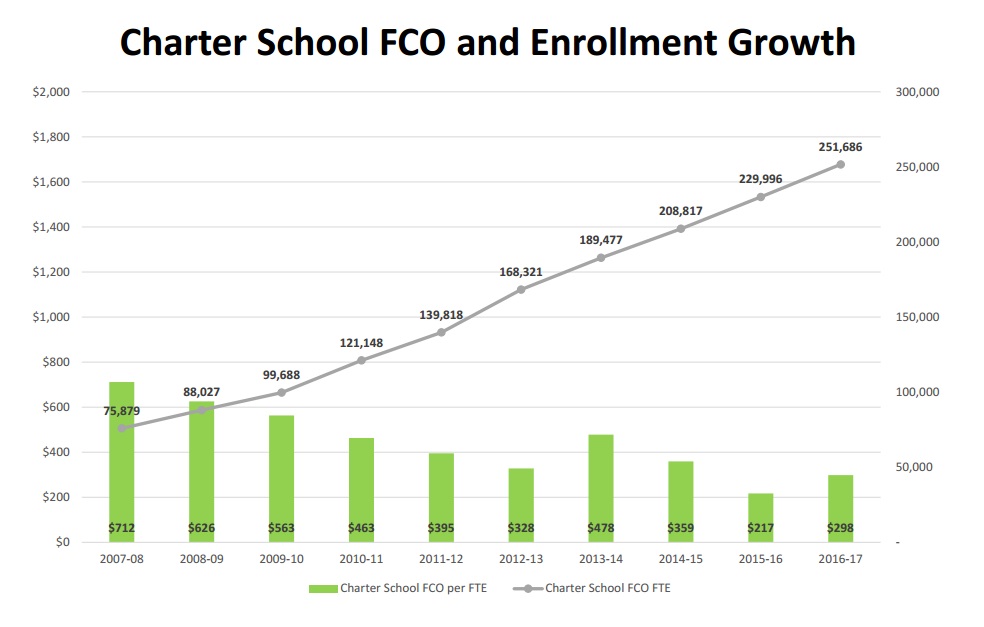
Charter schools rely on an annual appropriations from the state Legislature. That funding has fluctuated between $50 million and $100 million in recent years. But Florida's charter schools enroll more students each year. That means the same pool of money is being spread across more students and schools. Majdanics told the panel that the roughly $300 per student KIPP Jacksonville receives from the state "barely covers the interest on our loans" for capital expenses.
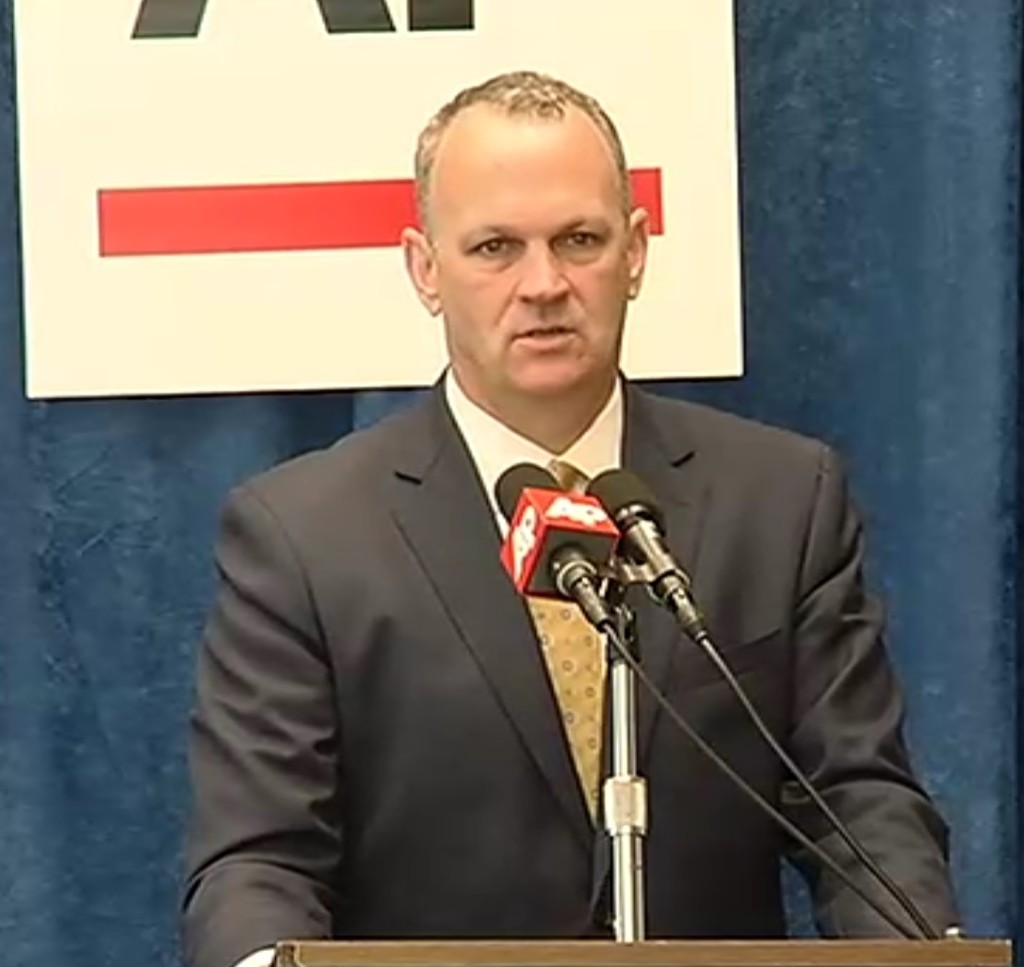
Florida House Speaker Richard Corcoran addresses reporters during a media briefing ahead of the Spring legislative session.
Florida's High-poverty urban areas shouldn't have to rely on wealthy backers to attract top charter schools, the state's House speaker told reporters this morning.
If the state wants more charters with national reputations for serving low-income students, he said, policies will need to change.
Speaking at an annual media briefing hosted by the Associated Press, Rep. Richard Corcoran, R-Land O' Lakes, lamented the fact that Florida has a lone collection of KIPP schools in Jacksonville and a single public charter boarding school — SEED Miami.
Both institutions receive annual line-item appropriations from the Legislature. The funding is intended to cover the cost of the extra instructional time needed to help low-income students catch up academically. But that funding doesn't cover all of their costs. (more…)
For its first hearing of the year, the Florida House's Education Committee heard from leaders of several out-of-state charter school networks. The theme, according to Mike Bileca, R-Miami and chair of the committee, was "schools that have taken excellence and scaled."
Florida education officials have pushed for years to bring more nationally well-regarded charter schools to the state. Bileca has long supported those efforts.
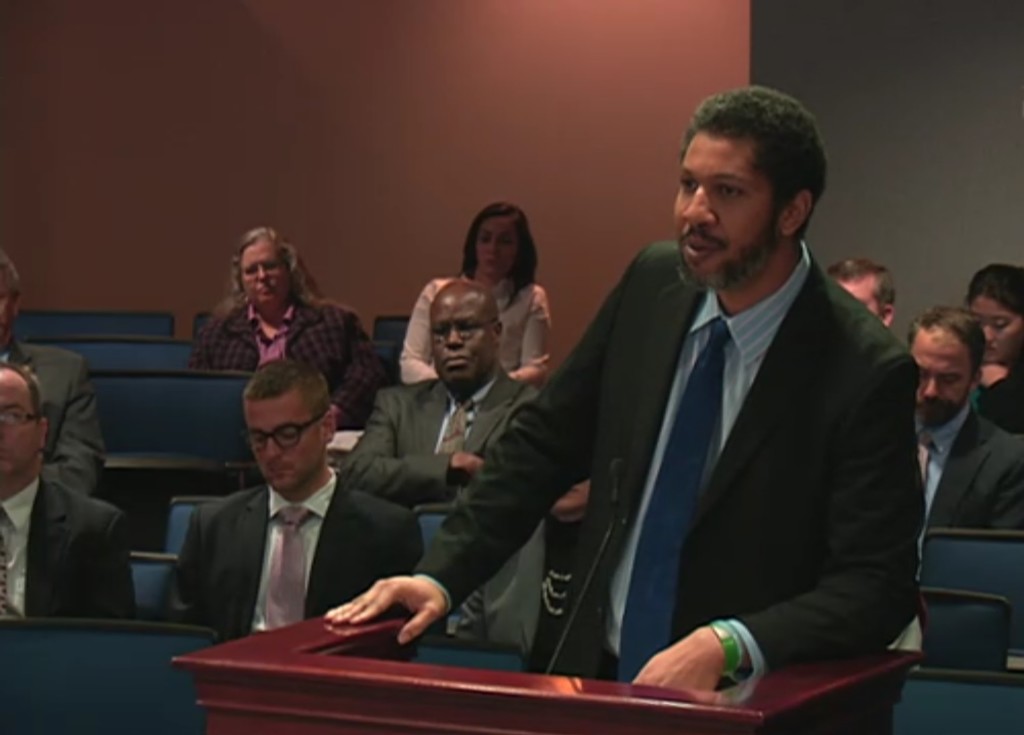
KIPP Foundation executive Quentin Vance addresses the Florida House Education Committee.
Quentin Vance, an executive at the KIPP Foundation, pushed back against the idea that there's "a trade-off between charter schools and public schools, and this is a competition." His organization, one of the largest charter operators in the country, has started a network of schools in Jacksonville, and is now in the early stages of a formal collaboration with the Duval County school district there.
An excerpt from his comments is below, lightly edited for length and clarity.
Nationally, what we've seen in growing schools in so many different cities across the country is that when there is increased choice for kids, where families can become consumers and the only metric of deciding where they want to go to school is what's going to be best for their kids it creates an environment in which everyone gets better.
(more…)
Testing. The Florida House is poised to pass its overhaul of the state's testing and school accountability system. Associated Press. Gradebook. Scripps/Tribune. Florida's testing glitches weren't entirely caused by a cyberattack. PolitiFact Florida. A Sun-Sentinel columnist argues state tests should have a "paper trail."
Catholic schools. Catholic schools can and should do for 21st-century U.S. Latinos what they did for 19th-century Irish immigrants, William McGurn writes in the Wall Street Journal.
Arts. The Florida Times-Union lauds KIPP Jacksonville's top-rated middle school band.
Class size. Orlando Sentinel columnist Scott Maxwell castigates state lawmakers and critics of the state's class size limits.
Funding. The Florida House and Senate unveil competing education spending plans. Scripps/Tribune. Gradebook, with more here. Lee County schools officials fret over the size of the proposed increase. Naples Daily News. The Broward school board taps three firms to oversee a bond referendum. Sun-Sentinel.
Raise the bar for charter schools that want to open in Florida, and give them access to predictable funding for facilities.
That was the bargain school district and charter school leaders suggested to the state Senate's main budget panel on Thursday, but questions remain about the best ways to achieve both of those things.
The Legislature is working on bills that, among other things, would give districts clearer authority to screen prospective charter school operations based on their academic and financial history.
District superintendents, including Kurt Browning of Pasco County, suggested further measures to the Senate Appropriations Committee, like having the state keep a database tracking how various charter operators perform, which of their schools shut down, and why.
Robert Runcie, Broward County's superintendent, told the panel that new charter schools should also be required to show proof that they have found a suitable building well before classes begin.
That would be easier to manage if they also had dedicated funding for buildings, which Runcie said should be structured in a way that avoids pitting charters and districts against each other. Right now, a shortage of facilities funding is a major cause of the revenue gap between charters and other public schools.
"Charters probably do need some source of capital funding," Runcie said. "It needs to be a dedicated source that does not impact traditional schools."
When charter schools don't have access to dedicated funding for buildings, they might have to raid operational funds that could otherwise pay for things like teacher salaries.
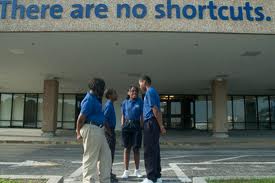
Students congregate outside KIPP's Jacksonville Campus.
The Duval school board is set to take up a plan next week that would allow for a substantial expansion of one of Florida's most high-profile charter school endeavors.
KIPP Jacksonville has applied to open a new K-8 school that could eventually serve 1,800 students, roughly tripling its current capacity.
The new school won't get that big overnight. Its plans submitted to the school district call for the new school to expand methodically over an 11-year period. It would add one grade each year, and gradually increase the number of students at each grade level.
"We want to make sure we scale and grow with quality," said Tom Majdanics, KIPP Jacksonville's executive director.
About 660 students currently attend KIPP's existing middle and elementary school in Jacksonville. Enrollment is expected to reach about 860 students once KIPP Voice Elementary, now in its third year, reaches full capacity.
The application for the new school, which is set for a vote at the school board's Nov. 4 meeting, calls for enrolling 50 kindergarten students during the 2015-16 school year. It would grow to 100 kindergarten students and 50 first-graders the next year, and eventually reach approximately 750 students in grades K-4 in the new school's fifth year. It could eventually grow to a K-8 school serving 200 students per grade.
Chartrand
Florida is a national leader in expanding school choice. And the state's new top education official doesn’t see the momentum slowing, especially with low-income children.
“The train has left the station on school choice,” Gary Chartrand, 58, told redefinED by phone this week - his first media interview since being elected chair of the Florida Board of Education on Friday.
“I often say that freedom is abundant in America but it’s not universal. When you’re stuck in a broken system, and you’re poor, and you’re full of despair, and you only have one choice, and that choice happens to be an F school, that’s not freedom. And so I think the school choice movement is bringing more freedom, especially to the most under served children in the state of Florida.”
Chartrand, a Jacksonville businessman, takes a leadership role at an especially sensitive time. Funding, already low compared to other states, has been stagnant. Common Core standards are around the corner. Teacher evaluations are in flux. Criticism of the state’s accountability system is as loud as it’s ever been (which, after the Jeb Bush years, is saying a lot.) And now the board is looking for its fifth education commissioner in eight years.
At the same time, Florida has been a pace setter in academic gains for most of the past decade. Those shaping state ed policy have no plans to ease up on the gas.
Chartrand touched on a number of issues in the interview, which is attached below. Some highlights:
On his priorities as chair: “I am not proud of the fact that America is 17th in reading, 25th in math and 30th in science in the world. We used to be No. 1. And I believe that if this continues, we’ll undoubtedly lower our standard of living … And so I just have one goal: and that’s a quality education for all. We can do better. We must do better. We got to prepare our kids for a very rapidly changing world.”
On the best way to raise standards: “We’ve got to raise standards incrementally. I get a little concerned at times, and I always use the analogy of, if you can jump on a high bar six feet, you don’t raise it to seven feet and try to get over it. Because you’re not going to get over it. You raise it from 6 to 6-1, to 6-2, 6-3, and that’s how you incrementally improve, to continue to excel. And I think that’s what we need to do at the Department of Education.” (more…)

