A Florida House panel is drafting legislation aimed at drawing more "high-impact" charter school networks to the state's most undeserved neighborhoods.
While the state is home to nearly 650 charter schools and more than 250,000 charter-school students, it's attracted only a few schools operated by the likes of KIPP and Yes Prep, which have national reputations for helping disadvantaged students.
The proposed legislation, reviewed today by the House Choice and Innovation Subcommittee, would allow those networks to apply for "high-impact" status with the state Board of Education.
Under the bill, high-impact charter schools wouldn't have to wait three years to qualify for state facilities funding. High-impact schools in areas with "critical" academic needs (meaning they're served by D- or F-rated public schools) would also be exempt from the administrative fees school districts typically charge. (more…)
Progressive Democrats can support school choice, and private options in education.
Catholic schools are at the cusp of a renaissance.
Schools that aren't "common" can still serve the common good.
Children in poverty can learn.
Teach For America volunteers don't always have short classroom tenures.
Austerity ... or efficiency?
Meanwhile... (more…)
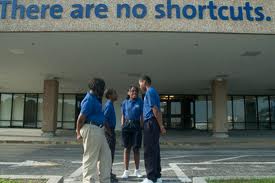 KIPP's growing network of charter schools has helped lift student achievement, a new 8-year study shows.
The charter school chain received a $50 million federal scale-up grant to speed its growth, leading to a proliferation of new schools beginning in the fall of 2011. The study results, released this morning by Mathematica Policy Research, suggest the expansion paid off and does not appear to have diluted the schools' effectiveness.
"Network-wide, KIPP schools have positive, statistically significant, and educationally meaningful impacts on student achievement, particularly at the elementary and middle school grades," the study says, and new schools opened during the expansion "are producing positive impacts that are generally similar to those produced by older KIPP middle schools when they were in their first years of operation."
The Houston Chronicle sums up the effects: (more…)
Tom Majdanics tells the story of KIPP Impact Middle School in Jacksonville, Fla., in a pair of video clips. In the first, the school's first class of fifth-graders sits in the band room, instruments at the ready, poised to play their first note.
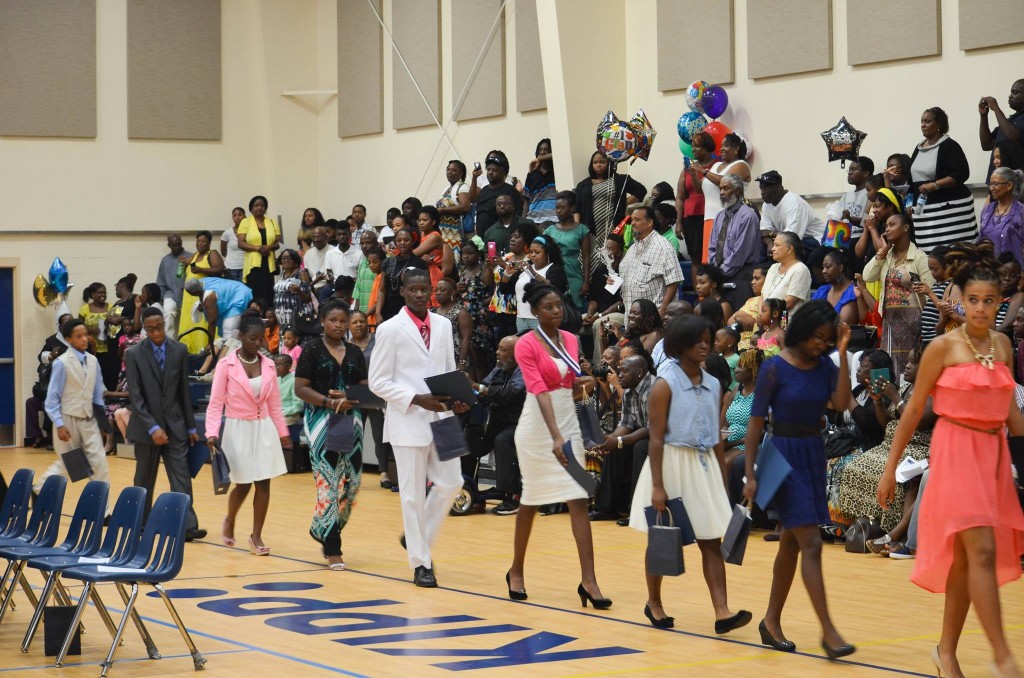
KIPP Impact Middle School graduated its first class of eight-graders earlier this year. Photo via KIPP Jacksonville.
"One, two, three, four," the conductor says. The instruments emit a warbly burst of noise. The screen fades to black.
The second clip shows the same students four years later, an orchestra of eighth-graders rocking a concert with a pitch-perfect rendition of Outkast's "Hey Ya."
Florida's first effort to bring a high-impact charter school to a high-needs neighborhood had its share of early stumbles, but it's starting to hit the right notes.
A recently approved expansion will allow KIPP to keep growing in Jacksonville. It raised its state letter grade again this year, and its students posted some of the strongest learning gains in Duval County. Meanwhile, KIPP's developing elementary school is expected to further boost the middle school, and it's hoping to work more closely with the local district to spread its impact.
Majdanics, KIPP Jacksonville's executive director, said the schools are still years from their goals, but this year more than ever, "the green shoots are unmistakable."
The effort is worth watching from across Florida and beyond, because state policymakers are looking to duplicate it.
Gary Chartrand, a state Board of Education member, is also a board member and early supporter of the KIPP Jacksonville foundation. He's pushing efforts to launch similar schools in other Florida cities - efforts that are set to get a boost from a new state grant program and might find additional support this year in the Legislature.
"What we're building with KIPP in Jacksonville should be a model, I think, for other urban areas throughout Florida," Chartrand said.
Need in Northwest Jacksonville
KIPP Jacksonville gives admissions preference to students in seven ZIP codes, a P-shaped area dotted with D and F schools.
At first, grades at KIPP's Impact Middle School languished too, with an F in its first year and a roller-coaster ride in the years that followed. But that's starting to change.
This year, its students boasted the second-highest learning gains in math among Duval's middle schools. The only school that performed better had about 20 percent of its students qualify for free- and reduced-price lunches, compared to 71 percent at KIPP Impact. (more…)
Florida education officials hope a new initiative will help the state attract more "high-impact" charter schools into academically struggling urban neighborhoods.
With the promise of $10 million in potential funding, the state is looking to entice six of its largest school districts to compete for grants that would help them launch partnerships with the likes of KIPP, YES Prep, or other organizations with established track records of raising achievement among disadvantaged students.
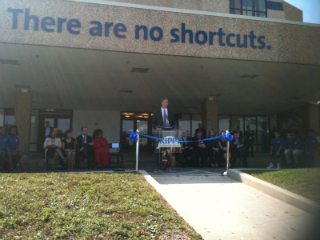
A new state initiative aims to open more "high-impact" charter schools aimed at high-needs areas, like KIPP Impact Middle School in Jacksonville.
"We hope that this will lead to some structural or systemic changes of how charter schools and districts can work together toward the common goal of making sure every kid has access to a great school," said Adam Miller, who leads the school choice office at the Florida Department of Education.
So far, at least two of the state's large urban districts have indicated they are interested, and another may join the mix before the full proposals come due next month.
State and local education officials, along with philanthropic and business groups in the state's major cities, have sought to attract "high-impact" charter school networks to high-needs areas of Florida's inner cities. One of their few high-profile successes to date has been an effort, backed by current Board of Education Chairman Gary Chartrand, to being KIPP schools to Jacksonville.
The state started seeking grant proposals over the summer from school districts that wanted to support similar efforts. The plan is backed by funding from federal Race to the Top grants and national philanthropic groups. Officials hope to amass additional funding from districts and local donors. Six districts are eligible, and under the plan, up to three could ultimately receive roughly $3 million each to support their proposals.
The outside funding boost, coupled with the fact that they'd be collaborating with districts from the outset, are intended to help overcome the barriers that have kept well-known charter networks from opening more schools in Florida. They're intended to help charter operators get access to facilities, the ability to tap local teaching talent, and certainty that the local district will allow them to open. Districts and charters could also work together on issues like transportation and teacher training.
In a letter to the department describing its intent to apply for one of the grants, the Duval County district notes the current KIPP operation has outperformed comparable district schools with a high-poverty student population. The district indicates it would like to expand its partnership with KIPP.
"By developing or participating in joint district-charter learning communities and professional development, the sharing of ideas and strategies can improve traditional public schools and KIPP," Duval's letter states.
Miami-Dade officials indicated they planned to meet with KIPP leaders as well as officials with the Harlem Children's Zone and YES Prep before crafting their proposal.
Other districts could also apply.
by Ron Matus and Travis Pillow
While some ed reform and parental choice organizations are working hard to increase diversity, there still aren’t enough people of color in leadership positions, says longtime parental choice activist Howard Fuller. And unless that and related concerns are addressed, the ed reform movement could be on shaky ground.
“The other thing that we have to do on that score is how we go into communities, and the discussions that we have with the people in those communities,” Fuller told redefinED, describing recent discussions he had with a cross-section of African Americans in New Orleans about ed reform. “And the thing that kept coming across clearly, no matter who I talked to was, we feel like this has been done to us and not with us. We have got to change that kind of idea about ed reform. And if we don’t, I’m worried about the long-term sustainability.”
Here is a mini-index of highlighted excerpts from an interview with Dr. Fuller about his book, "No Struggle, No Progress."
On clearing up misconceptions about what brought him to his position on parental choice
The reason I started out (the book) with the meeting with President Bush - other than shock value - was, it really did explain ... this man is sitting down talking to me. He really thinks he knows me, but he doesn't know me. And all kinds of people think they know me, but they don't really know me ... I really don't worry a lot about clearing up misperceptions. But what I really did want to do was to tell my own story in my own way, and whatever comes of that, fine.
On not knowing much about Milton Friedman until he became a voucher supporter
I actually got in a debate with Milton Friedman at a dinner in honor of Milton Friedman ... He didn't agree with me that it should be focused on low-income parents, because he believed in universal vouchers, which I will never support. It is true, I really did not come to it from the free-market standpoint. For me, it has always been an issue of social justice, and so that means that the framework that I use to look at it is probably very different.
On diversity in the education reform movement
We have to have more high-performing schools and networks of high-performing schools led by people of color. And then within TFA and KIPP and all of this, we've got to have more people of color. I do think that (Wendy Kopp of Teacher for America and Mike Feinberg and Dave Levin of KIPP) and all the people in KIPP and TFA have actually done that ... There's a lot more people of color in both those organizations. We still have not done the second part of this, and that is to have a significant number of high-performing schools and networks of schools led by people of color. We have simply not done well on that, nor have we done well on having more people of color in power positions, within some of our charter organizations in particular.
On giving parents greater control of the education reform movement
They have to own this. But if they have to own it, we have to make sure they feel good about what it is they're owning. Not only, therefore, do we have to talk about diversity. We have to talk about power. Constantly, you've got to increase people's power to control their own destiny. As our schools and our reform effort evolves, how people participate and what level of power they have is something we're going to have to address.
On why publicly funded private school choice makes sense - even though it did not exist to help him attend Catholic schools as a child
At one point in time, we didn't have a Pell Grant because people said, "If you want to go to colleges you ought to be able to do it on your own." But some enlightened group of individuals said, "You know what, in order for people who don't have resources to be able to have access to these great schools, we need to create a Pell Grant." The last I heard, a Pell Grant is, like, government money that you can use to take to religious schools. I think we made that change because we said it would be good public policy to be able to make sure that our low-income people in this country could gain access ... Why can't we make that policy decision at the elementary and secondary level?
On the definition of public education
Public education is a concept - an idea that we want the public to be educated. The system that we created to make that happen was not created by God.
On debating former Illinois state Sen. Barack Obama on whether vouchers constitute a "distraction" from the struggle to improve public schools
It's distraction, unless you're poor. If you're poor and you lack resources, it's not a distraction, because it impacts you and your kids ... Rather than see that as a distraction, (Obama) and others ought to see it as a part of a three-sector approach to reforming education in America, because you've got a private sector that has to be a part of the solution to the educational crisis that we have in this country.
On vouchers for the middle class
I could envision a program that would use a model like the earned-income tax credit, where you say we'll have a sliding scale, on the income basis. Now, there's got to be a ceiling. There's a point at which you're not going to get any government money. I don't understand why someone like me would get a voucher. That's ludicrous. ... Even with a sliding scale, the poorest people have to get the full benefit ... It's my belief that if you do not focus on the needs and interests of poor people, that they will get lost in the conversation.
On comparing the parental choice movement to a "rescue mission" for children in struggling schools
I have a Harriet Tubman view of the world. Harriet Tubman got up every day and said, "I want to end slavery, but in the meantime, I'm going to rescue every slave that I can." I get up every day saying, "I want the whole system to get better.” But in the meantime, I have a responsibility to rescue every single kid that I can.
Some of Florida's top policymakers have for the past few years been looking for ways to attract more high-performing charter school operators to the state's inner cities. But apart from KIPP Jacksonville and a few newcomers like the SEED School of Miami, they have few high-profile efforts to point to. And attempts to change state law to help recruit well-regarded operators have faltered in the Legislature.
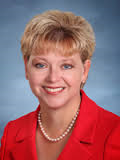
Rep. Adkins
Now one of the top state lawmakers on education policy, Rep. Janet Adkins, R-Fernandina Beach, says she wants lawmakers to try a different approach next year.
The state creates special provisions for charter schools designated "high-performing." Why not do something similar for charters that want to open in "high-needs" areas, helping them with issues from accountability to financing for their buildings?
"We need to have a whole new set of criteria," said Adkins, who currently chairs the House subcommittee dealing with K-12 policy. "I'm envisioning a whole new set of statutes dealing with high needs."
The idea came up during a recent gathering of charter school and district officials in Fort Lauderdale. Richard Moreno, who works with organizations that provide financing and other business services to charter schools, said one major barrier keeping organizations like KIPP and Uncommon Schools from Florida is the state's stringent "double-F" rule.
State law requires most charter schools that earn F's two years in a row to close. As a result, Moreno said, philanthropists and well-known charter organizations run a risk that they could sink resources into an area with high need, only to see their school shut down a few years later. "They're not touching Florida because of this," he said.
Adkins said she wants the state to emphasize learning gains when holding these new high-needs schools accountable so they aren't penalized for taking on low-proficiency students and/or ensnared by the double F rule. But right now, she said, proposals are in the "idea stage" and details would still need to be worked out.
Robert Runcie, the schools superintendent in Broward County, said he could envision school districts and other community groups vetting competing proposals from charter operators looking to move into struggling schools, creating "a very structured way of bringing a high-quality solution into a community." (more…)
Editor's note: This is the fifth post in our series on the Democratic Party's growing divide over ed reform and ed choice.

Whitmire
by Richard Whitmire
This spring I attended the Democrats for Education Reform conference in Lake Placid and watched a line of teacher union protesters, including Randy Weingarten, stand in the cold Adirondack rain and wave signs at us with slogans such as “Public Education is not for Sale.” I recall thinking: "This is going nowhere good.”It’s hard to be optimistic about the possibility that this political divide among Democrats will narrow. In Chicago, fiery teachers union president Karen Lewis is close to running against Democratic Mayor Rahm Immanuel. In New York, progressives still haven’t forgiven Democratic Gov. Mario Cuomo for putting down Democratic Mayor de Blasio over charter schools. In Los Angeles, where all the players are Democrats, the school board temporarily severed two of the highest performing charter schools there. And then there’s the NEA weirdly calling for the resignation of Education Secretary Arne Duncan. Yes, that nice Democrat Arne!
All these conflicts have one thing in common: Democrats v. Democrats. Or, to put it more precisely, liberals (think Cuomo) v. progressives (think de Blasio). While there are many education issues that fall along this divide, only one appears to have no resolution: charter schools. The bluer the state, the bigger the divide. On July 16 the Massachusetts Senate rejected an attempt to lift the very tight lid on charter schools, despite the fact that the state has the nation’s highest-performing charters.
What’s the problem? The fact that top charters have gotten significantly better in recent years (I define that as roughly the top fifth, the charters capable of adding a year-and-a-half of growth for every school year) presents a broad and enduring threat to traditional school districts and unions: These charters can both replicate quickly and produce student results that most districts can’t match. How to contain such an existential threat? Superintendents and unions, joined in common cause, rely on friendly legislatures (think of what just played out in Massachusetts) and lawsuits (think of San Jose, where opponents use zoning laws to slow down charter expansion).
Will the “pushback” strategy work? Definitely, at least in the short term. But not the long term. Given that parental choice is relatively widespread, and parents are not inclined to relinquish that choice, all that will matter in the end are quality schools, whether they are district or charter. But that “end,” can be far, far away. The power of the anti-charter forces to block expansion is considerable, and, at least from my perspective, that means denying quality schools to thousands of parents. How to solve that dilemma? (more…)
Study after study after study has looked at charter schools run by the Knowledge is Power Program and come to the same conclusion: KIPP schools significantly improve achievement among disadvantaged students.
A new study by researchers at Mathematica Policy Research goes a step further, addressing some of doubts raised by skeptics — specifically the idea that, in the authors' words, "these improvements reflect advantageous enrollment patterns at KIPP that are not possible at traditional public schools."
The findings, published in this fall's edition of Education Next, show KIPP schools attract students who face similar disadvantages to those in surrounding schools, and that their increased achievement cannot be explained by weaker students dropping out or stronger students transferring in.
The researchers looked at 19 of the network's older middle schools, all of which opened in 2005 or earlier (before KIPP opened its first school in Florida). Using detailed student-level data, they compared the KIPP students to those in the surrounding school districts, as well as a smaller group of nearby middle schools that draw students from the same elementary schools. Then they looked at students who leave the schools and those who transfer into the schools part way through middle school.
We find that, on average, KIPP middle schools admit students who are similar to those in other local schools, and patterns of student attrition are typically no different at KIPP than at nearby public middle schools. In both groups of schools, students who leave before completing middle school are substantially lower-achieving than those who remain. KIPP schools replace fewer of these students in the last two years of middle school, however, and, compared to district schools, KIPP schools tend to replace those who leave with higher-achieving students. Nonetheless, while this difference in replacement patterns is noteworthy, it cannot account for KIPP’s overall impact on student achievement. In particular, the literature on peer effects suggests that KIPP’s student replacement pattern could produce only a small fraction of KIPP’s actual impact on student achievement.
In short, the schools' positive effects on student achievement hold up even after accounting for student attrition and other "peer effects" examined by the study. (more…)
The latest release of school grades was cause for celebration at some of Florida's charter school networks, which saw substantial improvements over last year.
At other schools, though, it brought bad news. Ramz Academy Middle School, a charter school in Miami-Dade, sent a letter to parents, informing them it would not be open next school year and offering to help them find another option. At the opposite end of the state, near the Georgia border, Shining Star Academy of the Arts in Columbia County was rallying parents, pursuing an appeal of its F grade, and preparing to seek a waiver allowing it to remain open next school year.
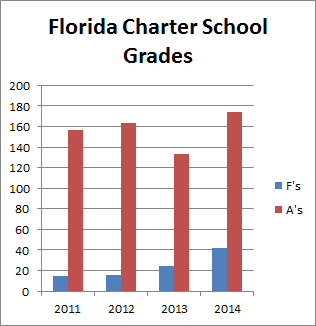
More Florida charter schools received grades this year, bringing an increase in the number of A's and the number of F's.
Florida statutes require most charter schools that receive F's in two straight years to close. In many cases, low test scores can either force them to shut down, as Hoggetowne Middle School in Alachua County announced before grades were released, or prompt efforts, like one now underway at Shining Star, to look for waivers or exceptions that can give them another year to improve.
In all, the double-F rule could affect an unprecedented eight elementary and middle schools around the state this year. Still more charter schools could face that reality next year, after 42 charters received F's, the highest single-year total ever. That number rose in part because there are more charter schools, and in part because a change in state law led to more charters being graded.
Most of this year's F-rated charters were receiving grades for the first time, either because they were new schools or too small to receive a grade the year before. Among the first-year charters that struggled was University Preparatory Academy, a high-profile effort to bring more education options to southern Pinellas County.
For many new charter schools - especially those that serve overwhelmingly low-income or minority students - it's common to receive poor grades in the early going, and then improve over time.
KIPP Impact Middle School in Jacksonville was struggling with an F four years ago. This year, it posted some of the highest scores in its history, and snared a B. Two other charter schools received F's as their first-ever grades in 2013, only to climb all the way to B's this year.

