 Tennessee Education Report
Andy Spears of the Tennessee Education Report says sponsors of Tennessee’s new education savings account program for children with special needs don’t know much about the bill they just passed.
But it may be Spears who doesn't understand the bill, as he spends more time speculating on parental rights than explaining what it would do. He also also incorrectly claims that Florida started a "similar program" in 1999.
First, let's address Tennesee's new school choice bill. The apparent confusion likely stems from a tendency among critics of private school choice to label all such programs as "vouchers." Tennessee could soon become the fifth state to implement a flavor of school choice known as education savings accounts, which are different from traditional vouchers.
The new program would allow parents of students with Individualized Education Plans access to education savings accounts worth up to $6,600. The accounts will allow parents to pay for private school tuition, fees, textbooks, school supplies, curriculum, tutoring, exam fees, services contracted by a public school (including individual classes and extracurricular activities), college savings accounts, as well pay for therapies with the child’s physician and more. There is a similar program in Florida, but it started in 2014, not 1999.

Tennessee - The Volunteer State
It is a fair concern, but Spears should stop and wonder why so many parents in Florida are have chosen private schools or home education. He might also wonder why, if IDEA ensured every child's needs were met, a cottage legal industry of parent advocates has sprouted up to sue school districts on behalf of shortchanged students.
For some parents, having a choice protects their children's rights more effectively than any regulation. It might not be for everyone, but neither is the status quo.
Headlines in the days leading up to Jeb Bush's closely watched visit to Tallahassee promised there would be protests. As it turned out, there were two demonstrations, one supporting private school choice programs and one opposing them.
On Tuesday, a phalanx of nearly 20 protesters gathered in a barricaded area outside a Foundation for Florida's Future event where the former governor spoke. They included current and former teachers, who railed against standardized testing and privatization. A few wore red t-shirts signaling their affiliation with the Badass Teachers Association, whose members are among the most virulent critics of Bush's education reforms.
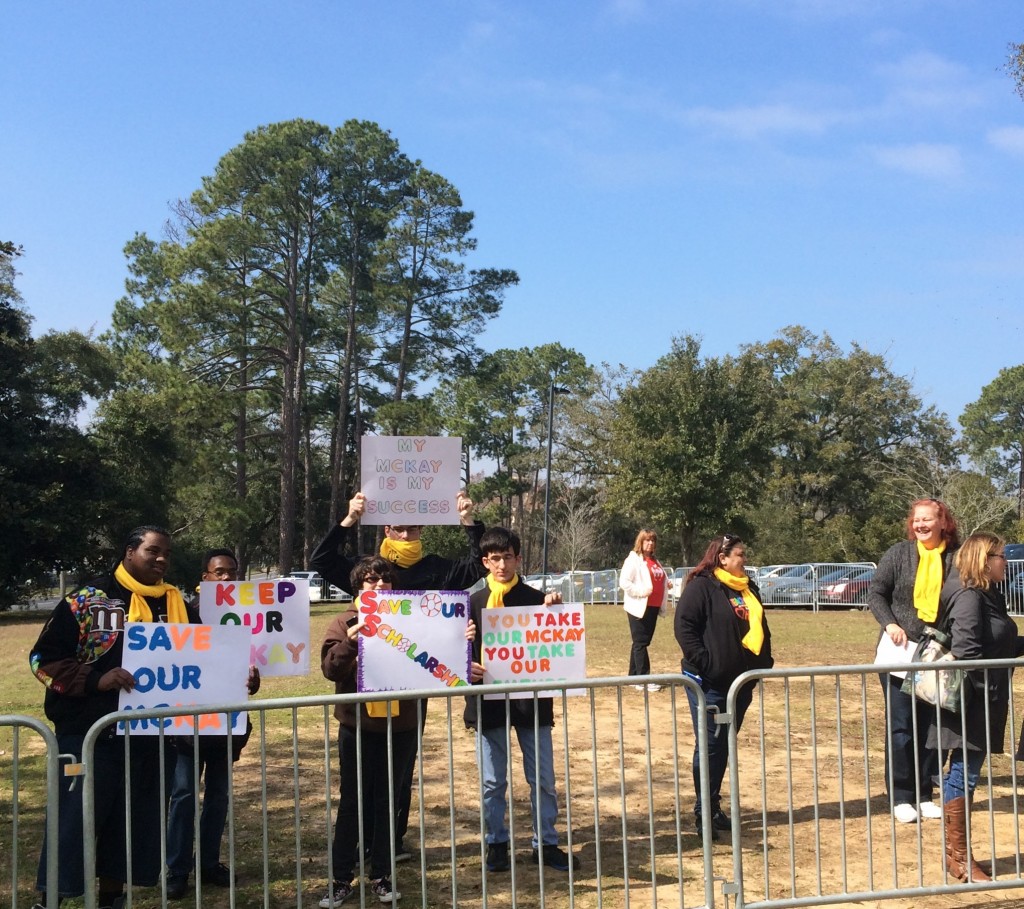
Students and parents who rallied for school choice scholarships in Tallahassee.
Before the event, a contingent of students, parents and teachers staged a separate demonstration in favor of school choice. Many of them were supporters of McKay Scholarships for special needs students, one of Florida's three private school choice programs (another of those, the tax credit scholarship program, is administered by Step Up For Students, which co-hosts this blog and employs the author of this post).
Wendy Blair is a teacher at the Arbor School of Central Florida in Winter Springs, which caters to students with special needs. She said that without McKay scholarships, its services would likely be out of reach for most of the children who attend. She said the program poses no threat to public education, pointing to studies showing it has saved school districts money.
Alexandria Forsh said her son attends Atlantic Inclusive Academy in Cocoa, a private school that accepts school choice scholarships. She said she had nothing against public schools, but parents often have a hard time advocating for special needs children and negotiating Individualized Education Programs, or IEPs, with their school districts.
Charter schools. The Sun-Sentinel castigates charters in an editorial calling for more regulation. The Palm Beach Post looks at a local charter with high test scores.
 Tax credit scholarships. The Orlando Sentinel does a Q&A on expanded eligibility.
Home education. A Christian school aims to support parents who homeschool their children with a new part-time program. Palm Beach Post.
Vouchers. The Sun-Sentinel criticizes McKay Scholarships in an editorial calling for stricter regulation.
Discipline. The Tampa Bay Times looks at a federal investigation into Hillsborough's handling of discipline for minority students.
Superintendents. The Tampa Bay Times looks back at the Hernando superintendent's first year. Hillsborough school board candidates focus on current superintendent MaryEllen Elia. Tampa Tribune.
Campaigns. Teachers jump into Volusia school board races. Daytona Beach News-Journal. Voters are split on a Brevard tax referendum. Florida Today.
Corporal punishment. Santa Rosa schools do away with corporal punishment. Pensacola News-Journal. Northwest Florida Daily News.
Administration. A study of effective principal supervisors comes to Broward. StateImpact. A Broward school district attorney worked with a lapsed law license. Sun-Sentinel.
Facilities. The Pinellas school district demolishes Largo High. Tampa Bay Times.
School boards. A Manatee County consent agenda leads to a glitch. Bradenton Herald.
Alternative schools. The Hernando school district prepares to consolidate two academies aimed at struggling students. Tampa Bay Times.
English Language Learners. Polk schools hire 22 bilingual teachers. Lakeland Ledger.
More students attended Florida private schools this year than in any year since the onset of the economic downturn, and there are now more private schools operating in the state than in any year on record.
But Florida's private school enrollment is still less than it was 10 years ago, according to the state Department of Education's latest annual report on private schools, released this month.
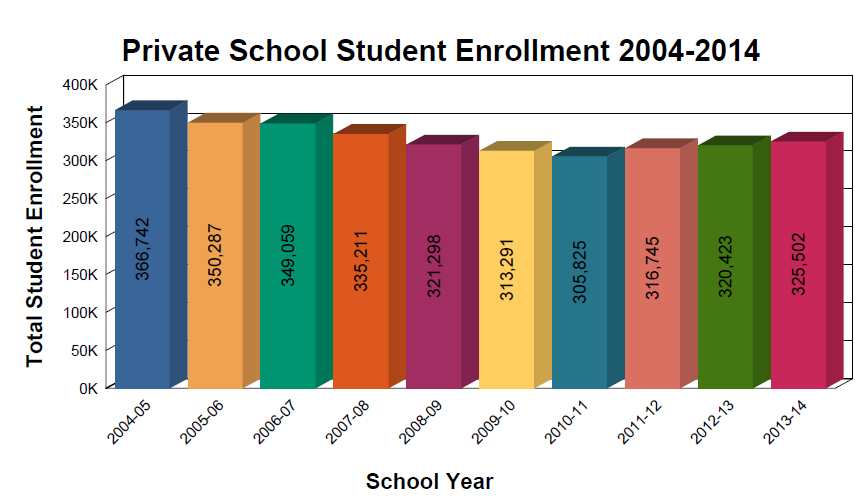
Chart by Florida Department of Education
Let's break down some of the trends highlighted by the report.
Testing. Statewide FCAT scores show slight improvement, with variation around the state. Tampa Bay Times. Miami Herald. Tampa Tribune. Pensacola News-Journal. Ocala Star-Banner. Tallahassee Democrat. Palm Beach Post. WJCT. WFSU. Florida Times-Union. Orlando Sentinel.
McKay Scholarships. The Sun-Sentinel airs criticism of the program for special needs students.
Career academies. Polk middle-school students earn professional-grade engineering credentials. Lakeland Ledger.
Charter schools. A Hillsborough charter school prepares to close amid falling enrollment. Gradebook.
Graduation. South Florida schools once seen as "dropout factories" see graduation rates soar. Miami Herald. A Bay County charter school is the last high school in the district to continue recognizing valedictorians. Panama City News Herald.
Books. Author Cory Doctorow takes to YouTube to call out administrators who pulled his book from a summer reading program. Pensacola News-Journal.
Summer slide. School officials hope to keep students from forgetting what they've learned during the school year, a problem especially pronounced among low-income students. Daytona Beach News-Journal.
Early learning. Funding delays pose problems for the Head Start program. Orlando Sentinel.
Budgets. There's no room for employee raises in the Palm Beach County schools budget. Palm Beach Post. The Okaloosa County school system may give the central office greater control over spending. Northwest Florida Daily News. A 5k helps the district raise money. Daily News.
Seniors. Prom, senior trips and class rings can make senior year expensive for families. Scripps.
Nutrition. A bus converted into a food truck will help make a summer meal program accessible to students. Bradenton Herald.
Administration. The Lee County school district seeks public input on coming policy changes. Fort Myers News-Press. Manatee County's handling of a sexual abuse case involving an administrator may run afoul of federal Title IX rules. Sarasota Herald-Tribune. A longtime Hernando administrator is given a choice to either take a pay cut or lose his job. Tampa Bay Times.
School boards. Five Pinellas school board seats are open to challenge. Tampa Bay Times. Every Manatee County incumbent up for re-election will face a challenger. Bradenton Herald.
Teachers. The Gainesville Sun talks to first year teachers at the end of the school year.
A lawsuit seeking more funding for public education has widened to challenge programs that help Florida parents send their children to private schools.
The original case aimed to put Florida's education system on trial, arguing among other things that lawmakers had not adequately funded public schools, in violation of the state constitution.
An amended legal complaint filed late Friday afternoon adds new claims to the case, challenging the tax credit scholarship program for low-income students and the McKay Scholarship program for special-needs students.
First filed nearly five years ago, the case centers on a requirement in the state constitution that the Legislature must provide a "uniform, efficient, safe, secure, and high quality system of free public schools."
The revised lawsuit contends:
Many of the State’s reforms and programs, including the accountability system, changes to the graduation requirements, retention and promotion requirements, teacher evaluations, charter schools, and the FTCSP and the McKay Programs, have wasted millions of dollars without producing the desired effect of a high quality public school system, and are thus not efficient.
It also argues the state "is not providing a high quality pre-kindergarten learning opportunity," in violation of a related constitutional provision that led to the creation of Florida's Voluntary Pre-Kindergarten program.
The Florida Supreme Court ruled in 2006 that the state Opportunity Scholarship voucher program, which used state education funding to help pay private school tuition for children in poorly rated public schools, was unconstitutional.
The ruling in Bush v. Holmes hinged in part on the fact that the program used funds already set aside for education. Justices gave themselves room to rule differently on other private school choice programs, including those that cater to students with disabilities.
Neither McKay nor tax credit scholarships have faced a similar constitutional challenge until now. The revised lawsuit argues that by creating and expanding the two scholarship programs, "the Florida Legislature intended to divert public money from the education finance program and use this money instead to fund private school vouchers." (more…)
While school choice in Florida has continued to mature, the array of options - and the information parents receive - can vary greatly from one school district to the next.
That's one of the findings from a recent report produced by the state Department of Education, which is intended to measure school districts' compliance with state school choice policies.
The data can be surprising. The proliferation of charter schools might get a lot of ink in Florida's seven largest urban districts. But as a percentage of enrollment, they play a larger role in a handful of rural areas and exurban enclaves.
In Franklin County, a single charter school serves nearly half the district's students. In Glades County, a K-8 devoted to preserving the traditions of the Seminole Tribe serves nearly 15 percent of the student population - a larger proportion than urban Miami-Dade (where charters serve about 13 percent of students) or Palm Beach (7 percent).
The enrollment figures are from last fall, and they're derived from the last enrollment survey of the 2012-13 school year. They paint a nuanced picture of a state where more than a million students take part in some kind of educational choice program.

In 13 Florida school districts, charter schools make up 10 percent or more of total school enrollment - an example of the variation in school choice options from one county to another. Source: DOE 2012-13 survey 5, choice access report (2014).
A new type of school choice program aimed at serving special-needs students in Florida won bipartisan support during its first legislative committee vote Tuesday.
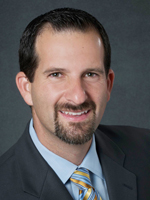
Rep. Michael Bileca, R-Miami, chairs the House panel that has proposed individual education accounts for special-needs students.
Several Democrats on the House Choice & Innovation Committee joined Republicans in voting 11-2 for “personal learning accounts,” a school choice option that would allow parents with disabled children to use state education funds for a range of education-related services.
Other Democrats, like Ranking Member Joe Saunders, D-Orlando, voted against the bill but held out the possibility they might support it in the future.
"Vouchers are so controversial at times, but I think that you have an honest desire to help the families that were up here today," Saunders said. "I think there's a very legitimate need."
Parents of special-needs children came to Tallahassee to testify on behalf of the proposal, while the Florida PTA and statewide teachers union objected.
Mindy Gould, the PTA's legislative chair, said the group had "great concerns," and mentioned a 2006 state Supreme Court ruling that found the state's Opportunity Scholarship program unconstitutional.
The Bush v. Holmes decision struck down the voucher program, which was created under Gov. Jeb. Bush for students in struggling schools. But justices in the case also indicated that other programs, including those for special-needs students, may be "distinguishable" under the state constitution.
Under the House legislation, individual accounts would be available to parents of children with conditions like autism and cerebral palsy who qualify for the state's two highest support levels for disabled children.
The accounts could reimburse them for specific kinds of therapy or specialized instruction for their children. Funding would be based on the formula for the state's McKay Scholarship program, also for students with disabilities. (more…)
 Again defying national trends, Catholic schools in Florida showed enrollment growth for the second year in a row this year.
Enrollment in PreK-12 reached 84,750, up from 84,258 last year, a modest increase of 0.6 percent, according to data released Monday by the Florida Conference of Catholic Bishops.
Enrollment was at 81,632 two years ago.
By contrast, Catholic school enrollment nationally, on the decline for decades, fell another 1.5 percent last year.
Publicly funded, private school choice programs in Florida are a big reason for the difference. Florida Catholic schools enroll students who use pre-K vouchers, McKay scholarships for students with disabilities and tax credit scholarships for low-income students. (The latter is administered by Step Up For Students, which co-hosts this blog.)
According to the conference, tax credit scholarship students in Florida Catholic schools increased 23 percent last fall, and 46 percent in fall 2012. McKay students jumped by 12 percent and 7 percent over the same span.
The latest numbers come as schools around the country celebrate National School Choice Week and National Catholic Schools Week. For a more detailed look at what's going on with Catholic school enrollment in Florida, check out our story from last year.
Update at 12:10 p.m. on Jan. 28: The Catholic school enrollment numbers in Florida are on the upswing even if you exclude Pre-K. According to the conference, there were 73,714 K-12 students in Florida Catholic schools in 2011-12, 75,969 in 2012-13 and 76,500 in 2013-14. Percentage-wise, the K-12 increase over the past two years is 3 percent and 0.7 percent, respectively.
Florida is reducing state-funded scholarships for private school students with disabilities if they take online courses through Florida Virtual School.
 The state Department of Education last week began notifying the 1,200 private schools accepting the McKay Scholarship that quarterly payments for students will be docked starting in February – in some cases, by as much as $800.
Since then, some school operators, such as Donna Savary of Savary Academy in tiny Crawfordville, have pulled McKay students from the FLVS programs to avoid the unexpected costs. They also have warned parents they’ll have to pick up the tab for courses their children already completed.
“We’re not happy,’’ said Savary, whose academy has 16 students of which six receive McKay Scholarships. “The kids are not happy. The parents are really upset.’’
In a letter dated Nov. 8, the department cited the recently-amended education funding formula as cause for the reduction. DOE officials reviewed the new law that went into effect in July and determined last month that it did apply to recipients of the McKay Scholarship because the funding comes from the Florida Education Finance Program (FEFP).
School districts and Florida Virtual School also are funded by the FEFP, and have been hit with similar cuts when public school students enroll in the online provider’s program.
“If they (DOE) had told me about this in the beginning of the school year, my kids wouldn’t have been in Florida Virtual School at all,’’ said Savary, who told one of her families this week it will owe $800 in February for two courses completed since August. “This is a rural area. Parents here don’t have $800 lying around.’’
The DOE decision means parents of McKay Scholarship students are the only ones in Florida directly assessed for FLVS courses, said Robyn Rennick of The Coalition of McKay Scholarship Schools. (more…)

