An episode of Paul MM Cooper’s outstanding documentary podcast series "The Fall of Civilizations" recounts the history of Carthage, which includes details of wars fought between the Carthaginians and Syracuse during the 300s BC. Carthage, a highly successful sea-trading nation, fought a number of wars with Greek colonies in Sicily prior to later wars with Rome.
Cooper describes how the Carthaginians made extensive use of mercenary armies, to spare themselves from the dirty business of fighting wars. During a Carthaginian siege of Syracuse, the Syracusans turned the tables on their attackers and sailed to attack Carthage. The wealthy but martially inept Carthaginians made impromptu efforts at fielding an army. This didn’t go well. The Carthaginians brought shackles in hopes of enslaving the Greeks, but instead found themselves routed in the field. Having scrambled behind their walls, the Carthaginians attempted to generate divine favor by sacrificing children to their gods.
Contemporaneous Greek accounts, and later archeological evidence, indicate that the Carthaginians may have been the last Mediterranean civilization to practice human sacrifice. As if this were not odious enough, wealthy Carthaginians would purchase and sacrifice other people’s children.
At first these rituals seem to have been an authentic sacrifice, giving up the life of your own children in the hope of receiving favor from the gods, but before long, wealthy Carthaginians found a way around this. In fact, they seem to have developed a macabre industry, a trade in other people’s children for sacrifice.
Fortunately, sensibilities have evolved in intervening millennia, and we don’t go in for either human or for that matter, animal sacrifice, these days. Still this account struck me as unsettling. We manage to field our own military here in the United States. The decades of scandal related to politically connected Americans avoiding the draft has, however, more than a faint echo of the Carthaginian elite sending someone else to fight for them. Dodging military service inevitably entailed sending someone less connected, less fortunate than yourself to fight and sometimes to die in your place.
The phrase “a trade in other people’s children for sacrifice” is perhaps a bit strong to describe what happened to students during the COVID-19 debacle, but perhaps not, especially considering the minimal value derived from billions of federal education dollars. No small number of Americans benefited from choice schools as children, benefited from choice schools as parents, but oppose programs to provide K-12 choice to others. Like Carthaginians of old, these people are willing to sacrifice someone’s children for one reason or another, just not their own.
Between damaging their demographic prospects by sacrificing children to statues and mercenary forces turning on them in the Second and Third Punic wars, the Carthaginians hit the dustbin of history.
Praeterea dico exercitia Carthaginiensium in America delenda est.
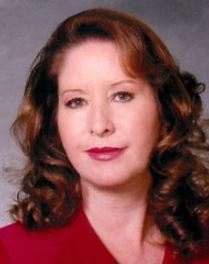
 Gloria Romero
 Gloria Romero, a former Democratic majority leader of the California Senate, helped pass a bill that required parents to be informed if their child attended a school in the bottom 10 percent of all public schools in California. If they did, the parents could stick around at the school and try to transform it (for example, by converting it to a public charter school) or transfer to a different public school.
The teacher unions and school districts opposed the bill, sued to stop the program, and continue to fight the program to this very day.
Gloria Romero
According to Romero, the state department of education delayed releasing the list of lowest-performing schools until the last minute. With only a few weeks remaining before the transfer deadline, L.A. Unified finally posted the transfer application, but only in English and only online. Districts also denied parent groups from informing parents of their rights at school events such as PTA meetings.
Kudos to Romero and the California Center for Parent Empowerment for highlighting these obstacles and fighting with and on behalf of parents to knock them down.
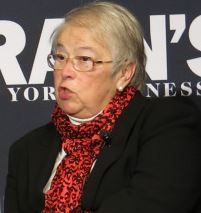 Carmen Farina, the chancellor of New York City Public Schools, recently accused charter schools of pushing out low-performing students just before statewide exams.
Charter schools responded by demanding the chancellor back up her claims with evidence. And the local union president more or less sided with them, saying enrollment data for both charter and district schools should be audited and disclosed. Marcus Winters even took her to task for misreading what little data is available.
Perhaps with some irony, Farina made those remarks while clarifying her position on how charter schools need to be more transparent. Now she has the opportunity to be transparent about her claims.

"Polly" Williams
Happy Birthday! The Milwaukee Parental Choice Program, America’s longest-running private K-12 school voucher program, is now 25 years old.
The program has not gone without controversies and critics but researchers generally find, at worst, no difference with traditional public schools and, at best, small but positive achievement gains, graduation rates and college attendance for participating students. Importantly, parents and students are happier going to the school of their choice rather than one assigned to them by the government. On a sadder note, Annette "Polly" Williams, a leading black Democrat and school choice leader who pioneered the program recently passed away. Her legacy, however, lives on.
Gloria Romero
Editor’s note: This is the last post in our series on the Democratic Party’s growing divide over ed reform and ed choice.
by Gloria Romero
While in the belly of the beast of government, I had a front row seat on how the wheels of government are greased to function for politically connected interests. Over time, I chose not to just be a cog in the ever-churning wheel of special interests and status quo, from both the left and the right. I saw a political system, led by Democrats, that was all too willing to ignore the needs of ordinary citizens, particularly the poor and minority kids I represented in East Los Angeles.
There is no aspect of state government operations or public policy in California, particularly education policy and budgeting, that is untouched by the power of the California Teachers Association (CTA) and its affiliates in Sacramento. With approximately 300,000 members, each paying some $1,000 a year in dues, it commands the most powerful war chest in California, raising over $300 million annually to finance its operations. From 2000-2010, CTA spent over $210 million on political campaigning — more than any other donor in the state, even outspending the pharmaceutical, oil, and tobacco industries combined.
Its political war chest is legendary. It dominates elections, including school board races in which voter turnout is anemic, often less than 10 percent. Political consultants fear crossing them because of the potential to be “blacklisted.” Almost half the entire California budget funds education thanks to Proposition 98, a 1988 initiative crafted by CTA. Democratic legislators fear interfering with it even though few understand how the formula functions.
Former Democratic Senate President Don Perata was one of the few to challenge it, comparing it to a “runaway escalator.” In retribution, CTA ran ads against him. It was not interested in “taking him out”; rather, the message was akin to sending dead fish to fellow caucus members so they would have to choose loyalty: their own president or CTA.
Former CTA staffers are ensconced in legislative leadership offices. Legislation benefiting their membership flies through the Capitol. Indeed, class size reduction was sold to voters as “benefiting kids.” In fact, it has more so grown the numbers of dues-paying members rather than improved the academic skills of, particularly, poor and minority children.
California teachers are amongst the highest-paid in the nation; yet, there is little accountability for student achievement or teacher performance. Laws make it almost impossible to fire teachers for incompetence or misconduct. Charter schools, mostly non-union, are attacked by the teachers unions. Any hint of privatization, including opportunity scholarships for kids in failing schools, are “off the table.” The 2010 Parent Empowerment Act I wrote, giving parents unprecedented tools to fight for their kid, like parent trigger and open enrollment, continues to be vilified.
Money flows to those who control the levers of power, and in California that means Democrats. (more…)
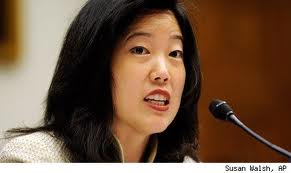
Rhee
Michelle Rhee's education reform group is scaling back its Florida operations, saying it wants to focus on policy battles elsewhere.
StudentsFirst will maintain a nominal presence in the state, but it's pulling out most of its policy and outreach resources. Some of its leadership positions in the state, including state director, had already been vacant.
Lane Wright, the group's regional spokesman, said StudentsFirst will keep operating in neighboring states. The group has been active in Alabama, Georgia and South Carolina.
"We will still weigh in publicly on some education reform issues in (Florida)," Wright said late last week. "We will not be as heavily involved as we have been with our outreach and our policy."
Wright said the decision was shaped in part by the fact that Florida has already adopted more of its policy agenda than any state besides Louisiana.
StudentsFirst's state report card gives Florida especially high marks for teacher effectiveness, but its efforts to win changes in other areas met resistance. It was among the groups that pushed for the "parent trigger" legislation that died on tie Senate votes in 2012 and 2013. This year, it shifted focus to spending and governance, but a bill that would have required the state to measure schools' return on investment did not make it out of the Legislature. (more…)
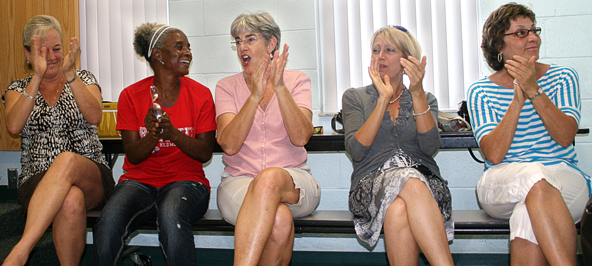
Rowlett Magnet Elementary teachers react after hearing the final vote count for a charter conversion school.
In a state that has found itself politically deadlocked over whether parents should be given the power to change who runs a public school, a Bradenton elementary magnet school pulled its own type of trigger this week. The vote to convert to a charter school was made under existing Florida law, which calls for both parents and teachers to approve, and the results were a disquieting declaration of educational independence. Parents: 480-26. Teachers: 57-4.
This is an arts school mimicking art, conducting what amounts to its own version of Won’t Back Down, the Hollywood drama that featured a band of parents and teachers who fought to turn their own school around. Yes, there are clear differences: Rowlett Elementary is not suffering. It is a popular magnet school that has received an A or B rating from the state over the past five years and has enjoyed the financial fruit of a Rowlett Family Association that raised $170,00 just last year.
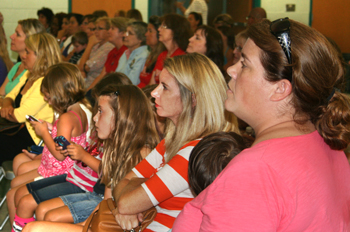
Parents gathered at Rowlett Magnet Elementary in Bradenton, Fla., recently to witness the final vote count to turn the district school into a charter school.
But Rowlett is a racially and economically diverse school, in a middle- to low-income neighborhood, and what is familiar is the powerful sense of self-determination. The campaign has brought together teachers and parents who in other circumstances might have been skeptical of such tools. One of the parents is an active member of a group in Florida, Fund Education Now, that has taken credit for defeating the parent trigger bill the past two years.
“It’s not the direction I thought we would be going in after 13 years,” said principal Brian Flynn, a 34-year school district employee who has led the school since it opened in 2000. “It’s not about wanting to leave the district. We wanted to be able to continue the type of programs that we have always offered.”
"We will be able to continue the excellence, the programs, the tone, that Rowlett already has," parent Glorianne Flint told the Sarasota Herald-Tribune. "What is the School Board going to do to continue the wonderful programs that Rowlett has? The district can't give us that answer." (more…)
Washington, D.C.: District Mayor Vincent Gray plans to allow charter schools and community organizations to lease 16 public school buildings, some of which were slated to close next school year (Washington Post). More from the Washington Examiner. The charter board approves two new schools, including one that helps adults learn to read (Washington Post).
 New Jersey: Charter school operators are finalizing plans for teacher and principal evaluations (NJ Spotlight).
Louisiana: A new state report finds that the education department had gaps in monitoring the academic performance of charter schools (Associated Press). More from the Times-Picayune. Khan Academy founder Salman Khan says virtual education may change the role of teachers, but it won't make them obsolete (Times-Picayune). Superintendent John White is scaling back the course choice mini-voucher program (Times-Picayune).
Florida: Virtual school gives teachers more freedom with scheduling and, in some cases, more opportunities (redefinED).
Pennsylvania: Thousands of Mastery Charter School students gathered for a "college signing day'' to celebrate the 450 graduating seniors continuing their education (Philadelphia Inquirer). Philadelphia charter school operators joined district leaders and Mayor Michael Nutter in calling for more education funding (CBS Philly). The Pennsylvania Coalition of Public Charter Schools responds to complaints that its operators violate open records laws (The Sentinel).
Alabama: The Legislature rejects Gov. Robert Bentley's proposal for a two-year delay on the school tax credit scholarship plan known as the Alabama Accountability Act (Montgomery Advertiser).
California: Dissatisfied parents use the state's parent trigger law to remove a principal from a Los Angeles elementary school (Education Week). Los Angeles' Renaissance Arts Academy charter school offers string instruments and dance instruction in every-day curriculum to motivate students (Southern California Public Radio).
North Carolina: The House passes a bill that would make charter schools eligible for permanent license tags that exempt their vehicles from annual fees and inspections (WRAL). Parents for Educational Freedom in North Carolina creates a new program to open charter schools in rural areas (Education Week). The state assembly considers creating a charter school board (North Carolina Public Radio). The House Education Committee hears both sides of a fierce debate on school vouchers that has Jeanne Allen, president of the Center for Education Reform, weighing in (Associated Press). (more…)
A new poll finds that mothers of school-aged children aren’t happy with the direction of K-12 public education nationwide, and they are more likely to favor nontraditional, school choice options – like charter schools, private schools and the use of vouchers.

Virginia Walden Ford
The telephone survey was commissioned by the Friedman Foundation and board member Virginia Walden Ford called attention to the findings about mothers: “No one knows better than a mom what education works best for their child, and mothers are crying out for more choices across our country.’’
Among the findings for moms with school-aged children:
• 61 percent said K-12 education has “gotten off the wrong track.’’
• 82 percent gave private schools an A or a B compared to 44 percent for public schools.
• 63 percent favored charter schools (once pollsters defined the schools), compared to 25 percent who opposed them.
• 69 percent supported tax-credit scholarships; 19 percent did not.
• 65 percent supported education savings accounts; 25 percent opposed the reform.
• 66 percent supported school vouchers (again, after they were given a definition of the program), compared to 26 percent who opposed them. School moms are more than twice as likely to agree (66 percent) with universal eligibility, but they mostly disagree (62 percent) when eligibility is limited to financial need.
• 54 percent favor a parent trigger policy compared to 38 percent who opposed the measure.
The survey also asked about education spending, with 65 percent of the moms saying per-student funding was too low and 35 percent believing public schools spent $4,000 or less per student. When they were informed that the national average was about $10,652 per student, the number of moms who thought the funding was too low dropped to 50 percent.
School choice. Pasco Superintendent Kurt Browning says the district's record in providing more school choice has been "abysmal." Gradebook.
Charter schools. The principal of a YMCA charter in Venice is put on leave for undisclosed reasons. Sarasota Herald Tribune.
 School turnarounds. Seven teachers who applied to keep their jobs at struggling Lacoochee Elementary in Pasco are not selected. Tampa Bay Times.
School rankings. Newsweek says 115 of the nation's 2,000 best high schools, including five of the Top 20, are in Florida. StateImpact Florida. Nine Volusia schools make the list, reports the Daytona Beach News Journal.
School spending. Miami Herald: "On Wednesday, the Miami-Dade School Board voted to explore the establishment of a trademark and licensing program that would create official district merchandise and at the same time outlaw pirate products." The Lake County School Board looks at a slew of cuts to close a $16 million budget deficit, reports the Orlando Sentinel. The Marion school board rejects pay raises for teachers and paraprofessionals through the end of this year, reports the Ocala Star Banner.
Legislative wrap-up. Parent trigger aside, Patricia Levesque sees a lot of positive changes. Orlando Sentinel. (more…)
 I’m kind of glad the ruckus over the parent trigger is over for now. I continue to believe that despite how mercurial it was, there are far more issues that can unite parents, the press and policymakers, if only we can wall off the static and talk.
Perhaps this is one: I think most of us can agree that poor and minority students are getting shortchanged when it comes to getting the best teachers in traditional public schools. I think most of us can agree this is fundamentally unfair to students and teachers alike.
No matter how you define teacher quality – and let’s leave teacher evaluations out of this for now because, sheesh, that is a mess – poor and minority students get less of what is ideal and more of what isn’t. There are far more rookie teachers in high poverty schools, far more teachers who needed multiple attempts to pass certification exams, far fewer board certified. In many urban districts, the teacher transfer pipeline is one-way from inner city to leafy burbs. Given what we know about great teachers – that they are the biggest in-school variable in student achievement, that they can and do change lives – this is unconscionable.
The latest evidence is from a Stanford University study published last month. It’s based on data from the Miami-Dade School District. And it finds that even within schools, lower-performing students are more likely to be taught by the less-than-ideal teachers.
I wish issues like this got more media attention, especially in Florida. As far as I can tell, the only major news outlets that wrote about the Stanford study were Education Week and BET. I know reporters are under more stress than ever, and the timing – near the end of the Florida legislative session – couldn’t have been worse. But this isn’t a fleeting issue. (more…)
School turnarounds. Tampa Bay Times education editor Tom Tobin offers his take on what it takes: "a long, slow slog that requires principals and teachers to keep on task, stay inspired and fight through times when things don't seem to be working." The Times also offers a statistical snapshot of the five Pinellas schools on the turnaround list.
Legislature. Fund Education Now co-founder Christine Bramuchi offers her take on what happened in this year's session in a Q&A with the Orlando Sentinel. John Romano does here. The Palm Beach Post does here. Orlando Sentinel rundown here. Tallahassee Democrat here. Times/Herald here.
Florida's progress. Accountability through school grades has made a positive difference, writes Matt Ladner at Jay P. Greene Blog.
Teachers unions. The Florida Education Association has been operating without its tax-exempt status since January. Florida Center for Investigative Reporting.
Teacher pay. The Broward County School Board agrees to give extra money to high-performing teachers at low-performing schools. Fort Lauderdale Sun Sentinel.
Teacher conduct. A Broward County band teacher is accused of marijuana-fueled, sexual trysts with a student, reports the South Florida Sun Sentinel. In another teacher conduct case, the Palm Beach Post has the latest on a former private school teacher accused of giving students candy in return for sex acts.
Parent trigger. StateImpact Florida does a Storify on the post-trigger battle over #parentempowerment. Margo Pope from Florida Voices: "Parents already have options in state law that empower them. They don’t need another law. They need to know how to use what is already on the books." (more…)

