 Like the Democratic Party platform on education, this is no surprise: Democratic tension over school choice and parental empowerment is on display at in Charlotte. But some of the developments and statements are still worth logging in.
StudentsFirst co-sponsored a special screening of the new movie “Won’t Back Down” at the DNC yesterday, just as it did at the RNC in Tampa last week. And in the panel discussion that followed, Ben Austin, executive director of Parent Revolution, told the audience that the parent trigger law – upon which the movie is loosely based – is a progressive idea aimed at giving parents more power to right struggling schools. According to coverage of the panel by Education Week’s Politics K-12 blog:
The laws allow parents to "unionize and collectively bargain, just like teachers' unions," said Austin, who served in the Clinton White House. "Parent trigger fundamentally makes public schools more public. ... We need to be modern 21st-century progressives" who stand for government working.
To be sure, people like Austin and former California state Sen. Gloria Romero have tried, mightily, to dispel the notion that the trigger is a right-wing creation, but the myth persists. In June, the U.S. Conference of Mayors unanimously endorsed the parent trigger idea, and among the big-city Democrats who led the charge was Los Angeles Mayor Antonio Villaraigosa.
Villaraigosa is chairman of the Democratic National Convention this year, as the Huffington Post notes in this piece over the weekend. He’s also a former teachers union organizer. Wrote the HuffPo: “It is hard to paint the school reform movement as a right-wing conspiracy. Support for taking on teachers’ unions is growing in Democratic and liberal circles.”
More DNC coverage of the growing divide between Dems and teachers unions in the Los Angeles Times and the Washington Times.
After going 56 years without attending a national political convention, I’m headed to Charlotte for my second convention in a week. For school choice advocates, the Democratic National Convention will be a somewhat hostile environment, unlike last week’s Republican National Convention in Tampa, where all forms of school choice were enthusiastically embraced.
As we’ve discussed previously on redefinED, the political left, including wide swaths of the Democratic Party, was supportive of giving parents - especially low-income and minority parents - access to more diverse schooling options in the 1960s and throughout most of the 1970s. That support began eroding when the National Education Association gave Jimmy Carter its first-ever presidential endorsement in 1976, and was mostly gone by 1980.
President Clinton’s support of charter schools marked the beginning of a renewed interest in school choice within the party, and pro- and anti-school choice forces have been battling ever since. After two decades of struggle, the momentum today is clearly on the side of the pro school choice Democrats, which has caused anti-choice Dems to become more desperate and strident. American Federation of Teachers’ President Randi Weingarten’s recent attack on the new teacher/parent empowerment movie, Won’t Back Down, was so disingenuous and hyperbolic I was embarrassed for her.
Both Weingarten and NEA President Dennis Van Roekel will be participating in a town hall meeting tomorrow sponsored by Democrats for Education Reform. Four years ago, at the Democratic convention in Denver, DFER burst on the scene at a similar event, and, with close ties to the Obama Administration, immediately became a majority power center within the party. I’m anxious to see what issues predominate tomorrow, and how Weingarten and Van Roekel position themselves.
While the U.S. Supreme Court's decision in Citizens United v. Federal Election Commission will no doubt continue to reshape the campaign finance landscape, a Wall Street Journal report today is a reminder that teacher unions remain very active players. Using information from both U.S. Labor Department and Federal Election Commission reports, the Journal identified $377 million in total political spending by the nation's two top teacher organizations from 2005 to 2011. That's roughly four times the amount previously reported just from FEC records.
Of note to those of us in Florida, the Journal also reported that the Florida Education Association spent $14.7 million over the same period, ranking it behind only teachers unions in California, New York and four other northern states.
The Florida number brings to mind a Florida Times-Union story published last year on the campaign influence of a separate education organization, the American Federation For Children. That story, which is still actively linked by various progressive blogs, made the legitimate point that AFC, a national organization that supports private school options, has been spending money for candidates who feel the same way. The reporter identified $313,757 in Florida campaign contributions since 2007, and singled out Democrats who, as it turns out, had received roughly three-fourths of that total.
What the story and the blog posts have missed is that the AFC money pales in comparison to what FEA spends to influence the process. This is not intended as a criticism of FEA or its investment in the political process, because its members indeed have a profound interest in education policy. But the story carried with it the implication that the Democrats who support private learning options for low-income students are selling out for campaign money. It said as much through how it reported the response of the Democrats: "They say their vote is about bringing choice to districts with poor public schools, not campaign cash." Pointedly, it did not ask the same question of Democrats who oppose private learning options and receive FEA contributions. That question is more than little relevant, given that unions still forcefully oppose any voucher for any child for any reason.
A South Florida progressive blog recently branded any Democrat who votes to give poor children a private learning option a "sellout to the school voucher lobby." Given the striking difference in the financial stakes between the voucher lobby and the FEA lobby, this accusation assumes such a Democrat not only lacks the moral conviction to help poor school children but the political acumen to sell out to the highest bidder.

Romero
by Gloria Romero
Diane Ravitch, are you listening?
This is former state Sen. Gloria Romero calling.
I am the author of California’s first Parent Trigger law, the first parent trigger law in the nation. Since I first wrote that law, some 15 other states have seen some version of the law introduced in their states.
I wanted to reach out to you since we have never met, and I look forward to meeting you so we can one day talk directly with each other. Woman to woman.
In one of your recent blog posts on Education Week, you wrote that the parent trigger came from the American Legislative Exchange Council (ALEC). On the blogosphere, I now read many claims that ALEC wrote the law. This is completely false, and I ask you to correct this.
Please, stop saying that some organization I had never met until just this year gave me the idea and somehow, miraculously, turned it into law without me not knowing about it. ALEC happens to like the law and encourages other states to write similar laws. That is true. But that does not mean it developed either the idea or the law. That’s preposterous! Quite frankly, it’s also a bit sexist and ethnocentric to assert my work actually came from someone else - that somehow the Latina senator from East Los Angeles couldn’t think on my own, or figure out how to write a bill and turn it into law.
To be fair, you are not alone in failing to acknowledge my role, or the role of other strong individuals (mostly women of color) in getting the bill passed. I always recognize Ben Austin from Parent Revolution for suggesting the idea. Unfortunately, the materials Parent Revolution distributes make it sound as if parents cascaded on the state Capitol and forced this into law. It seldom concedes in its materials that someone actually had to write a bill and argue and negotiate for its enactment. While it sounds romantic to say parents demanded this and descended on the Capitol to force this into law, that is too much Hollywood. In fact, we did have parents in Sacramento. But many of them were from organizations that were not affiliated with Parent Revolution, and they are seldom acknowledged.
One day I will write the full story of how the Parent Empowerment Act (its official title) became law. In the meantime, let it suffice to say that both you and Parent Revolution and anyone else who writes about the law should know that once the idea was discussed with me, I chose to expand and develop it in a bill. I developed a strategy. I worked with my legislative staff to write language. I assembled a “rag tag” army of civil rights activists who understood that this was our moment to enact the change in which I so strongly believed. And I never saw an ALEC representative. (more…)
 Waldorf schools are a splendid example of how the private marketplace can fill a learning niche. Their humanistic approach can work in perfect harmony with some families to produce creative, lifelong learners who become highly successful adults. And as redefinED editor Ron Matus pointed out in this post about the Waldorf Sarasota and an oped in today’s Sarasota Herald-Tribune, they also help make two pertinent points in the world of tax credit scholarships. One, not every school is right for every student; and, two, any education program that includes Waldorf is not easily described as a right-wing conspiracy.
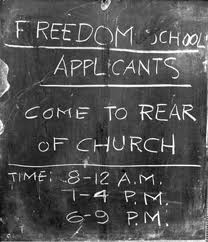 Think school choice is solely a conservative idea? Think again.
* After the Civil War, blacks in the South who were tired of waiting for the government to organize schools – or who were dissatisfied with the quality – built schools themselves.
* During the civil rights movement, activists in both the north and south established alternatives to segregated, second-rate schools.
* In the 1960s, leading progressives proposed private-school vouchers because of anger over failing inner-city schools.
Historical gems like these sparkle throughout “The Secret History of School Choice: How Progressives Got There First,” a 2005 academic journal piece by Georgetown University law professor James Forman Jr. From Reconstruction to the civil rights era to the “free schools” and “community control” movements – indeed, for most of American history - progressives have been a leading voice for choice.
So forget what you hear from choice critics and read in the newspaper. The parents who use vouchers and tax credit scholarships to help their kids can’t be shoved into one political box or another. The same goes for the political and philosophical roots that sprouted those options. Conservatives have advanced compelling reasons for school choice. So have progressives. (more…)
Editor's note: Vouchers, charters, tax-credit scholarships - all part of the right-wing conspiracy to privatize education, right? Doug Tuthill argues that it's the political left that should champion choice - because it's the only path to equal opportunity in education.
For progressives who believe in equal educational opportunity, the current state of school choice is problematic. As the movie "Waiting for Superman" illustrated, limited access to school choice is exacerbating inequalities. Parents who win lotteries, have the right political connections or have the money to buy homes where they want have schooling options less fortunate or less wealthy parents don’t have.
To resolve these inequities, progressives can advocate eliminating all parental choice - and force every child to attend their assigned neighborhood district school - or they can support making school choice ubiquitous.
Leveling the playing field by eliminating all parental choice is not a viable option. This solution would mean closing down all within-district choice programs such as magnet schools, alternative schools, open enrollment programs and career academies, and choice programs that occur outside school districts, including charter schools, online learning programs, homeschooling and private schools. This approach would also require eliminating the most common form of school choice: parents buying homes in their preferred school zone. To stop this practice the government would need to assign families to school zones and then require them to purchase homes in their zones. Of course, this is never going to happen. (more…)
"We're living in a revolutionary moment," says Ben Austin, executive director of the Parent Revolution, as we begin our interview for redefinED's inaugural podcast. And the moment to which he refers has been marked by California's "parent trigger," a law that has upended the status quo at one Compton school in a way that few education measures can do with such sweep. A majority of parents at McKinley Elementary wanted a charter operator to come and take over their struggling school, just as the parent-trigger law allows, and what Austin and the Parent Revolution fought for, and the Compton Unified School District has done everything possible to make their job harder. The struggle will be left to the courts to resolve, but Austin does see success in the very nature of what the law has sanctioned.
The trigger has allowed parents to essentially organize and effectuate change at a bargaining table that has been the exclusive province of school boards and teachers unions. Whatever the outcome at McKinley, the law has transformed relations between school boards and the parents at their failing schools, said Austin, a former member of the California State Board of Education, who also served Los Angeles as a deputy mayor from 2000-2001 as well a variety of roles in the Clinton White House. "Already there are parents across California that are organizing to get to 51 percent with no intention of at least initially turning the signatures in," he said. "They're organizing to bargain. They're organizing to basically say, 'You haven't listened to us for years, but now we have the power to fire you, so you have to listen to us.'"
We talked with Austin about the launch of the Parent Revolution and how its role as a parent union might manifest itself at the bargaining table. What else did we ask?
Why the parent trigger, and not a more collaborative approach? "It's people with power that want a collaborative approach ... Power and Money is the language that the other side understands, and if you're not speaking that language, they're not going to listen to you."
Can the PTA fulfill the role as a parent union? "We've had good experiences with the PTA, and we've had bad experiences with the PTA. We believe there needs to be a lot more "P" in the PTA."
Click here to listen to the rest of the conversation, which runs about 24 minutes.

