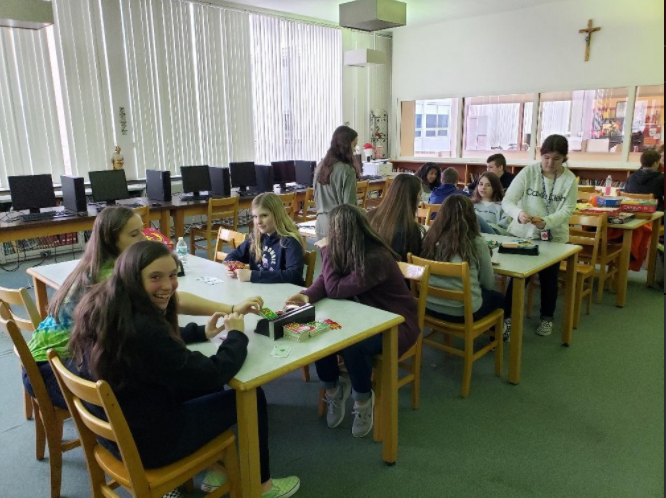
Bishop McCort Catholic High School in Johnstown, Pa., offers one of the best college preparatory programs of study in the area in a unique academic environment.
Editor’s note: reimaginED guest bloggers Walter Blanks Jr. and Nathan Cunneen, who serve as press secretary and communications associate, respectively, for the American Federation for Children, recently had the chance to see the inner workings of several charter, private and virtual schools in Pennsylvania. Their visits came courtesy of an AFC partnership with the Pennsylvania Coalition of Public Charter Schools, the Commonwealth Foundation, and Harrisburg Families United. In this post, Cunneen reports on what he saw at one of those schools during the “Stronger Together Tour.”
Bishop McCort Catholic High School is located roughly 300 yards from one of the worst school districts in Pennsylvania and one of the poorest areas in the state.
The district down the road, which remained closed for the entirety of last year, receives approximately $16,000 per pupil from the state. Meanwhile, Bishop McCourt educates nearly 400 students at a $7,000-a-year rate, inside a 100-year-old building.
The school has a 100% graduation rate over the last five years.
Most of the students are recipients of the Pennsylvania Educational Improvement Tax Credit, which helps them afford to attend McCort; otherwise, they couldn’t afford to do so.
This example just goes to show – money isn’t everything.
Bishop McCort has the highest private school transfer rate in the state of Pennsylvania. More than 70 students seeking a high-quality, in-person education experience transferred in last year. McCort has room for more students, but Pennsylvania’s hesitancy to expand school choice options further makes it increasingly difficult for families to exercise that option.
Walter and I had the opportunity to address the student body at McCort, along with the school’s CEO Tom Smith; Harrisburg Families United CEO Naijimah Roberson; parent Andrea Jaber; and two students, Ean Jaber and Kiersten Way. We took a few moments to share our personal education choice stories and explain why school choice is so important.
It was clear that no one at McCort takes education choice for granted. Everyone, from students and families to teachers and administrators, know they are receiving and providing a top-notch education, and they want that for other kids. In fact, during the assembly, principal Smith asked everyone if they knew someone who wanted to attend Bishop McCort but couldn’t afford it.
Nearly every student raised his or her hand.
It was moving to hear the students talk about their school. Ean, during his address, explained the joy he felt to transfer from another school. He told his audience: “I wish I’d started here earlier.”
Perhaps more Pennsylvania students will have that opportunity thanks to the advocacy of engaged students like Ean and their families.
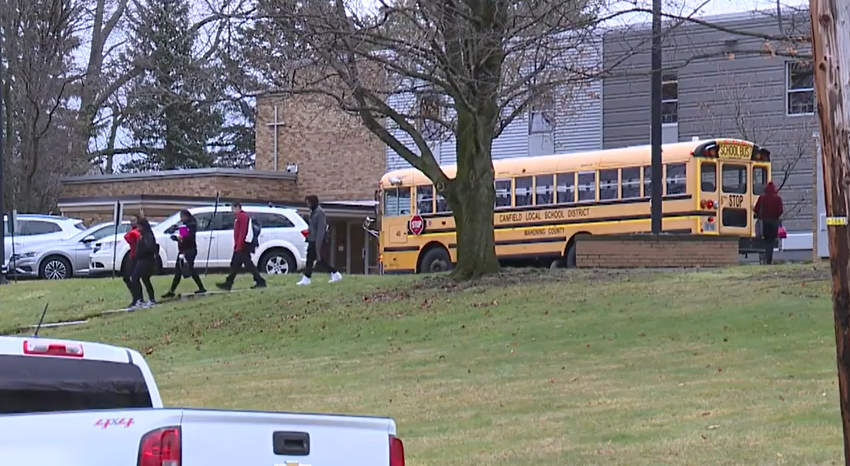
The Ohio Senate’s education plan for the state budget for 2022–23 would prioritize families’ needs and wants.
Editor’s note: this commentary from Aaron Churchill, the Ohio director for the Thomas B. Fordham Institute, appeared recently on the Institute’s website.
Across the nation, state lawmakers have been heeding the call for parents to have more control over their children’s education.
Recognizing that there is no “one-size-fits-all” model that meets every kid’s need, legislators have been actively strengthening school-choice policies and expanding options for families. Florida, for instance, recently expanded its nation-leading private school scholarship programs. Iowa just significantly improved its charter school law. West Virginia and Kentucky created brand-new educational savings account (ESA) programs that offer parents flexibility in how they meet (and pay for) their kids’ educational needs.
So far this year, Ohio’s education debates have paid scant attention to choice. Lawmakers have focused on technical issues with the school funding formula and overall spending levels. But that changed last week with the unveiling of the Senate’s education plan for the state budget for the fiscal years 2022–23 (HB 110). If enacted, its proposals would be a huge step forward in putting families’ needs and wants at the center of education policy. Here are highlights of the Senate approach:
Removes caps on the number of EdChoice scholarships available. EdChoice, the largest of Ohio’s scholarship programs, allows children from low- and middle-income households to attend private schools of their choice. The program has grown significantly over the past decade, but legislators have limited the number of available scholarships, which in the past has left some children in the lurch. The Senate plan would ensure that any eligible student applying for an EdChoice scholarship receives one.
Increases the EdChoice and Cleveland scholarship amounts. The EdChoice and Cleveland scholarship amounts have fallen well behind public school spending. Today, they’re worth just $4,650 in grades K–8 and $6,000 in grades 9–12, even as Ohio’s public schools spend on average $14,000 per pupil. The Senate plan narrows that gap somewhat by lifting these scholarship amounts to $5,500 and $7,500 in grades K–8 and 9–12, respectively. Importantly, it also ensures that in future budgets, scholarship amounts will automatically rise in proportion to any increase in public schools’ base funding. This provision would create more predictability and fairness for families that rely on these programs.
To continue reading, click here.
Critics have spilled considerable ink attacking Florida’s proposed Family Empowerment Scholarship. The voucher would cost about $100 million and allow at least 15,000 low- and working-class students to attend private schools.
“I’m afraid it will do damage to the regular public schools in the state of Florida,” said Sen. Bill Montford (D-Tallahassee), who opposed “diverting” money in the Florida Education Finance Program (FEFP) from public schools to private schools.
“DeSantis private school voucher plan robs Florida public schools of needed money,” exclaimed the Palm Beach Post editorial board.
“The plan would divert money from public education in a state that already ranks a disgraceful 41st in the country in per-pupil funding and 46th in teacher salaries,” the Gainesville Sun editorial board wrote.
These critics seem to think the $100 million for the Family Empowerment Scholarship could be used to improve public education, increase per-pupil spending and raise teacher salaries all at the same time. But it’s not like the 15,000 kids who could have accessed the program are suddenly going to educate themselves.
Although $100 million would be removed from the total public school pot, 15,000 students – and many of the expenses that come with them – would go, too. And while the proposed program isn’t finalized, both the House and Senate versions set the voucher amount at a percentage of what the FEFP pays public schools.
One version even excludes more than $1.6 billion in the FEFP from being used to calculate that percentage. That’s $1.6 billion that can be spread among remaining public school students.
Additionally, the FEFP doesn’t cover the full cost of public education in Florida, as local and federal sources collect billions more. This is why the average scholarship from the Florida Tax Credit Scholarship program is worth just 59 percent of Florida’s per pupil expenses.
Every student who takes a scholarship not only removes expenses from public schools, but also creates a savings that can be spread to other students. That is why multiple studies have shown that scholarships save taxpayers money. It’s also part of the reason why the Florida Supreme Court tossed out a lawsuit claiming scholarships harmed public schools.
And it’s not like the FEFP is some sacrosanct source of public school funding, either.
Last year, the state “diverted” $221 million from the FEFP to fund 31,044 private school scholarships for children with special needs. No one batted an eye.
Even if the Legislature decided to appropriate $100 million from the General Fund to pay for the Family Empowerment Scholarship, as it does with the Gardiner Scholarship program, the FEFP would decline by around $100 million anyway. Why? Money is fungible.
The FEFP is mostly based on the number of students enrolled in public schools. If 15,000 low-income students leave public schools because they now have a scholarship to a private school, that is 15,000 fewer students to calculate a base student allocation and more. The FEFP would decline by about the same amount as the total voucher fund. Other pots of money still would be available for the remaining public school students.
Money is fungible, but it’s not magical. You can’t take a voucher worth a fraction of per-pupil spending and suddenly increase per-pupil spending in public schools, and increase teacher pay at the same time. Let’s stop pretending you can.
 Forty-six years ago a plaintiff named John Serrano sued the State of California, asserting that the capacity of school districts to raise money was grossly unequal, hence unconstitutional. The quality of education in property-poor districts was said to be diminished by the resulting disparities in spending per pupil. Students had a right to a more rational and fair distribution of money.
As in most litigation the claimants had to prove some real injury. The disparities in spending were colossal, ranging, at the extremes, from a few hundred dollars per pupil in property-poor districts, to several thousand in freakishly wealthy industrial centers and top-rank suburbs. The injury seemed self-evident.
But it wasn’t. By whichever measure of outcome - graduation, test scores, reputation - there was no pattern linking spending to actual quality. In addition, surprisingly, there was little or no evidence that children from poor families were systematically getting less spent on their schools. The lawyers for Serrano et al. could not credibly assert that money was the key to quality education or indeed, that it affected the success of schools in any way - except one. It was obviously true that the richer districts could buy more stuff. They could hire more teachers, administrators and superintendents, at higher salaries, build fancier buildings and secure the most up-to-date supplies, books and equipment. The trial judge decided this was injury enough. His judgment for the plaintiffs was affirmed by the California Supreme Court. As yet, however, 40 years later, no one has succeeded in establishing a clear link between spending per-pupil and the benefit for the child.
Nevertheless, spending has skyrocketed in succeeding generations across the nation for reasons political - principally the monopoly power of public-service unions. But the apparent disconnect between spending and quality of education remains. This reality has conflicting implications for the school choice movement. It reduces the political significance of the consistent discrimination in spending against today’s charter schools; we are not at all clear that it really affects outcome. On the other hand, it is plain to anyone who knows the facts that, whatever it is that does make a school successful, it can be had without exploding the cost. In short, if school choice supporters are willing to accept and even exploit politically the cheaper regimes now in place, they have a more powerful case. (more…)

FDOE: Florida’s school district data reporting systems are highly regarded and are used as models for other states.
Editor's note: On redefinED last week, Jason Bedrick at the Cato Institute offered suggestions to the Florida Department of Education on improving its financial transparency, including how to make fuller, more accurate per-pupil spending figures easily available to the public. The post drew the following response from the FDOE communications office.
The Florida Department of Education staff is concerned the Cato Institute’s release on financial reporting failed to explore or consider important elements of the Florida financial reporting process. In the process of grading all states, researchers often use a one-size- fits-all research model that does not necessarily accommodate state variation in financial reporting. To validate initial findings, it is appropriate to share the findings with information sources before publication. Below is a summary of available Florida school district finance data.
Transparency Florida
Florida’s school district financial reporting systems for approximately 2.7 million students and over 321,000 full-time employees have long been considered among the best in the nation. With the enactment of the Transparency Florida Act established in Section 215.985, Florida Statutes, by the 2011 Florida Legislature, the FDOE has improved the availability of school district financial data for taxpayers, parents, and education advocates. Governmental agencies, including the FDOE and school districts, provide current budget data and the most recent year’s revenue and expenditure information on their websites. Within the next year, school districts also will provide current-year expenditure information and vendor contract information on a regular basis.
Profiles of Florida School Districts
The Profiles of Florida School Districts – Financial Data is an annual publication that summarizes school district Annual Financial Report data that is available on the department’s webpage at https://www.fldoe.org/fefp/sdafr.asp. The Annual Financial Report presents data at the district level detailing revenue by source and presenting expenditures by fund, function, and object. For ease of use, the FDOE condenses the data, in part, into the profiles publication, which is available at https://www.fldoe.org/fefp/profile.asp. (more…)
by Jason Bedrick
 Florida earns high marks for its innovative education reforms and strong academic performance, but its level of financial transparency leaves much to be desired. In a new report from the Cato Institute on financial transparency, the Florida Department of Education earned a D for the data published on its website.
The report, “Cracking the Books: How Well Do State Education Departments Report Public School Spending?”, examines the spending data that all 50 state education departments make available to the public on their websites. The report reveals that very few state education departments provide complete and timely financial data that is understandable to the general public.
As in school, these grades are intended to be informative, not punitive. Since Florida has a record of striving to improve, here are a few ways the FLDOE could be more transparent with its data:
1) Report total per pupil expenditures, not just operating. Half of all state education departments publish total per pupil expenditure (PPE) figures but Florida does not. At present, the FLDOE’s “Financial Profiles of Florida Districts” only includes “current expenditures per UFTE (unweighted full-time equivalent),” which excludes expenditures for capital projects and debt service. While these expenditures are reported separately, citizens looking for the total cost per pupil would have to break out a calculator.
The differences between total and operating PPE can be quite significant. According to the most recent data from the National Center for Education Statistics (2009-10), Florida’s total PPE was $10,283 on average that year while Florida’s Financial Profiles reported that operating PPE was only $8,578.
Moreover, citizens looking for the change in PPE over time would have to gather the data from multiple reports since the FLDOE does not provide a single chart or table displaying that data. By contrast, the FLDOE does provide a table showing the change in average employee salaries over time.
2) Break down total salary data and publish average employee benefits. (more…)
The collision of budgetary distress and school vouchers has produced a familiar financial accusation in North Carolina. But an honest accounting of the state’s new scholarships for low-income children finds no conflict with public school spending.
This is not meant to diminish the political fight over the budget there. After all, North Carolina is ranked 45th in per-student spending and 46th in teacher pay, and has been dropping in those rankings in recent years. Even some Republicans voted against the 2013-14 budget this week as the party sent a lean appropriations bill to Republican Gov. Pat McCrory on Wednesday.
The point, rather, is that the education budget is made no worse by the inclusion of a $10 million voucher program for low-income students.
Various activists and commentators have tried to make the opposite case, one portraying school vouchers as “siphoning public dollars away,” another saying private schools “seek to profit off of public schools,” another finding incongruity in not giving teachers raises while “pumping public funding into a voucher program.” The Progressive Pulse blog wrote “the larger the program becomes, the more money it will lose for North Carolinians.”
The Pulse based its claims on a legislative fiscal evaluation of the scholarship program that was previously approved in the House, but pointedly ignored the local tax savings. When local and state are combined, the evaluation put the five-year savings at between $23.4 million and $52.3 million.
What’s more, the savings are likely to be much greater because the evaluation used a methodology that, to put it charitably, is outside the mainstream. (more…)
 The American school system was, from its inception, a product of intolerance for human difference. Grounded in 19th Century religious and cultural prejudice, it was artfully designed to assure no government resource would end up supporting the teaching of religious or cultural notions that were uncongenial to the Protestant majority. Carefully limited by the constitutions of various states, the curriculum was centralized and sanitized in each of the 50 school systems to favor the beliefs and values of the dominant group. Further, students were confined to their own school districts - indeed to their own neighborhoods - assuring (at least in the cities) that children of different social classes and races would see little of each other within government schools.
One overall effect was and is a quasi-market for the affluent; well-to-do families choose admission to the government school of their preference. By contrast, for the ordinary family, government schools are a compulsory monopoly. There are, of course, private schools, and we know from survey research and direct experience that they are very attractive to the poor. Nevertheless, though most such schools are relatively inexpensive, they can scarcely compete with the “free” government alternative. It is, therefore, remarkable that the private sector is still able to attract nearly 10 percent of the total student population; equally impressive is the proportion of these students who come from poor families who make enormous sacrifice to pay tuition. I suppose Justice Sotomayor’s story suggests this reality.
The tragedy is 19th Century America, a new country exploding with creativity, decided to hobble the minds and souls of its children with a system of finance and assignment that for ordinary families was, and remains, oppressive. Americans spend $800 billion each year in state-owned schools; I suspect they constitute the largest socialist enterprise outside of China.
The effects of this government monopoly upon the ordinary family have been what one would predict: The family is put under the most destructive pressures. At age five the child is taken from the parent who has been both friend and advocate. The child now discovers the parent is impotent to intervene. The parent learns self-contempt and withdraws from responsibility.
Whatever one’s philosophical starting point, schools in the U.S. pose a moral issue of crisis proportions. Intellectual monopoly by The State is especially peculiar in a culture as diverse as ours. Where there is no consensus about values, it is on its face ludicrous for an ephemeral regime of bureaucrats to impose its own favorite curriculum upon everyone. The case against monopoly, however, need not rest upon pluralism. Monopoly control over value content is unjust and, in the end, will be destabilizing even in a society with a common culture. The idea of a social consensus itself rests upon an underlying conception of human freedom. That is, consensus is a clustering of beliefs that are voluntarily held. We value these ideas not simply for the numbers who profess them, but out of respect for the individual human persons who freely believe them. Consensus can, of course, be one among other principles of policy, but it is a very weak principle. A just government never opposes value diversity as such, but only those rare forms of diversity that threaten social order. To say diversity itself is socially destructive is merely to beg the question. It may be quite the opposite. That very issue seems to me at the heart of the problem.
In the end it boils down to this question: Whom do we trust to choose the ideas the child of the ordinary family will study - the family or the government? Society needs a theory of the best decider - the one who decides best for the good of individual children and for the common good. (more…)
Charter schools. They're becoming more involved in the political process, reports the Florida Times Union. The Bradenton Herald takes a look at the challenges ahead for Rowlett Elementary, the Bradenton magnet that's becoming a charter school. So does the Sarasota Herald Tribune. (Sidebar on other charter school conversions here.) The fledgling Ben Gamla charterschool in Pinellas closes because of a dispute with its national board, reports the Tampa Bay Times. The Lake Wales Charter School system has more than 400 students on a waiting list for its middle school, prompting debate how to expand, reports the Lakeland Ledger.
 Dual enrollment. Districts are chafing at having to pick up the tab, reports the Tampa Bay Times. More from the Northwest Florida Daily News.
School choice. The lottery process will be a topic for discussion at a school choice summit in Palm Beach County. Extra Credit.
Common Core. Training helps teachers instill love of math, reports StateImpact Florida. It's clear, concise and good for kids, says a teacher at a high-poverty school in this column by Karin Choweth at Ed Trust (H/T Tampa Bay Times).
Testing. The Happy Scientist raises questions about the science FCAT. Miami Herald.
Humanities. Don't forget them amidst the growing emphasis on STEM. Tampa Bay Times.
School technology. Hillsborough teachers like BYOD. Tampa Bay Times. (more…)
School choice. Pasco Superintendent Kurt Browning says the district's record in providing more school choice has been "abysmal." Gradebook.
Charter schools. The principal of a YMCA charter in Venice is put on leave for undisclosed reasons. Sarasota Herald Tribune.
School turnarounds. Seven teachers who applied to keep their jobs at struggling Lacoochee Elementary in Pasco are not selected. Tampa Bay Times.
School rankings. Newsweek says 115 of the nation's 2,000 best high schools, including five of the Top 20, are in Florida. StateImpact Florida. Nine Volusia schools make the list, reports the Daytona Beach News Journal.
School spending. Miami Herald: "On Wednesday, the Miami-Dade School Board voted to explore the establishment of a trademark and licensing program that would create official district merchandise and at the same time outlaw pirate products." The Lake County School Board looks at a slew of cuts to close a $16 million budget deficit, reports the Orlando Sentinel. The Marion school board rejects pay raises for teachers and paraprofessionals through the end of this year, reports the Ocala Star Banner.
Legislative wrap-up. Parent trigger aside, Patricia Levesque sees a lot of positive changes. Orlando Sentinel. (more…)

