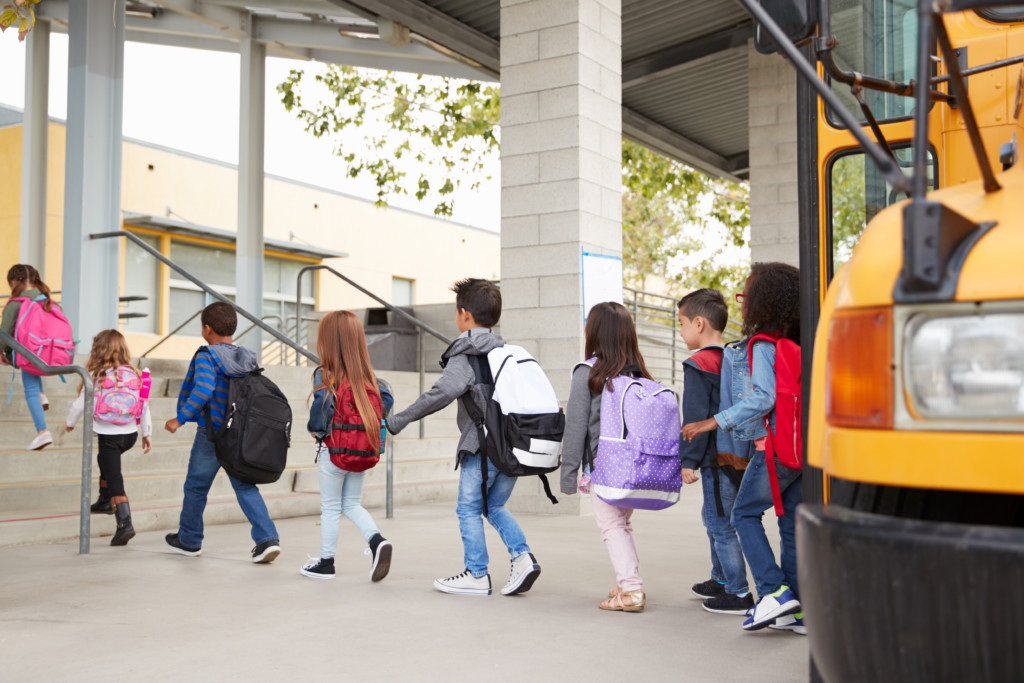
 Public schools historically have been defined by their location. Whether one’s home is in a “good school district” matters. But the last few years have raised important questions about whether tying children to a particular building is wise policy.
Zoning laws may have made some sense decades ago, but today, they serve little purpose other than protecting established interest groups at the expense of children and families.
Some parents have lofty goals for their child’s school. Yet everyone wants his or her child to be able to read, write, and solve math equations proficiently. Parents need to know that their local public school can teach the basics. Unfortunately, some public schools across the country are failing to meet this rudimentary requirement.
Recent studies show that test scores have plummeted in public schools across the nation during the pandemic. Math scores have decreased in every state. Reading scores fell by the largest amount in more than 40 years. In addition to these poor numbers, many public schools have failed to help students socially and emotionally during these turbulent times. Isolation and depression are up, especially for those in high school.
Despite warnings that this might happen, teachers’ unions argued repeatedly that kids could learn from anywhere. Maybe we should take that claim seriously.
Obviously, kids can learn from home, but children should also be able to learn at the institution that suits their needs. Remote learning, charter schools, micro-schooling, also known as small, personalized private schools, and homeschooling all point to the same question: What is preventing students from learning in the environment of their choosing?
For most kids, the answer is school zoning laws. School zones give local schools a quasi-monopoly over the local area. One of the functions of zoning laws is that they ostensibly ensure that children go to a school near their house; unfortunately, even in that most basic function, zoning laws repeatedly fail.
In Hillsborough County, Florida, for example, possible changes in school boundaries are upsetting some parents, while others hope changes will result in their kids being sent to more highly rated and conveniently located schools.
More perniciously, these regulations stifle innovation and heighten inequality. Public schools in many parts of the country get a substantial amount of funding from local property taxes, which may make financial sense, but it starkly disadvantages low-income children. Parents in low-income school zones have to send their kids to the local school, which typically has significantly worse educational outcomes.
Zoning laws don’t help schools or administrators much either. The system makes schools beholden to teachers’ unions, locking parents and students out of the reform process. This, in turn, breeds an unhealthy lack of trust between parents, teachers, and administrators.
Furthermore, the funding system means that “bad” schools have little ability to financially compete with “good” schools, making things difficult for reform-minded administrators.
Of course, zoning laws don’t prevent all competition. Charter schools, private schools, and homeschooling allow some flexibility. But the success of these programs indicates that the typical defenses of school zoning don’t hold much weight. Kids at charter schools make friends despite not living next to each other. Competition for school choice scholarships would drive down the need to rely on local property taxes.
School zoning laws are a relic from a bygone (and segregated) time without any school choice. In today’s era of dynamism, the downsides to zoning laws far outweigh their benefits. Parents are looking for change. We should give it to them by eliminating the archaic school zoning law requirements holding children back.

Trippi
Some people grow up on the wrong side of the tracks. Joe Trippi, the legendary Democratic consultant, grew up on the wrong side of the school zone. On one side of the arbitrary, invisible line that ran down his street in L.A.: safe schools, high school grads, kids who went on to college and careers. On the other side: gangs, dropouts, a dead end.
Trippi got across the line, thanks to a tenacious mom. But, he told redefinED in a recent phone interview, he’s haunted by what happened to the kids who didn’t. And 50 years later, he’s aghast that the same “crazy way to shuffle kids around,” as he put it, remains largely intact.
“It’s just unfathomable to me,” Trippi said in the podcast attached below. “I think about all of those years, and that system is still in place today, everywhere. Most places anyway. Too many places.”
Trippi is yet another high-profile Democrat who supports school choice, including publicly funded private options like vouchers and tax credit scholarships. His personal experience informs that position. So does something more urgent and practical: a belief that with so many kids falling through the cracks, it makes sense to put all options on the table. “I think we should try them all,” he said. “The current status quo, it may be working for some kids, maybe even many." But for too many, it isn't.
Democrats and school choice have a long, tangled relationship. Few know better than Trippi. He’s been deep inside Democratic politics since the 1970s, and his firm, Trippi & Associates, has advised National School Choice Week since its inception in 2010. So what’s he seeing on the ground now? A lot of Democrats coming around on school choice, especially at the local level, especially in inner cities.
Even more will come around, Trippi said, if both sides cut the nastiness, and if school choice supporters continue to stress bipartisanship. To that end, the Republican push to emphasize school choice in the run-up to the 2014 elections carries some risk, he said. “I’m not begrudging them for their efforts. I know they care about it,” Trippi said. But making school choice partisan potentially sustains “the polarization and the demonization on both sides.”
The choice for every child will be made by some adult. The only question is which authority will impose its will on the child of the not-so-rich; will it be the parent or the stranger state?
Up to a certain point schooling is an example of the free market. Any family with financial resources or the ability to home school can choose where and how children are educated. However, schooling is a compulsory good and the forms of education that satisfy the parent’s duty are limited.
Moreover, parental authority over schooling is an instrument to be judged by its effect upon the goals to be served. One of its goals may be the healthy development, not merely of the child, but of the parent - in turn enhancing the family’s possible contribution to specific social goals. Suppose one decides that a 7-hour-a-day, 12-year disengagement of the parent from the child is a very bad thing for the social order. Suppose it teaches parents to leave responsibility to government strangers and invites the child to view the role of parent as an insipid condition to be avoided. What deadly disease of contemporary society does this image identify? Would responsible parental choice of school be at least part of its necessary social medicine? In the short run or the long run or neither? Perhaps this is the kind of question about ends that a fixation on economic means tends to obscure. The American Center for School Choice exists to ensure the conversation about parental choice includes serious discussion of both ends and means.
To the extent that any market is unregulated or “free” it is left so for the enhancement of certain ends that are approved by our society and its 51 constitutional governments. One of these ends is rather immediate; before all else, the free market is an instrument to achieve the personal objectives of individuals who exchange goods and services or make promises to do so. Promises create contracts, which are enforced (or not) by courts, which are an arm of formal government and decide whether certain bargains are illegal or ineffectual - because there are other ends that can override the aims of individuals. An example is an agreement for delivery of illegal drugs or (in California) the livers of force-fed geese. The free market has these various limits because society has purposes other than realizing individual choices.
Although contracts for schooling are - up to a point - relatively free, what is peculiar about the market in schooling is the law and reality that the individual most affected by the free choice has none at all himself. Nature has decided that Junior’s intellectual fate is in the hands of one adult or another; some older person will decide. If schooling is a free market, it is not his freedom. Indeed, he is the subject matter of a contract between two adults - parent and educator. He is in effect a valuable animal who is being farmed out to the greenest pastures the parent can find and afford.
Society and its laws thus recognize the reality that the choice of schools - if it be a “free” market - is a unique species of choice, having objectives that extend beyond just the child for whom the choice is made. (more…)
Charter schools. What happened to the Ben Gamla charter school in Pinellas is a "study in bad charter school governance." Choice Words. Parents try to figure out what to do now that a struggling charter school in Deland is closing. Daytona Beach News Journal. Ditto for the parents of a charter school in Lutz. Tampa Tribune. After 22 years in traditional public schools, a local principal is hired to lead the city of Cape Coral charter school system. Fort Myers News Press.
 Homeschooling. The Palm Beach Post takes a look at Space of Mind, a pricey but fascinating home-school school that insists it's not a school.
Tax credit scholarships. The number of parents seeking them grows in Highlands and beyond. Highlands Today.
School grades. Education Commissioner Tony Bennett is recommending another year of a "safety net" provision so grades don't drop more than one letter grade. Tampa Bay Times, Miami Herald, Palm Beach Post, Orlando Sentinel, Florida Times Union, Tampa Tribune, TCPalm.com, Associated Press. Other states are watching the goings-on. Miami Herald. Another story on how everyone is expecting grades to drop. Sarasota Herald Tribune.
VPK. Needs to be more focus on pre-K for poor kids. Pensacola News Journal.
Common Core. The Tallahassee Democrat offers an overview of the big challenges and potential payoffs ahead. (more…)
Teachers unions. The rise of Fedrick Ingram, new president of the the Miami-Dade teachers union. Miami Herald.
Teacher conduct. Ocala Star Banner: "Teacher suspended for bonk with a banana."
Dual enrollment. A mandate that school districts pick up the tab for dual enrollment students is putting districts in a tough spot. Fort Myers News Press.
Rick Scott. Gov. Rick Scott must decide on several high-profile education issues, including virtual school funding and the future of state-mandated tutoring for low-income students, reports News Service of Florida. He's going to veto a proposed tuition hike, reports the Times/Herald.
School atmosphere. A Palm Beach County School District investigation finds an elementary school torn apart by a feud between the principal and a school board member, reports the Palm Beach Post. The Florida Commission on Ethics dismisses two complaints against the board member, including one filed by the principal, the Post also reports.
Bullying. State officials work with the Walton County school district to combat bullying, reports the Northwest Florida Daily News. Pasco Superintendent writes in this op-ed for the Tampa Bay Times that bullying prevention is a moral imperative.
School closings. Citing cost concerns, Manatee plans to close a small high school for struggling students. Bradenton Herald. (more…)
Virtual schools. In an Orlando Sentinel op-ed, U.S. Rep. Daniel Webster, R-Winter Garden, politely suggests to the Florida Legislature that cutting funding for Florida Virtual School is a bad idea.
 Charter schools. Many charter schools struggle under the state's funding system to spend enough in the classroom, reports the Daytona Beach News Journal. Parents of struggling Bradenton Charter School plea with Manatee board members to keep the school open, reports the Bradenton Herald.
Magnet schools. The possibility of new ones is under consideration in Pinellas as the district looks at potential remedies for 11 struggling schools. Tampa Bay Times.
Parent trigger. Education Commissioner Tony Bennett suggested changing the bill to give school boards final say reports StateImpact Florida. The bill is a "simplistic sham," writes the Palm Beach Post.
Diplomas. The House unanimously passes a bill to provide alternative pathways to graduation, including more emphasis on career education, and sends it to Gov. Rick Scott. Coverage from Tampa Bay Times, South Florida Sun Sentinel, Orlando Sentinel, Associated Press, Tallahassee Democrat.
Board of Education. The Tampa Bay Times documents the downfall of former board member Akshay Desai's health care business.
Educator conduct. Four Orange County staffers are disciplined after making disparaging comments on facebook about students with disabilities. SchoolZone.
Testing. FCAT time again, notes the Daytona Beach News Journal. Preparing for the FCAT and other tests online has been a challenge, writes the Tampa Bay Times. Testing time is eating into computer use, reports the Palm Beach Post. A prime example of testing going too far, writes Orlando Sentinel columnist Scott Maxwell. (more…)
Charter schools. The Pinellas school district could lose $6 million next year if the school board approves a new charter school and the proposed expansion of several others. Gradebook.
Jeb Bush. Digital learning, Common Core and empowering the parents of students with disabilities top the legislative agenda for Jeb Bush's Foundation for Florida's Future, says executive director Patricia Levesque. StateImpact Florida.
School spending. Lawmakers consider bringing back the "critical needs" millage, reports Gradebook. The Lee school district is auctioning off two unused buildings, reports the Fort Myers News Press.
School safety. Lawmakers are poised to pass legislation that would allow school nurses to use EpiPens for students without a prescription. Tampa Bay Times. (more…)
School choice rally: More than 1,000 turn out in Tallahassee from magnet, charter, voucher, virtual and other school choice sectors (redefinED).
Charter schools. The Broward school district's former construction chief, forced to resign, now works for Charter Schools USA. Miami Herald.
School rezoning. Boynton Beach version. South Florida Sun Sentinel and Palm Beach Post.
Teacher conduct. Though criminal charges were dropped, a Palm Beach County band director is suspended for 10 days without pay for allegedly using band funds to bring relatives on a trip to Paris. South Florida Sun Sentinel and Palm Beach Post.
Teacher evaluations. Orlando Sentinel's Beth Kassab: "The state's system for evaluating teachers is nonsense." (more…)
Florida Formula. South Carolina is looking at third-grade retention and other parts of the Florida model. The State.
Parent trigger. The Senate Education Committee passes the parent trigger along - altogether now - party lines. The Buzz, WFSU, Tallahassee Democrat.
Charter schools. StateImpact Florida writes up a bill sponsored by Sen. Bill Montford, D-Tallahassee, that would allow districts to create charter-like "innovation schools." (The Senate Education Committee passed the bill unanimously.) The Orlando Sentinel notes passages of another charter bill that would beef up accountability requirements.
Dual enrollment. The DOE picks the College of Central Florida to create a website promoting dual enrollment. Ocala Star Banner. (more…)
Charter schools. Some big ideas on tap for today's discussion in the Senate Education Committee, including a proposal to let school districts start their own charter schools. Tampa Bay Times.
Tax credit scholarships. Jewish groups let lawmakers know much they value them. South Florida Sun Sentinel.
Parent trigger. Senate sponsor Kelli Stargel, R-Lakeland, crafts an amendment that would leave the final parent trigger decision to school boards, not the state Board of Education, reports the Tallahassee Democrat. Creative Loafing notes the parent trigger origins on the political left, but inaccurately writes that unlike California, "troubled schools singled out in the Sunshine State would be taken over by a for-profit corporation." Fund Education Now's Kathleen Oropeza pens an anti- parent trigger op-ed for the Gainesville Sun. Former state Sen. Paula Dockery pens one for the Miami Herald.
Virtual schools. SchoolZone writes up the proposed funding cut to Florida Virtual School.
Magnet schools. The proposed Senate budget includes $1.5 million for a proposed STEM magnet in Pasco. Tampa Bay Times. (more…)

