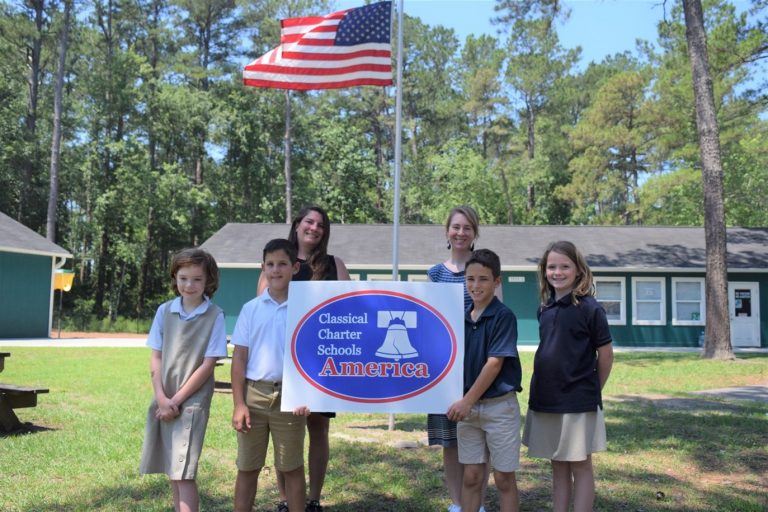
Students at Charter Day School, which in 2021 changed the name of its network to Classical Charter Schools of America.

Charter schools are still public schools, at least for now.

The U.S. Supreme Court announced Monday that it would not hear Charter Day School, Inc.  v. Peltier, a closely watched case involving a North Carolina charter school’s dress code but that could have had broader implications for charter schools.

A group of female students sued Charter Day School, arguing its skirts-only dress code rule violated the Constitution. Their case hinged on whether the school was public or private under North Carolina law. Charter Day School had argued that charter schools, which receive government money but are privately managed, are essentially private and therefore not subject to the Constitution’s Equal Protection clause.

The high court’s decision to turn away the case came after the U.S. solicitor general for the Biden administrator advised the court not to hear the case and said that the U.S. 4th Circuit Court of Appeals 10-6 decision in favor the plaintiff was correct and that the case was not “a good vehicle for considering the question presented.”

The question it referred to centers on the status of charter schools. A ruling that affirmed Charter Day School’s assertion that such schools are private could have opened the door to faith-based charter schools that would not be bound by federal anti-discrimination laws.

Another test case could come from Oklahoma, which last month approved an application for the nation’s first religious charter school. The state’s Catholic church leadership have said St. Isidore of Seville Catholic Virtual Charter School would enable them to better serve students in rural areas without access to traditional Catholic schools and that charter status would allow it to serve families of all incomes as well as provide services for students with special needs.

Opponents argued that allowing the school violated the constitutional separation of church and state.

The application, which the Oklahoma Stateside Virtual Charter School Board approved on a 3-2 vote, has been mired in controversy, with advocates on both sides threatening a legal challenge depending on the outcome.

Brett Farley, a spokesperson for the Catholic Conference of Oklahoma, responded to the high court’s decision not to take up the North Carolina case, saying that any ruling it would have issued likely would have been limited to North Carolina.

“While it's a surprise, this case was not an ideal vehicle to resolve the question precisely because it's one can only be resolved state by state given that there are 45 unique charter regimes,” he said. “What may be true in North Carolina, therefore, isn't necessarily true for Oklahoma or for other charter states.”

However, a national charter school advocacy group, which opposed the Oklahoma charter application, praised the Supreme Court’s decision as confirmation that charter schools are public.

“We are pleased to put this matter behind us and move forward with the critically important work of ensuring every child in this nation has access to a high-quality public education,” said Nina Rees, president and chief executive officer of the National Alliance of Public Charter Schools. “The actions of the high court affirm that as public-school students, charter school students are entitled to the same federal protections as their counterparts who attend district schools."

David and Amy Carson of Maine, pictured here with their daughter, Olivia, are challenging a decades-long policy that that limits to secular schools a state program offering financial assistance to families seeking education choice for their children.

The question of whether parents in Maine can send their children to religious schools using a K-12 state aid program will come another step closer to resolution this week when the nation’s highest court hears arguments in a case that could also influence whether other states adopt school choice programs.

The justices are scheduled to hear arguments at 10 a.m. Wednesday in Carson v. Makin, (Case No. 20-1088) which pits two families (a third has since withdrawn) against the state of Maine and its “town tuitioning” program that prohibits participants from sending their children to schools that include religious instruction. Arguments will be live streamed.

Though the case directly affects families in Maine, the ruling has national implications, said Michael Bindas, a senior attorney at the Institute for Justice, a nonprofit organization that represents plaintiffs in civil liberties cases. Bindas will argue the case before the high court this week.

Based on the number of amicus curiae, or “friend of the court” briefs – 33 in support of the plaintiffs and 12 opposed — the case has generated tremendous interest.

“Oftentimes when a school choice program is proposed, school choice opponents will run to the legislature and argue that they can’t adopt a school choice program because their state constitution prohibits public funds flowing to religious schools,” Bindas said.

He added that almost inevitably, “opponents will run to the courthouse to challenge it.”

“If the Supreme Court holds correctly … and says state law cannot single out and exclude religious options from these types of programs … then the argument that school choice opponents have consistently made in statehouses and courthouses will be removed once and for all.”

Bindas said a favorable ruling would assure states that allow religious school participation to be “legally bulletproof” while convincing states that were “on the fence” about such programs that they could safely move forward.

Since 1873, Maine has allowed families in areas without public schools to use taxpayer dollars to send their children to participating private schools. The controversy began in 1980 when the state’s attorney general issued an opinion that said allowing state aid to go to religious schools that promote “a faith or belief system” would violate the First Amendment’s ban on government establishment of religion.

The Maine Legislature responded by banning religious schools from participating in the state aid program.

The law withstood a challenge in 2002 when a Maine court upheld the state. However, the challenge of a ban of a Missouri church-affiliated preschool’s participation in a public benefit program to renovate playgrounds won a victory at the U.S. Supreme Court, which encouraged advocates of faith-based education and school choice.

A year later, school choice advocates scored a landmark victory when the U.S. Supreme Court ruled in Espinoza v. Montana Department of Revenue that religious schools cannot be excluded from school choice programs simply because they are religious. But the case addressed only the status of the schools and not whether they incorporated religious instruction or practices.

That issue was left unclear, explained Bindas, whose organization also represented the plaintiffs in that case.

Because Maine’s law bases its ban on religious instruction, lower courts hearing Carson v. Makin have sided with the state, which contends that “public education” means participating schools must offer only secular instruction.

“It is not the religious status of an organization that determines whether they are eligible to receive public funds, but the use to which they will put those funds that dictates the result,” the Maine Attorney General’s office, which is defending the state law, said in the brief it filed in Washington, D.C. “In excluding sectarian schools, Maine is declining to fund explicitly religious activity that is inconsistent with a free public education.”

Bindas said it should come as no surprise that religious schools do religious things. After all, that’s what makes them religious in the first place.

“One of our main arguments here is this is really a distinction without a difference,” he said. “Maine seems to argue although a state cannot discriminate against schools because they are religious, that it’s perfectly free to discriminate against them because they do religious things, and we just think that’s splitting hairs, and regardless of whether you call it used based or whether you call it status based, it’s unconstitutional all the same, and we fully expect the court will hold as much.”

The Supreme Court is expected to issue its ruling in spring or summer.

Amendment 8 debate. Video at the Naples Daily News. Featuring Jim Towey, Ave Maria University president, and Howard Simon, Florida ACLU executive director. The Naples Daily News also runs this op-ed in favor of 8.

Drug-sniffing dogs. The U.S. Supreme Court considers arguments in two cases, including one in Florida, with potential implications for the use of drug-sniffing dogs in public schools, reports Education Week.

U.S. Rep. Brown

Request for investigation. U.S. Rep. Corrine Brown, D-Jacksonville, wants an investigation of online education provider K12, reports StateImpact Florida.

Online growth. Lake County appoints its first virtual school principal, reports the Orlando Sentinel.

Growth in tax credit scholarships. From redefinED (with speadsheet showing district-by-district growth over the past eight years). From Gradebook.

Vouchers and the Florida Supreme Court. Critics of the three justices up for a merit retention vote say their 2006 ruling on vouchers is evidence of liberal judicial activism, the Washington Post reports in a broader story about the campaign against the justices.

magnifiercross linkedin facebook pinterest youtube rss twitter instagram facebook-blank rss-blank linkedin-blank pinterest youtube twitter instagram