School choice supporters have long pointed to government programs that assist people in buying goods or services to draw parallels to vouchers, tax-credit scholarships and (more recently) education savings accounts. Pell Grants, the GI Bill, food stamps and housing assistance programs all essentially function in the same way as education vouchers (some literally are vouchers).
Spurred by a recent newspaper column that was critical of school choice, I’d like to recast another government program as a model for education and choice: Medicare. (The author of the op-ed said she wouldn't want her Medicare replaced with a voucher).
 Medicare, of course, is the government health insurance program that helps cover medical expenses (hospital visits, outpatient care, pharmaceuticals) accrued by Americans aged 65 or older. Indeed, a lot of Americans don’t want to alter Medicare. Even Tea Party Americans famously wanted to keep government out of their Medicare.
We could “Medicarize” education by offering education insurance for every K-12 child. Let’s just call the program “Educare” and imagine it was passed under the Educational Premium Insurance for the Children Act, otherwise known as EPIC (because politicians love acronyms).
Educare would provide coverage for 13 years of education. After the $150 deductible, the insurance would cover 80 percent of tuition and fees – or up to the full public state support, whichever is smaller. The remainder would be the student’s co-pay.
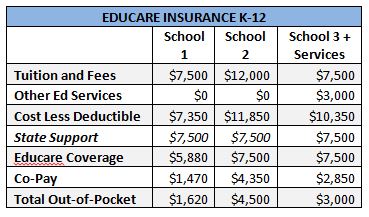
For those interested in income equality and “fairness,” we could limit the maximum co-pay based on household income so lower-income families have a smaller out-of-pocket expense. Or perhaps the deductible would increase for higher household incomes.
Like Medicare, Educare would be good for both public and private institutions. We could even have an Educare Part D which covers education-related expenses such as tutors, textbooks, school supplies and electronic education materials.
School choice opponents would have a difficult time opposing the “Medicarization of education.” More importantly, they may come to realize how similar vouchers, tax-credit scholarships and education savings accounts are to other government programs that many of them love and support.

