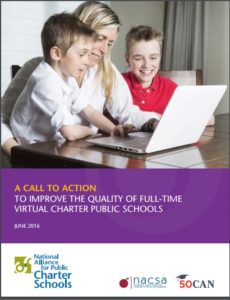
A new report calls for states to subject virtual charter schools to greater scrutiny.
States need to overhaul the way they fund and regulate online charter schools and rein in "large-scale underperformance," a new report argues.
The argument isn't coming from the usual anti-charter school suspects. The report was released this morning by the National Alliance for Public Charter Schools, the National Association of Charter School Authorizers, and the pro-charter advocacy group 50CAN (aka the 50-State Campaign for Achievement Now).
The three groups say they support full-time virtual schooling, and that the model can be beneficial for some students. But the report says recent research has found negative effects so significant and widespread that "[t]he breadth of underperformance by full-time virtual charter schools convinces us that states need to change the policy framework within which these schools can operate."
"If traditional public schools were producing such results, we would rightly be outraged," the report adds. "We should not feel any different just because these are charter schools."
Online learning companies and some allied advocacy groups have disputed some of the most widely cited studies of virtual charters' effectiveness, pointing out that virtual charters often serve disadvantaged students who change schools frequently, making their performance hard to gauge.
The report addresses this argument, noting that in a study by Stanford University's Center for Research on Education Outcomes, the "mobility" rates of virtual charter students and their comparison groups in traditional public schools are similar. Other observers have concluded the negative findings are simply too strong to explain away. (more…)
Florida's charter schools fare well in most student achievement comparisons in a new state report.
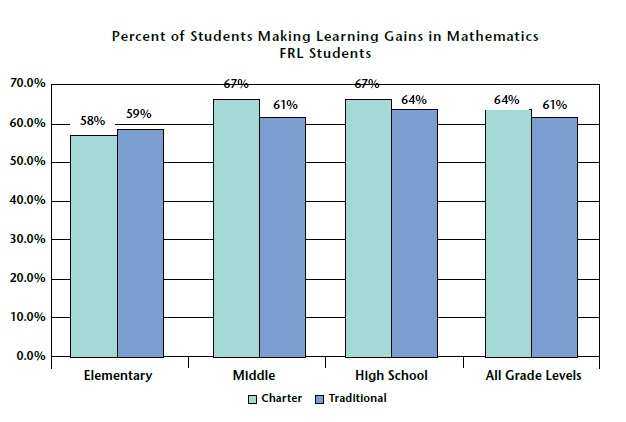
Florida's charter school students continue to score higher, make larger gains and face smaller achievement gaps than their traditional-school peers, according to a new state report.
The annual report, based on student achievement data from the 2013-14 school year, largely aligns with the findings of six previous versions. Charter schools fare better in 154 of its 177 comparisons, which track proficiency, learning gains and achievement gaps for different student groups.
The report also shows that in Florida, charters on average serve fewer students who qualify for free- or reduced-price lunches, fewer students with disabilities, and fewer students who are classified as English-language learners than district schools. They also tend to serve fewer students who are classified as gifted, a stat not tracked in previous years' reports. (Those statistics also likely mask some complexities, from varying student preferences to varying approaches to classifying students.) (more…)
Charter schools are having a growing, positive impact on student performance in cities around the country, according to a new study from researchers at the Center for Research on Education Outcomes, or CREDO, at Stanford University.
Yet the findings released Wednesday present a mixed bag in Florida, where charter schools' results varied from one city to the next, and in several cases fell short of urban charter sectors elsewhere or district schools in their communities.
CREDO researchers compared the learning gains of charter school students with similar students in traditional public schools. Unlike their previous, national studies, they looked exclusively at urban schools, focusing on 41 regions in 21 states and the District of Columbia.
The national results, based on student test scores from the 2006-07 through 2011-12 school years, show urban charter schools provided students the equivalent of about 40 additional days of learning each school year in math, and about 28 in reading, on average.
The numbers aren't as flattering for urban charter schools in the seven Florida cities covered by the study.
In Miami, one of the bright spots, the study found charter schools significantly outperformed traditional public schools in both reading and math. The charter school advantage there was especially strong among students in poverty and those learning English. Tampa charters showed a significant advantage over traditional public schools in math, and achieved similar gains to traditional schools in reading.
However, in two cities, Fort Myers and West Palm Beach, the study found charter schools significantly under-performed in both tested subjects.
Charters' results in Orlando, Jacksonville and St. Petersburg were more mixed. Because the researchers looked only at urban schools, this study doesn't paint a full picture of charter schools' results throughout the state.
 Last week Diane Ravitch warned her readers not to trust the findings of the latest Center for Research on Education Outcomes (CREDO) report highlighting student achievement in charter schools. To make her case, she cited a review of the CREDO study written by the National Education Policy Center (NEPC). Diane Ravitch citing NEPC struck me as humorous for a very good reason.
As the CREDO study results changed direction in favor of charter schools, both Ravitch and NECP took a u-turn of their own.
Now there is nothing wrong with changing your mind. In fact, I applaud people who review research and reassess their previous held beliefs, because it takes considerable courage to change your mind or admit you were wrong. However, the CREDO research methods didn’t change and neither did the concerns raised by NEPC. The only thing that did change was the CREDO results, and it no longer supported Ravitch’s or NEPC’s professional opinion.
Back in 2009, the CREDO report concluded, “Despite promising results in a number of states and within certain subgroups, the overall findings of this report indicate a disturbing — and far reaching — subset of poorly performing charter schools.”
When Ravitch accepted the National Education Association's “Friend of Education” award in 2010, she cited CREDO findings stating, “five out of six charters will get no different results or worse results than the regular public schools.” Ravitch was still highlighting CREDO findings as late as the summer of 2011, but today she attacks CREDO as part of a corporate education reform plot to privatize education.
Like Ravitch, the NEPC had nice things to say about CREDO back in 2009. Despite very little change in NEPC’s own concerns, or even in the CREDO methodology, the organization’s opinion turned decidedly negative in 2013 when the CREDO results shifted in favor of charter schools. (more…)
A growing body of research suggests charter schools provide a good quality education relative to the traditional district schools from which their students transferred. This is especially true for low-income and minority students – the primary beneficiary of most charter schools nationwide.
A new report by Will Dobbie of Princeton and Roland Fryer of Harvard, shows significant achievement gains for low-income students in Harlem attending charter schools. Importantly, these low-income students are far more likely to attend college than their traditional school peers.
How do school districts respond?
Even the CREDO report from Stanford University now states that charter schools, on balance, provide a slightly higher quality education. The study finds that students in poverty attending charter schools gain an extra 14 days of learning for reading and 22 days of extra learning in math. English language learners in charter schools gain an additional 43 days of learning in reading and 36 days in mathematics. The much misunderstood CREDO report in 2009 also found charter schools had a significant positive impact for students in poverty.
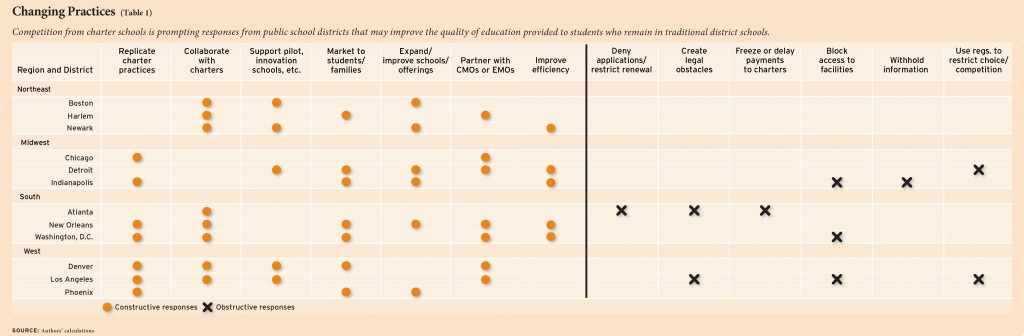
With solid academic achievement and a nationwide enrollment exceeding 2 million students, charter schools are gathering steam. So how do districts react when faced with competition from charters?
A new report in EducationNext, by researchers at the Walton Family Foundation and the Department of Education Reform at the University of Arkansas, attempts to answer that question.
The researchers selected 12 urban areas that had at least 60 percent minority student population and 60 percent low-income to create a more accurate comparison with the typical charter school population. They also limited their research to districts with a charter school enrollment that was at least 6 percent of the overall enrollment within the district. According to the article, Caroline Hoxby of Stanford University believes this threshold is high enough that districts will respond to competitive pressure.
After selecting the districts that met these criteria, the researchers combed through 8,000 newspaper articles to locate instances of districts reacting to competition from charter schools. When they discovered an example, the researchers reviewed district meeting minutes to uncover if and how the district responded.
They divided the responses into 13 action categories, some positive and some negative. Positive responses included replicating charter practices, collaborating with charter schools, creating pilot or innovation schools and expanding or improving school offerings. Negative responses included creating legal obstacles for charter schools, blocking access to facilities and using regulations to restrict choice and competition.
The most common response, found in 8 of the 12 districts, was to collaborate with charters. The most common negative response, found in 3 of the 12 districts, was to restrict access to facilities (i.e., refuse to share unused space or school buildings with charter schools). Overall, the researchers discovered that the districts had more positive responses than negative ones.
Overall this is a good sign, though more research needs to be done as charter schools – and the school choice movement – expand. School districts should always put students first, whether or not they educate the child. By collaborating with and emulating successful charter schools – rather than blocking and fighting – school districts can make an even bigger impact on student achievement.
As they have in the past, Florida charter schools earned both A and F grades at higher rates than district schools this year, according to data released Friday by the Florida Department of Education.
According to our preliminary number crunching, 38 percent of the 340 elementary, middle and K-8 charter schools that received grades earned A’s, compared to 27 percent of 2,278 district schools. Meanwhile, 7 percent of charter schools earned F’s (24 total), compared to 4 percent of district schools (83 total).
High school grades won’t be released until later this year.
Schools in both the charter and traditional sectors earned fewer A’s and more F’s this year due to tougher accountability standards.
Charter school performance is under scrutiny in Florida, as it is in many states. Florida charters have higher rates of minority students than district schools (64 percent to 57 percent), but lower rates of low-income students (47 percent to 57 percent).
Studies have come to different conclusions about their performance. DOE numbers based on 2011-12 data show charter school students outperforming their district peers by most comparisons. On the other hand, a recent study by Stanford’s Center for Research on Education Outcomes, based on 2010-11 data, shows them on par with district peers in math but seven days behind in reading.
National. A new study from CREDO shows charter schools improving nationally, compared to traditional public schools, but with results varying widely from state to state. National coverage in the New York Times, Washington Post, Hechinger Report, Charters & Choice, Associated Press, Huffington Post. State-level coverage in the Minneapolis Star Tribune, Salt Lake City Tribune, Tampa Bay Times, Detroit News, Newark Star Ledger, The Morning Call, St. Louis Post-Dispatch, New Orleans Times Picayune.
 National. Charter school waiting list nears 1 million nationally, according to a new survey from the National Alliance for Public Charter Schools (The Charter Blog). More from the Los Angeles Daily News.
Ohio. Lawmakers move to expand vouchers statewide for low-income students, beginning this fall with 2,000 kindergartners and expanding one grade level each year. (Friedman Foundation)
Wisconsin: Lawmakers expand vouchers statewide but with an enrollment cap of 500 the first year (Education Week). State Superintendent of Public Instruction Tony Evers criticizes the proposal (Journal Sentinel). Democrats predict a backlash (Wisconsin State Journal). Private schools in Madison consider whether to participate (Wisconsin State Journal). Same with schools in the Wausau area (Wausau Daily Herald). A key lawmaker leaves the door open for another stab at a voucher for special-needs students (Wisconsin Reporter).
Indiana. Voucher supporters are giving a thumbs up to the expansion that begins Monday (Evansville Courier & Press). The Louisville Courier Journal raises questions about whether private schools have the capacity to absorb additional students.
New Jersey: Gov. Chris Christie plans to sign off on the state budget, saying he'll bring back the fight for school vouchers next year (Newark Star-Ledger). Newark Mayor Cory Booker reiterates his support for school choice in his bid for U.S. Senate (Associated Press). Teachers and parents criticize the decision by Education Commissioner Chris Cerf to put the kibosh on a virtual charter set to open this fall (Newark Star-Ledger). (more…)
Charter schools. The updated CREDO study isn't as flattering about charter school performance in Florida. Gradebook, SchoolZone, StateImpact Florida.
 Virtual schools. Pasco sets up a summer program for its e-school so students don't take Florida Virtual School classes - and cost the district money in the process. Tampa Bay Times.
Private schools. The head of a high-end Tampa private school resigns after a rocky year. Tampa Bay Times.
Common Core. Could weed out some teachers. State Impact Florida. But will put teachers in the driver's seat. Eduwonk. Some Florida teachers see a juggling act between the new standards and current curriculum. Tampa Tribune.
ALEC. Progress Florida says the state's ed policy is run amok with ALEC. StateImpact Florida writes it up.
School grades. DOE appoints a task force to review grading policies before this year's grades are released. Gradebook.
School spending. Seminole plans to move ahead with a property tax increase. Orlando Sentinel. Lake decides against changing school start times to make up for a projected $16.3 million deficit. Orlando Sentinel. Lee aims to save $1 million a year under new Superintendent Nancy Graham's re-org. Fort Myers News Press, Naples Daily News. The Marion school board approves a staffing plan with 525 fewer positions. Ocala Star Banner.
School discipline. Black community leaders are concerned about high suspension rates for black students in Flagler. Daytona Beach News Journal.
Teacher merit pay. A judge denies FEA's request to reconsider his decision to throw out a lawsuit challenging the state's new merit pay law. South Florida Sun Sentinel.
Teachers. Badass Teachers Association says payback is coming. Orlando Sentinel.

