PALATKA, Fla. — All Risa Byrd wanted to do was start a little preschool. That’s it. But then the former public school teacher got swept up in one of the most epic education stories in American history. Now her fast-growing school is the latest example of what’s possible when school choice is the new normal.
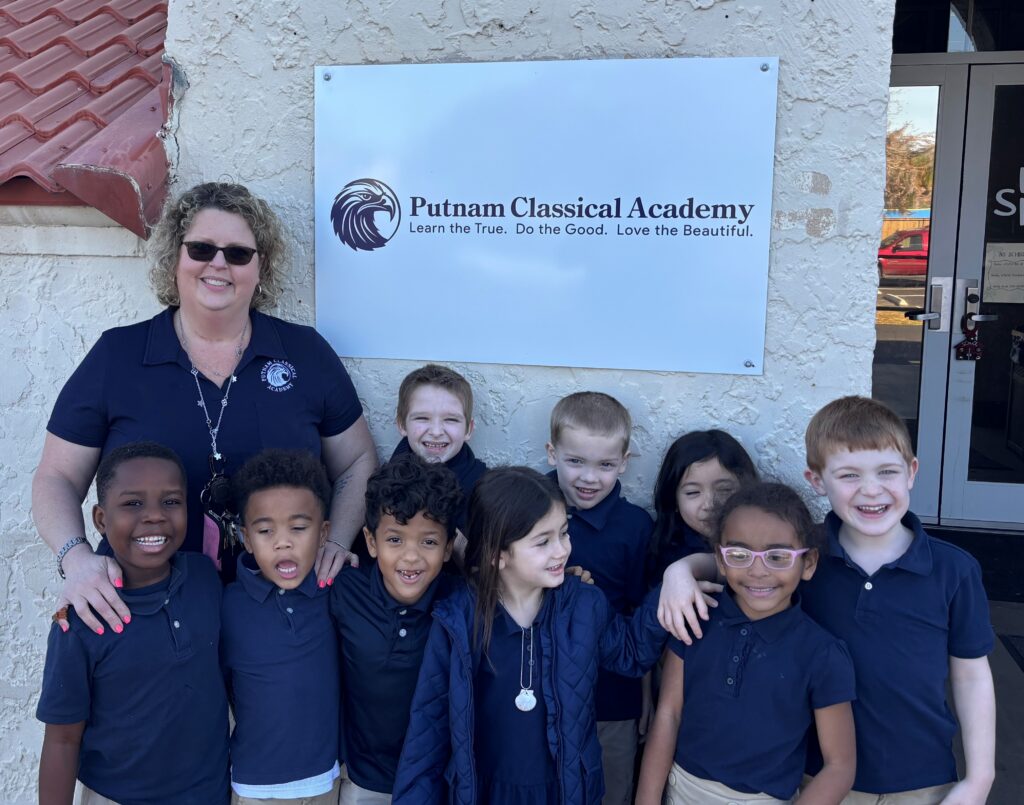
In 2022, Byrd retired from a 26-year teaching career to start Little Sprouts Learning Center. The goal was modest: Get her granddaughter’s academic journey off on the right foot.
A few months later, though, Florida lawmakers passed, and Gov. Ron DeSantis signed, one of the most sweeping school choice bills of any state, ever. Suddenly, every student in Florida was eligible for a state-supported choice scholarship.
Byrd didn’t realize it at first. But her school had caught a wave.
In the fall of 2023, Byrd added kindergarten and first grade, starting with eight students in those grades. She called the school for the higher grades Putnam Classical Academy.
By the fall of 2024, Putnam Classical had 50 students in grades K-5.
By the fall of 2025, it had 234 students in grades K-6, in addition to 60 in preschool.
Now Byrd’s looking for a whole other building to house a separate middle school. When she announced plans via Facebook, 111 students signed up in three days.
“Parents are desperate for their kids to be well educated,” Byrd said, particularly those from underserved communities. “They’ve been written off.”
Byrd is one of hundreds of former public school teachers who have leveraged Florida’s choice scholarships to create their own learning options. They can be found in every corner of the state, even in rural and semi-rural counties like Putnam, where a paper mill is the biggest private employer, the biggest town has 10,000 people, and the best-known landmark may be a blast-from-the-past diner.
The parents driving demand aren’t looking for anything exotic, Byrd said. They just want safe schools with top-quality academics, high expectations, and no drama.
“Parents got the word that we don’t play. That’s the biggest draw,” Byrd said. “They’re fed up. They know kids can’t learn, and teachers can’t teach, if there’s sheer chaos in the classroom.”
Byrd’s story may be a particularly dramatic example of what’s happening in Florida, and particularly symbolic.
More than half of Florida’s 3.4 million students are now enrolled in something other than their zoned neighborhood schools, and more than 1 million are enrolled outside of district schools entirely. Perhaps it’s fitting, then, that Putnam Classical leases a century-old building that once served as the local school district’s headquarters.
Despite the name, Putnam Classical isn’t truly classical yet. Byrd said she and her staff, which includes 20 teachers, will transition to a more recognizable “great books” curriculum within two years.
The first order of business is to establish a higher rate of basic literacy.
A self-described “data nerd,” Byrd is a “science of reading” adherent and a huge fan of Natalie Wexler, author of “The Knowledge Gap” and a leading proponent of using a content-rich curriculum to boost vocabulary and comprehension.
For the early grades, Putnam Classical uses an explicit, evidence-based phonics curriculum developed by the University of Florida. For the higher grades, it uses the highly regarded Core Knowledge curriculum for language arts, science, and social studies.
“If you teach these kids to read, you will change the trajectory of their lives,” Byrd said. “Then they can be an astronaut, a chef, anything they want to be.”
Byrd said as a public school teacher, she earned a reputation for working well with struggling readers, so more and more were sent her way. It became obvious, she said, that many students acted out because they couldn’t read well.
One time, she said, she stopped a 10th grader from disrupting her classroom, then took her out to the hallway to talk. The girl broke down and told her, in between sobs, “I’d rather everyone in that room think I’m a b---- than think I’m stupid.”
In three years, Byrd said she’s expelled two students. The school isn’t orderly because it’s draconian about discipline, she said. It’s orderly because kids are achieving academically and are proud of themselves. “When you learn to read,” Byrd said, “school becomes a lot more fun.”
About half of the students at Putnam Classical are Black or Hispanic; about 75% would be eligible for free- or reduced-price lunch in public school. The school does not charge tuition beyond the amount of the choice scholarship, which averages about $8,000 statewide and is far less than what districts spend.
Most of the students who switched to Putnam Classical were not reading at grade level when they arrived, Byrd said. Some incoming second graders didn’t know their letter sounds.
But now?
Now more than 60% are showing average or better growth compared to their peers nationwide, according to the STAR reading assessment Putnam Classical uses. In other words, students who were previously losing ground in their prior schools are now catching up and starting to get ahead.
Dalton Crews chose Putnam Classical for his 5-year-old, Delilah. He said he attended a private elementary school before moving on to public school and thought it built a good foundation for academics and character. He wanted the same for his daughter, and thankfully, he said, choice made it possible.
“I love the teachers. They communicate really well. They always tell me what’s going on,” said Crews, who installs fire sprinklers for a living. “They tear up when the kids leave. That’s love. They’re good people.”
Shentae Roberts said her 10-year-old granddaughter, Ja’Zyiah, was receiving good grades in her prior school, even though it was obvious to her family that she was struggling with basic material.
Her daughter tried contacting the school to get more information, she said, but never got a response. That’s why, in 2024, her daughter switched Ja’Zyiah and younger brother, Hakiem, to Putnam Classical.
“Best thing she did,” Roberts said.
Roberts said her granddaughter initially struggled at Putnam Classical, too. But the teachers gave her the attention and instruction she needed, she said.
The result: Ja’Zyiah “came back 10 times stronger,” Roberts said. “All the staff get to know the children, and they’re responding to them. They’re pulling the children to the next level.”
Byrd said more good things are ahead, not just for her school.
Even though Florida has been a national leader in private school choice for a quarter century, Byrd said she didn’t know much about it until HB 1, the landmark legislation Gov. DeSantis signed in 2023. Now, though, she realizes the game-changing potential not just for families but for teachers.
“Every public school teacher says, ‘If I were the boss, I would do it this way,’ “ Byrd said.
Well, now’s their chance.

Saltwater Studies in South Florida was founded by education entrepreneur Christa Jewett. It is among the growing number of a la carte providers in Florida made possible by the state's education savings account programs.
Every state’s public education system is a market with supply (i.e., instruction) and demand (i.e., students needing instruction). These markets function as the operating systems for public education. Unfortunately, since the mid-1800s, these markets have been poorly designed and managed. As a result, every state’s public education operating system is deeply flawed.
Just as digital applications fail when their underlying operating systems malfunction, public education programs fail when the market mechanisms beneath them are ineffective. This helps explain why nearly every major reform initiative since "A Nation at Risk" (1983), from site-based decision-making and outcome-based education to teacher empowerment and regulatory accountability, has failed to deliver sustained, systemic improvement.
Public education will not realize sustainable improvement until each state’s public education market becomes more effective and efficient.
Public education’s primary problem is that the supply side of each state’s market is dominated by a government monopoly that also controls most demand side funding. A necessary correction is giving families greater control over a significant portion of the public funds allocated for their student’s education. Thanks to decades of advocacy by the education choice movement, families in 18 states may now use public funds to purchase education services and products from government and nongovernment providers.
But family-controlled funding alone is not enough. Every aspect of the design and management of public education markets must be improved, not just their demand side.
In high-performing markets, supply and demand are in sync; transactions are easy, and transactional costs low; information to guide decision making is transparent and accessible; resource allocation is effective and efficient; risks are managed appropriately, and customer satisfaction is consistently high.
The education choice movement has historically focused on increasing the number of families who control a portion of their students’ education funding while putting less emphasis on ensuring the market’s supply side grows in tandem. This imbalance often causes demand to exceed supply, driving up costs without improving quality and leaving families unable to access the best educational environments for each child. A recent study in Florida found that 41,000 students were awarded education choice scholarships last year but never used them, in part because there was no space in their desired schools.
Policymakers can help by enacting policies that better align supply with demand, ensuring students have access to the options they need.
During the 2025-26 school year, families nationally will spend about $6.75 billion in public funds customizing their children’s education. Emerging Artificial Intelligence tools are already showing promise in streamlining compliance, verifying transactions in real time, and safeguarding public dollars. By adopting these technologies wisely, states can protect taxpayers while reducing bureaucratic burdens on families and providers.
Families shape public education markets through their purchasing decisions. When those decisions are well-informed, they drive higher quality and better prices. Yet in every state, families lack easy access to reliable information about provider performance and pricing. To support better choices, states should create user-friendly tools that provide transparent, trustworthy information. Without this transparency, families are navigating markets in the dark.
Every market decision carries risks and consumes resources. For example, when states implement policies that drive high demand without growing supply, costs rise, and families lose access to the best options for their children. Effective markets require careful regulation and risk management to balance innovation with accountability while ensuring resources are allocated efficiently.
States are responsible for the design, implementation, and ongoing management of public education markets. Their goal should be market optimization, with family satisfaction as the ultimate indicator of success. An optimized market is one where all components function well together, and widespread family satisfaction suggests that children’s needs are consistently being met.
Public education markets are interdependent ecosystems and must be managed as such. When states align supply and demand, reduce friction, expand transparency, and manage risk wisely, they create conditions where every family can access instruction tailored to their child’s needs.
Lasting improvement will not come from the next reform fad. It will come from building healthy markets that empower families and unlock the full potential of every student.
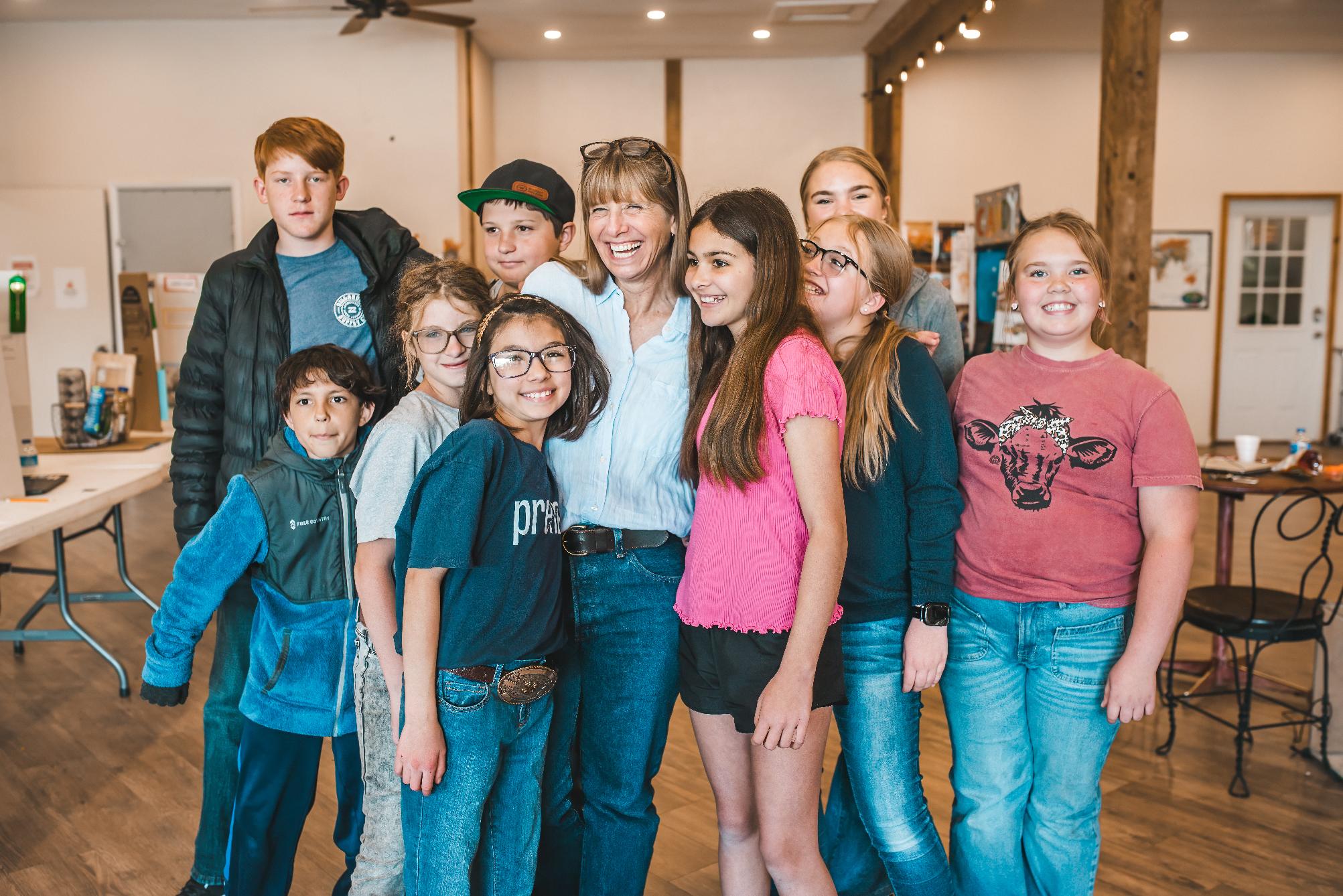
Denise Lever with her students at Baker Creek Academy, a tutoring center in Eagar, Arizona. Photo provided by Denise Lever
Nothing can stop Denise Lever. Not a raging wildfire and certainly not a state fire marshal’s effort to shut down her tutoring center by trying to impose regulations that could have forced her to spend $70,000 on building upgrades.
As one of the nation’s few female wildland firefighters in the late 1980s, Lever survived the hazing that came with being a woman in a male-dominated profession by proving herself and never backing down.
For example, take this story: Lever’s team had been dispatched to a California fire. Roads were closed, and the crew had to climb up a cliff to get into position. Loaded down with their gear, they pulled together and worked through the night.
“It was absolutely brutal,” Lever recalled. “It was hot. It was windy. Our hands were cut up from moving brush, and we lost gloves in the middle of the night, and we couldn’t find them on the fire line because of the debris.
As morning broke and a cold Pacific Ocean breeze stung their faces, the team huddled together in space blankets and reflected on their victory.

Denise Lever, center, during her days as a wildland firefighter. Photo provided by Denise Lever
“The camaraderie and the sense of accomplishment, they’re irreplaceable,” Lever said.
Lever’s days of battling blazes ended when she got married and became a homeschool mom to three kids, but her trailblazing spirit stayed with her when she became an education entrepreneur.
In 2020, she opened Baker Creek Academy, a tutoring center/microschool to support homeschool families in Eagar, Arizona, just west of the New Mexico state line. The center operates four days a week for five hours per day and serves about 50 students, who attend on different days at various times. Baker Creek provides a host of supplemental services, primarily to homeschooled students, from one-on-one tutoring to limited classroom instruction and group projects to field trips. Students and parents can customize the services that best fit their needs. Baker Creek doesn’t keep attendance records because, Lever said, parents are the ones in charge.
After completing her city’s approval process, Baker Creek began operating in a historic commercial building once occupied by a church, shared with three other independent microschools.
One day, out of the blue, an official at the Arizona Office of the State Fire Marshal left Lever a voice mail message. He wanted to inspect her “school.”
“And I said, ‘No, not really, because we're not a school,’” she said.
As an experienced firefighter, Lever recognized a school designation for what it was: the potential kiss of death for her tutoring center.
Being labeled a school triggers a list of code restrictions intended for campuses that serve hundreds or sometimes thousands of students and often include sports fields, playgrounds, auditoriums, cafeterias, gymnasiums, classrooms, and offices.
On the line are often tens of thousands of dollars in mandated building changes, which are not required for other commercial buildings, such as dance studios and karate dojos.
Levers wasted no time. She contacted the Stand Together Edupreneur Resource Center, which offers guidance, but not legal advice, about regulatory issues. The representative encouraged Lever to contact the Institute for Justice, a national public interest law firm that specializes in education choice litigation and zoning issues.
IJ Senior Attorney Erica Smith Ewing sent a letter to the state’s fire inspector questioning the basis for the inspection.
“Ms. Lever successfully completed a local fire safety inspection in 2023 and has been operating successfully with no problems,” the letter said. “Your request to inspect her property was unexpected. Could you please explain why you wish to inspect her property? We do not currently represent Ms. Lever, and we hope that formal representation will be unnecessary.”
Lever said she faced the possibility of having to spend tens of thousands of dollars upgrading doors and electrical systems. Because the building was smaller than 10,000 square feet, she avoided the order to install a sprinkler system, which can cost $100,000.
However, the timing couldn’t have been worse.
“If the state was going to require some of these upgrades, that was just not going to be possible for (our landlord) to renew our lease,” she said, adding that she used the building to host summer programs and annual meetings for other microschool leaders who use her consulting services.
Lever also wondered why similar businesses weren’t targeted -- for example, a dance studio across the street that taught school-age students and operated similar hours to Baker Creek.
“Because she offered dance instead of math tutoring, her program was considered a trade, and our program was going to be shut down and treated like an education facility simply because we offered more of an academic program,” Lever said.
State officials performed the inspection, but finally backed down, offering only that the situation was a result of “confusion” and the Lever’s business wasn’t under their jurisdiction.
“Forcing Denise to follow regulations designed for sprawling, traditional schools would be both arbitrary and unconstitutional,” Ewing said. “More and more, we are seeing state and local governments hampering small, innovative microschools by forcing them into fire, zoning, and building regulations that never anticipated microschools and that make no sense being applied to what microschools do.”
In Georgia, local officials tried to force a microschool to comply with unnecessary inspections and building upgrades, in violation of state law protecting microschools. They backed down after a letter from IJ. And in Sarasota, Florida, Alison Rini, founder of Star Lab, nearly closed her doors this spring when the city interpreted the fire code to require she install a $100,000 fire sprinkler system, despite operating from a one-room building with multiple exits. Only after a donor provided a generous gift was she able to stay open.
“Teachers shouldn’t need lawyers to teach,” said IJ Attorney Mike Greenberg. “Bureaucrats shouldn’t use outdated and ill-fitting regulations to stifle parents and students from choosing the innovative education options that best suit their needs.”
Lever said the state’s decision to back off sets a precedent that will help other microschools across Arizona.
“I was definitely willing to go forth with the lawsuit,” she said. “At this point, though, we’re going to take our win. We’re going to publicize it so the other microschools will know what their options are.”
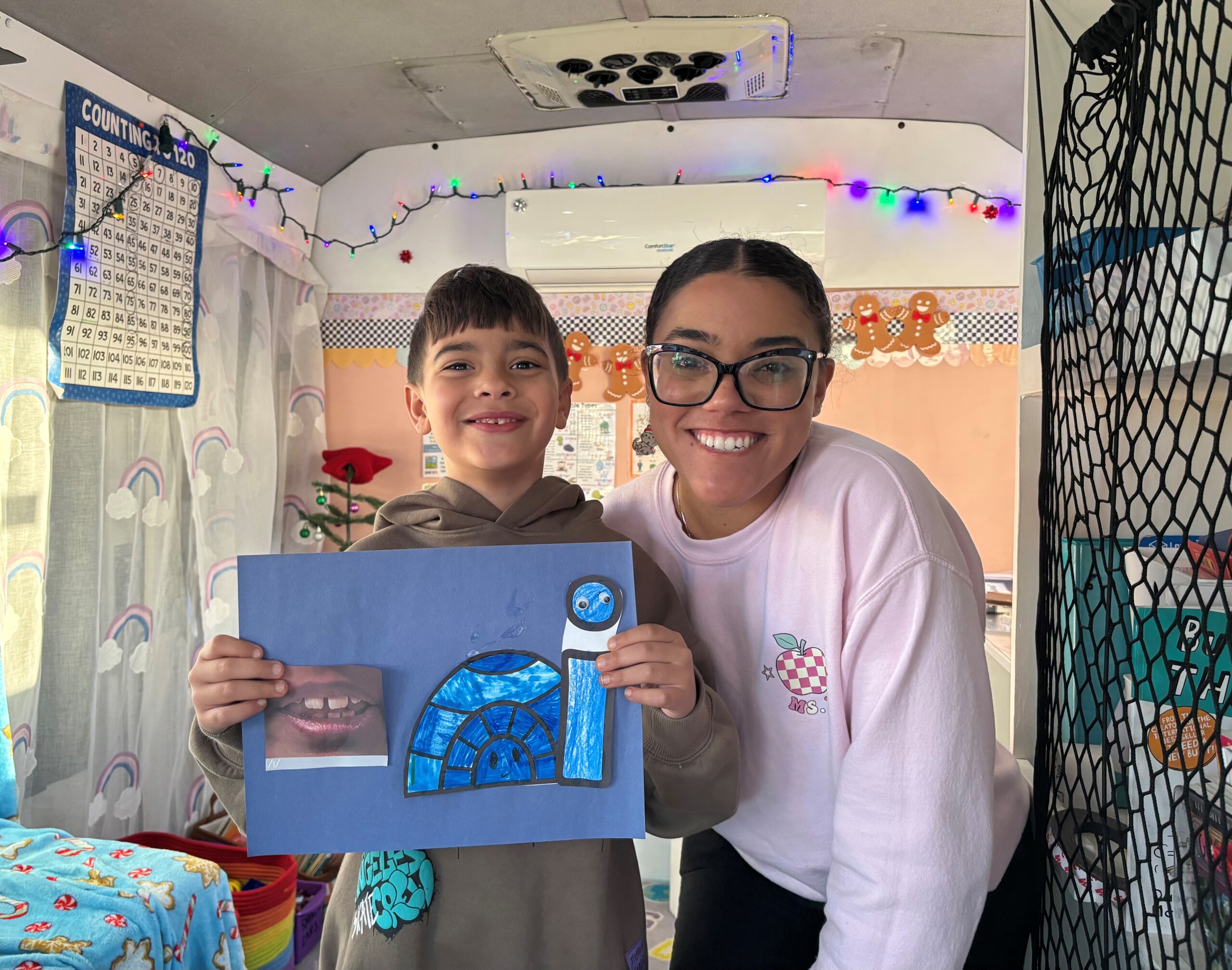
DAVENPORT, Fla. – Valeria Oquendo didn’t set out to be an entrepreneur. “Ms. V,” as her students call her, had wanted to be a teacher since she was a teenager. On her way to an elementary education degree, she interned at a public school and, initially, those dreams became even clearer.
“Still in my brain I was thinking, ‘I’m going to graduate, I’m going to have my perfect classroom, I’m going to be a first grade teacher,’ “she said.
But then, in education-choice-rich Florida, a funny thing happened.
Oquendo’s “side hustle” became her full-time gig.
When COVID-19 hit in 2020, friends and family begged Oquendo to tutor their children, many of whom were struggling with online instruction. Oquendo was still in college. But before she knew it, she was tutoring 20 kids.
The light bulb flickered on.
Today, Oquendo runs Start Bright Tutoring, a mobile tutor and a la carte education provider in this insanely fast-growing corner of metro Orlando.
She focuses on elementary reading and math, with 20 to 30 students who are homeschooled or in public schools. A handful use state-supported education savings accounts (ESAs), and it’s highly likely even more will use them in the future.
Demand is soaring. When Oquendo pitched her business on TikTok, mayhem ensued: She racked up hundreds of thousands of views and put 70 students on a wait list before being forced to stop taking calls.
Now Oquendo sees a future outside of traditional schools not only for herself, but for other young educators. As choice continues to expand, she said, more and more can tap into the new possibilities.
“Everybody has their niche,” said Oquendo, 26. “It all depends on the effort and not giving up.”
Florida is humming with former public school teachers who, thanks to choice, have created their own learning models. Their often-inspiring stories (like this and this and this) are becoming commonplace.
Oquendo, though, is the next wave: Educators creating their own options instead of becoming traditional public school teachers.
Oquendo represents a couple of other fascinating trend lines, too.
She’s a niche provider instead of a school, which allows her to serve Florida’s fastest-growing choice contingent: a la carte learners.
Florida has multiple ESA programs that give families flexibility to pursue options beyond schools. With ESAs, they can choose from an ever-growing menu of providers, like Start Bright, to assemble the program they want. The main vehicle for doing that, the Personalized Education Program scholarship, met its state cap of 60,000 students this year, up from 20,000 last year.
Oquendo’s decision to create an option on wheels is also noteworthy.
Florida’s education landscape gets more diverse and dynamic every day. But it’s still rife with frustrating stories about talented teachers trying to set up microschools and other innovative models, only to run into outdated zoning and building codes and/or code enforcers who seem to be curiously inflexible. (Thankfully, some still find happy endings.)
Until those barriers are addressed, going mobile – something choice visionaries suggested nearly 50 years ago – may be one way out.
Oquendo is the daughter of a police officer and an accountant. After Hurricane Maria devastated Puerto Rico, the family moved to Florida, and she enrolled in the University of Central Florida.
Oquendo said she was fortunate to have an amazing teacher as her mentor when she interned at a public school. But she was also haunted by the moment the teacher told her the class needed to move on to the next unit of study, even though several students, including one with a learning disability and another learning English, were not ready.
“She said, ‘This is what we do.’ “Translation: We have to move on.
That experience pushed Oquendo to choose a different path, too.
Initially she wanted to steer her tutoring venture into a microschool. She found a good location, but the building needed $15,000 in adjustments to meet building codes, and even then, there was no guarantee of a green light from local officials. Oquendo was bummed. Thankfully, her mom came to the rescue, inspired by a mobile grooming service the family uses for its Schnauzers.
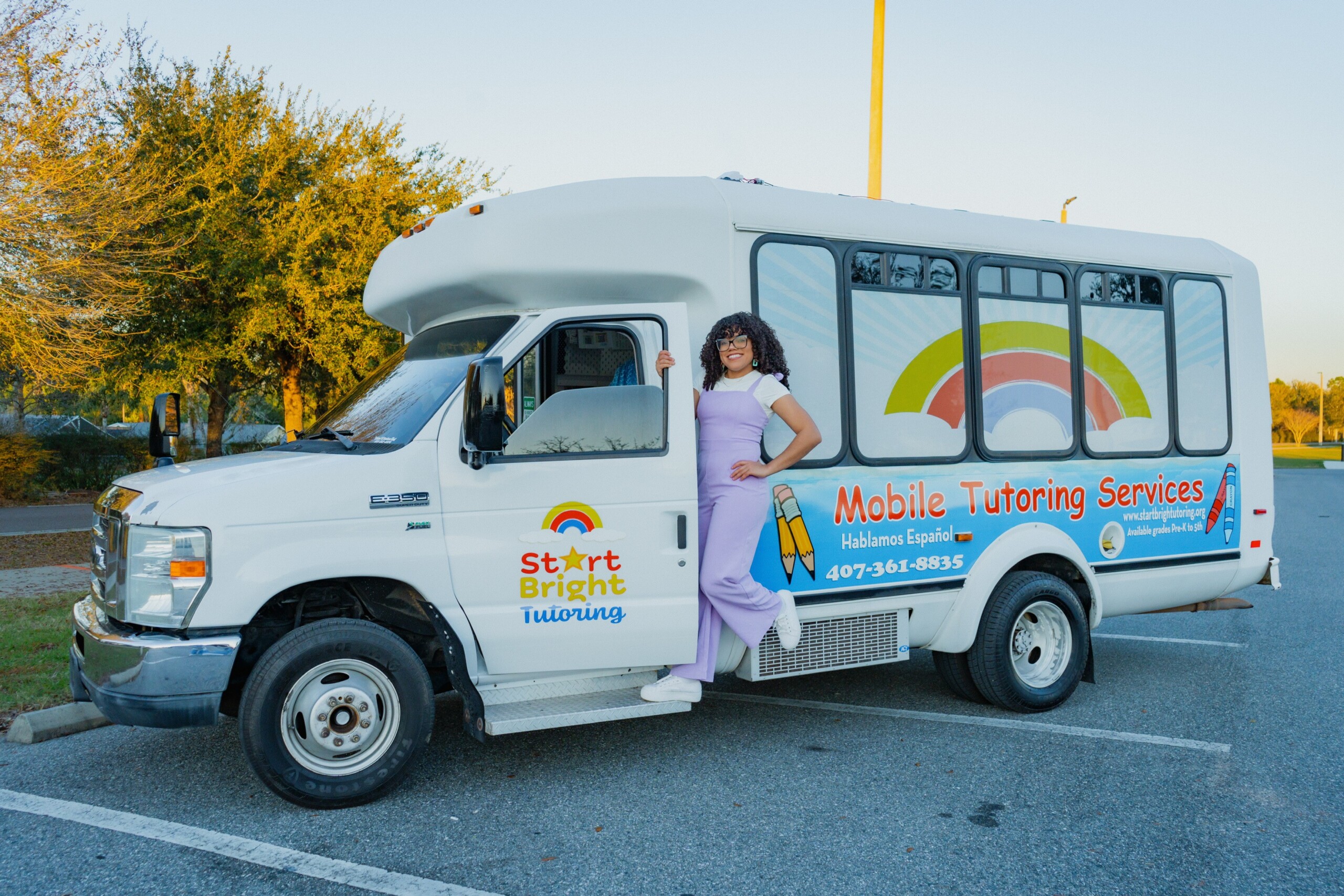
“She said, ‘Why don’t you get a van and make it a mobile classroom?” Oquendo said. “I was like, ‘Mom, the kids are not pets.’ “
Upon further investigation, mom was on to something. In the summer of 2021, Oquendo spent $8,000 for a 2014 Ford E-350 shuttle bus, then another $7,000 to turn it into a mini-classroom. Ms. V’s van is complete with desks, bins, lights, shelves, computers – and just about anything else you’d find in a typical classroom.
That fall, Oquendo was up and running, visiting students in their homes. At some point, she realized she could reach more families if she parked at locations that were still convenient – like shopping plazas – and have them meet her there.
Oquendo’s TikToks came just months after she earned her degree. The response was understandable, she said, given that many families lived the same reality she witnessed as an intern.
“It’s the system,” she said. “If it was better, we wouldn’t have the demand.”
Oquendo said many families also respond to her because they share a cultural connection. She was still struggling with English when her family moved to Florida, and many of her students are English language learners, too. She offers living proof they will overcome.
“I tell them, ‘I get you,’ “she said. “I tell them, ‘It’s okay to make mistakes. I love mistakes.’ That way, they’re not afraid.”
Forging her own path has not been all peaches and cream.
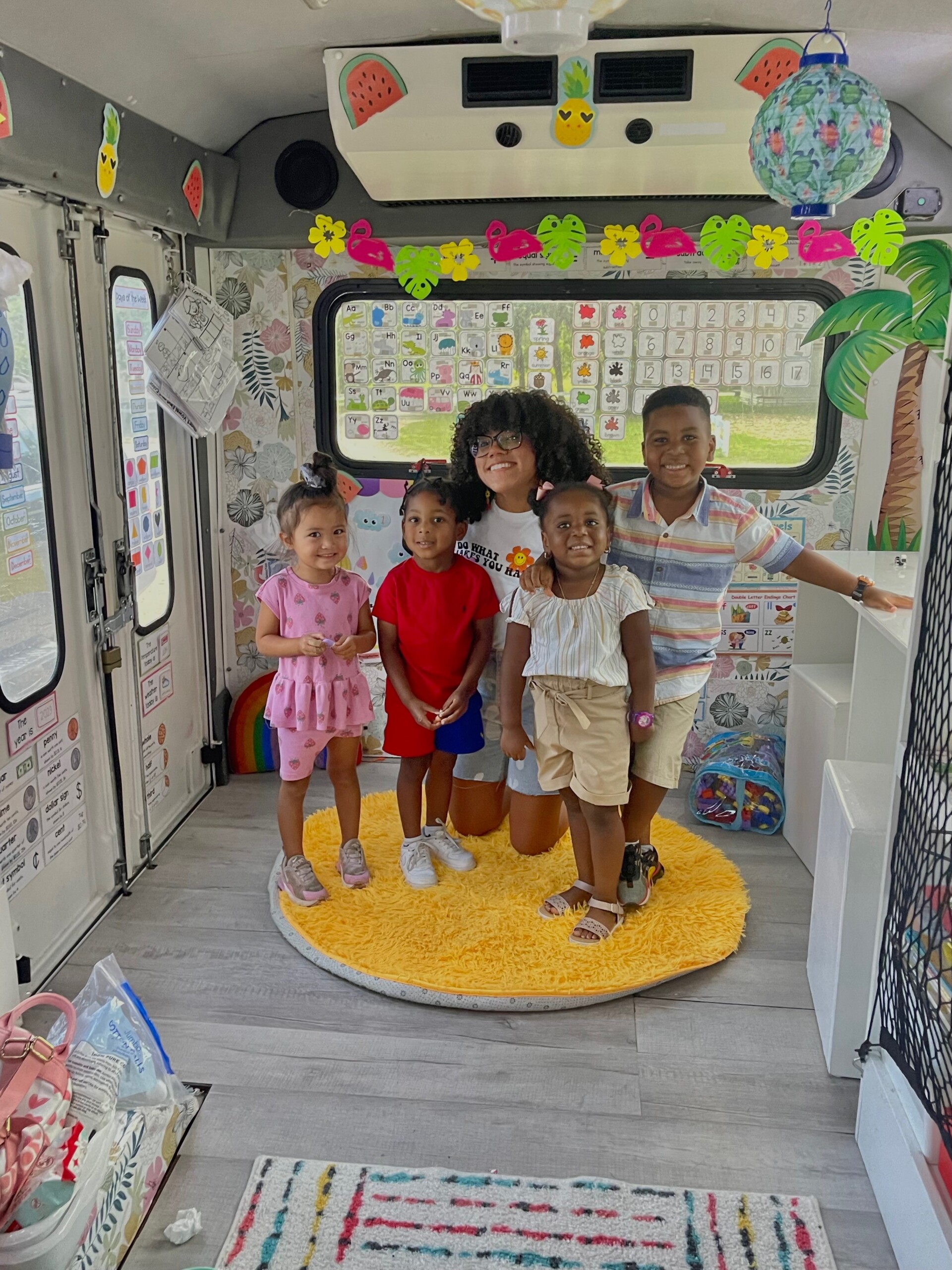
At one point, the van engine died, and Oquendo had to find $6,000 to replace it. At another, she invested in solar panels, hoping to cut down on fuel costs for air conditioning. But they didn’t work as she hoped. “I didn’t have a guide,” she said. “I just had myself – and my mistakes.”
At the same time, she said, she takes satisfaction in knowing her students are making progress. And that she has the power to quickly adjust, both for them and herself.
Oquendo is shifting to serve more students whose parents want in-home tutoring for longer stretches. She’s adding Spanish lessons. She’s also offering monthly field trips to places like LEGOLAND and a local farm.
On a whim, Oquendo recently set up gardening lessons for interested families, essentially sub-contracting with an organic farmer. Her students loved it.
In South Florida, similar operators are realizing they fit into changing definitions of teaching and learning and becoming ESA providers themselves.
Oquendo said the challenges to doing her own thing are real. But the freedom to control her own destiny, and to better help students in the process, makes it all worth it.
“I feel happy, blessed, and fortunate to be doing what I love the most,” she said.
VERO BEACH, Fla. – For eight years, Danielle McLean couldn’t believe her luck. Through all of pre-school and elementary school, her twin boys Jackson and Lincoln, both on the autism spectrum, had only three teachers. Two were Teacher of the Year finalists in their east Central Florida school district, and all of them, McLean believed, were exceptional.
So, when it came time for middle school, McLean was distraught. She was not hearing good things about where her boys were headed. And at a meeting last October to discuss next steps, two of their teachers weren’t optimistic either. “I’m almost in tears,” McLean recalled. “I’m like, ‘Where should I go?’ “
One of the teachers, Ryan Sandgren, wasn’t sure where he was going either. He had his own frustrations with the system. He told McLean, “If you created something, we are willing to be creative with you.”
McLean got the hint. That night she asked, “Alexa, how do you start a school?”
McLean did not start a “school.”
But last month, she, Sandgren, the other teacher at the meeting, Jessica Geary, and Megan Knowles, a speech language pathologist, opened the nonprofit Keystone Education Center.
Keystone is a full-time tutoring operation for students in grades three through seven that focuses on life skills, job skills, and academics. It uses 1,600 square feet of space in a church. It serves 17 students, including 16 on the autism spectrum and many with attention-deficit/hyperactivity disorder, also known as ADHD.
All of them use the Family Empowerment Scholarship for Students with Unique Abilities, a state-funded education savings account administered by Step Up For Students.
It’s the funding and flexibility of those ESAs that allowed the foursome to create the learning model they wanted.
“The whole journey has been this pinch-me-I-can’t-believe-this-is-happening,” said McLean, who was briefly a public school teacher herself.
“It was always like a dream, to have a school to help students in need, to have more control and input” into how education should be done, said Sandgren, who worked in public schools for eight years. “You look around and you’re like, ‘I can do this.’ If you have the right team, you can.”
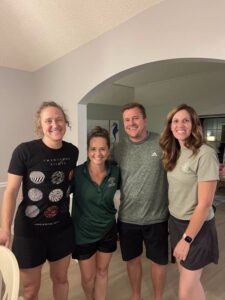
Founders from left to right, Jessica Geary, Danielle McLean, Ryan Sandgren, and Megan Knowles. Courtesy of Keystone Education Center
The story of Keystone Education Center underscores so many distinctive subplots happening in Florida, the most choice-rich state in America.
For one, it’s not a school. That’s significant because as Florida leads the nation in the transition from school choice to education choice, more diverse options like tutoring centers, hybrid homeschools, and a la carte providers are on the rise.
The teacher empowerment angle is key, too. The former public school teachers who co-founded Keystone join a growing list of teachers who are finding choice is giving them the power to create what they think is best, rather than submit to bureaucracies they find smothering. A number of them are creating options, like this one and this one and this one, that are specifically for students with special needs.
Sandgren comes from a family of public school educators. He said he’s always been passionate about helping students with special needs develop their talents. But sometimes, in traditional settings, obstacles creep into the way, like, in his view, too much emphasis on standardized testing, or classes with such a wide variety of special needs, no student truly gets the instruction they need.
“There came a breaking point,” he said.
Keystone is also another good example of the barriers that continue to challenge education entrepreneurs even when robust choice programs are in place.
The founders had no problem attracting families who wanted an alternative to traditional schools. “I didn’t need to do a market analysis,” McLean said. “I knew there was a gap for kids like mine.”
But finding a building that was affordable and accessible? Different story.
McLean said the pickings were so slim, the founders considered signing a lease for a building that would have cost $8,000 a month. Fortunately, McLean was relentless in reaching out to local pastors. and one of them offered church space for a fraction of that cost.
Keystone’s founders plan to add a grade a year through high school. They’re emphasizing small class sizes, best practices from applied behavioral sciences, and character development to nurture lifelong learners who can “thrive beyond the classroom as kind, contributing citizens.”
“We want to make learning applicable to real life,” Sandgren said.
The center’s schedule reflects those goals.
Mondays are for recreational activities and social clubs. The founders wanted to make sure students eased into the week and started on a joyful note.
Tuesdays, Wednesdays, and Thursdays are for core academics.
Fridays are for field trips. Publix, the movie theater, the bowling alley – anywhere, McLean said, where community-based instruction can help students work on functional skills.
Geary, who worked in public schools for 10 years, said she’s grateful for Florida’s choice programs and what they’re allowing her to do as an educator.
Having meaningful input into core components like curriculum and scheduling and assessment is a pleasant contrast to the dynamic in district schools, she said. Recently, the team at Keystone called a local business that offers sailing lessons to see if it could accommodate Keystone students on a field trip. (The answer was yes.)
“I could never do something like that at the district,” Geary said.
The rush of creating your own option, she continued, is “better than I ever though it could be.”
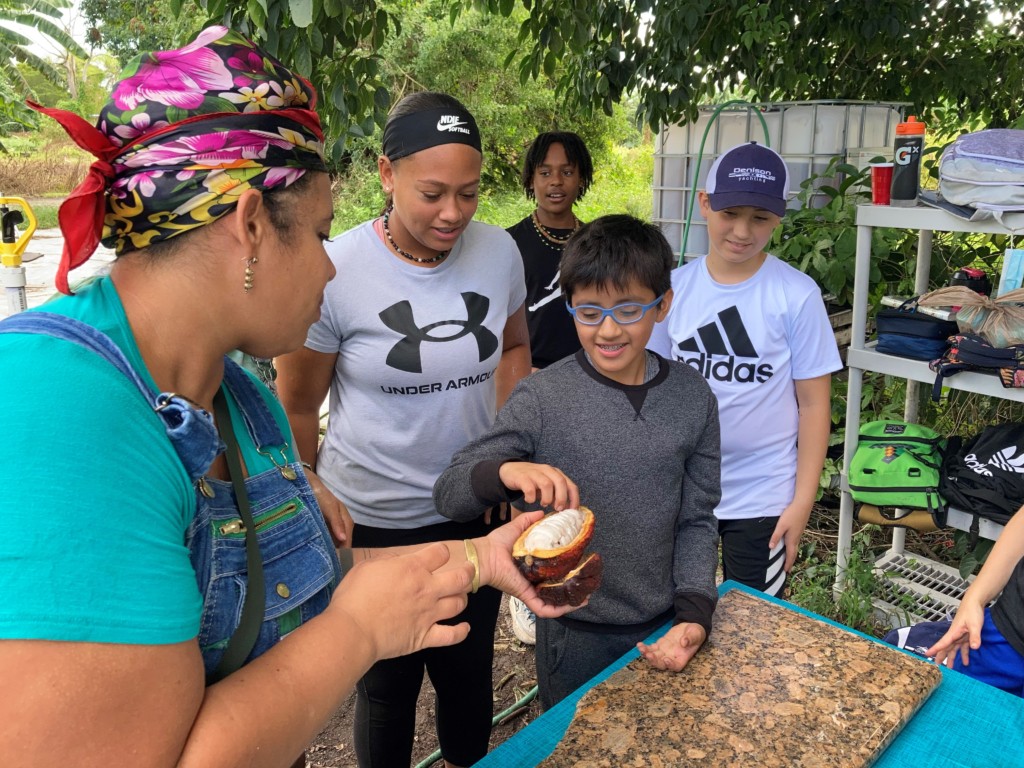
Shiren Rattigan, foreground, founded Colossal Academy in the Miami-Fort Lauderdale area for curious and active tweens and teens. The experiential learning microschool aims to utilize inquiry and students’ natural curiosity to help them navigate their learning.
The expanding number of states making flexible spending accounts (ESAs) accessible to their public education students is accelerating the transition from school choice to education choice as families spend their ESA funds on a variety of educational services and products beyond schools. As more education providers enter the public education market and public education increasingly occurs outside of schools, a transition from school districts to education districts also seems inevitable.
This transition will change the role of districts in the public education market from providers of instruction to market facilitators and regulators.
A diverse array of independent teachers, autonomous schools and collaborative educator networks will take responsibility for delivering instruction. Farms, parks, zoos, businesses, museums, libraries and community centers will offer learning experiences or resources to families in this public education market. And education districts will help families and educators thrive in this dynamic ecosystem and protect the public interest by providing leadership, support, regulatory oversight, and connective tissue.
This new role for government in the public education market is like the current role government plays in important markets such as housing, health care, and food. Government is not our country’s primary owner and provider of housing, health care, or food. Government facilitates, supports, and regulates these essential services and products, but independent individuals and entities are the primary providers in these markets.
In the United States the management of public education is primarily a state and local responsibility. Consequently, the pace and character of a transition from school districts to education districts will differ across states and local communities. Here is speculation about how a future education district might function in my local community.
The date is Sept. 24, 2054. A new school year has not begun in Pinellas County, Florida because the previous one never ended. Public education is continuous and ubiquitous in 2054.
The operational focus of our educational district has shifted from owning and managing schools to leading, facilitating, and supporting publicly funded teaching and learning wherever and whenever it occurs. This is a shift many school district leaders had long advocated for.
Our county government now owns and maintains buildings and other property our school district once owned. Our county sheriff’s office is responsible for safety and security in these buildings, and local businesses provide meals for students and educators.
Our school district transportation system has merged into our regional public transportation system, which now transports students to educational and childcare sites throughout the county. This expanded regional system includes vehicles ranging from small cars and mini-vans to 50-seat buses, ride-sharing services, and autonomous driving vehicles. Transportation in all these vehicles is safe, reliable, and transparent. Families always know where their children are and may communicate with them at any time.
Our PreK-12 students have flexible spending accounts (ESAs) containing public funds their families use to pay for state-approved educational products and services. All students have customized learning plans that include their current learning priorities. Families regularly update these priorities to help them decide how they spend their children’s ESA funds.
Families are using state-approved e-commerce sites to access and pay for state-approved educational services and products with their ESA funds. These sites contain information about available services and products and include feedback from other families about their experiences with each service and product provider.
Most of our education service providers are not government owned or managed, but the education district ensures these venders are safe and provides comprehensive information about their services. The district also helps arbitrate customer service disputes between providers and families.
While our education district does not own or maintain education facilities, it is responsible for allocating the space in these facilities. Some Florida education districts auction off leases to space in their buildings. We don’t. Education organizations apply to our district for space, and the district leases space based on criteria we think best serve the students and each facility. We are particularly thoughtful about the ages of students in each facility and the educational models the various providers are using. Most facilities house multiple education organizations of varying sizes.
Our education district helps education providers find space in privately-owned buildings when space in county-owned facilities is not available. Our district also collaborates with our county commission to determine future space needs and with our regional transportation agency to help ensure students’ future transportation needs are met.
Our education district sells administrative services to education providers who prefer to outsource their administrative needs, including payroll, insurance, IT support, procurement, and health benefits. In some instances, our district employs personnel for education providers and then leases those employees back to them.
Our local teachers union expanded its business model and now provides incubator and administrative services for union members who are starting new businesses such as micro and hybrid schools and tutoring services.
Our preservice and in-service teacher education programs have added entrepreneurship to their core curricula. Most teachers, like all other professionals, prefer working for others, but all benefit from understanding how to run a successful education business.
Looking back, it’s clear the administrative burdens we placed on school districts over the past 200 years were overwhelming. Well intentioned and hardworking professionals did their best to make school districts in 2024 work, and they did lots of good. But these systems with their roots in the early-to-mid 1800s were not designed to consistently deliver educational excellence and equal opportunity in the 21st century. Education districts are enabling teachers, district administrators, and local school boards to focus solely on supporting teaching and learning. An aspiration most have had for many years.
Meanwhile, back in 2024, the transition from school districts to education districts, while perhaps inevitable, will be messy politically and operationally. Progress usually is.
In the early days of education savings accounts, several of our intrepid Scooby-gang members wrote and spoke about user reviews as the future of “accountability.” In a multi-vendor system, we argued, the only people qualified to judge whether, for example, Granny Smith’s Piano Lessons were worthwhile were people who took Granny Smith’s piano lessons and so on. How much could students learn from the new exhibition at the museum? Can anyone help me find an occupational therapist in my area? Is Rosetta Stone a useful tool? Customizing generates an endless number of possibilities. Jack Coons and Stephen Sugarman therefore saw the need for a brokering service connecting educators with students back in 1978 in their book Education by Choice:
To us, a more attractive idea is matching up a child and a series of individual instructors who operate independently from one another. Studying reading in the morning at Ms. Kay’s house, spending two afternoons a week learning a foreign language in Mr. Buxbaum’s electronic laboratory, and going on nature walks and playing tennis the other afternoons under the direction of Mr. Phillips could be a rich package for a ten-year-old. Aside from the educational broker or clearing house which, for a small fee (payable out of the grant to the family), would link these teachers and children, Kay, Buxbaum, and Phillips need have no organizational ties with one another. Nor would all children studying with Kay need to spend time with Buxbaum and Phillips; instead some would do math with Mr. Feller or animal care with Mr. Vetter.
The “loved ESAs before they were cool crowd” may have been ahead of our time, but we were also decades behind Coons and Sugarman’s vision casting starting about a decade ago. What we needed was an online platform to collect K-12 education user reviews at the experience level. Lo and behold, we now have one.

From the recently launched MatchED website:
The growth of homeschooling and microschools (now over 6M children nationally), supplementary educational services (tutors, test prep, camps, etc.) and school choice (ESAs, vouchers, tax credits) has created a large market of educators/parents with full flexibility to personalize learning. However, it is very overwhelming and challenging to sort through all the options to find the right fit for their child. MatchED will build and operate technology-enabled matching platforms to create low-friction, high-value matches between producers and consumers in education to make the new era of “matching” education easier and better.

MatchED is a project headed by OpenSky Education’s Andrew Neumann, whose experience stretches from private schools in the Milwaukee Parental Choice Program to charter schools and more. Helping families taking the plunge into permissionless education navigate myriad opportunities represents a crucial next step for the choice movement.
The possibilities for a platform like MatchED however is still greater in scope. Imagine a world in which teachers could “hang a shingle” and become their own boss on either a full time or part time basis. A matching service for educators and students has the potential to enormously benefit both.
Stay tuned to this channel for further updates.
A private elementary school that emphasizes self-paced, competency-based learning is set to open next year in the Sarasota community of Newtown.
Newtown was founded by Black residents who were forced to leave Overtown, a vibrant area near downtown Sarasota.
Today, the community features an African American Cultural Resource Center and a $58 million magnet high school with a state-of-the-art visual and performing arts program.
The school: Star Lab
Grades/ages served: The school plans to welcome its first kindergarten cohort and add grades until it serves students through fifth grade.
The founder: Alison Rini brings expertise in gifted education as well as helping students overcome challenges and disabilities from more than two decades teaching in public and private schools. She taught at P.S. 6 (Manhattan) and St. Croix Country Day School (U.S. Virgin Islands), and served as principal at Island Village Montessori, a Sarasota charter school.
The vision: Star Lab intends to emphasize “learning and joy.” According to the Drexel Fund, Rini’s vision is a true collaboration between teachers, families and students that offers self-paced progress in each subject, real-time feedback and project-based learning. The school will allow students to run and play every hour and offer mindfulness exercises.
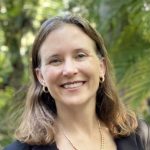
Alison Rini
In her own words: “A student’s path is not aligned to grade levels, but to academy skills. Students can progress at their own pace through each content area – they can move faster or slower as needed.”
Where Rini got help and where you can, too: The Drexel Fund is a national venture philanthropy that provides financial support and mentoring to educational entrepreneurs seeking to launch and scale private schools focused on underserved communities.
Drexel will offer free information sessions starting Oct. 10 for first-time private school founders to learn the basics of school development and hear from leaders who have launched private schools.
Founders who are already on the path to opening schools may apply for the Founders Program, a one-year paid fellowship that helps leaders continue to plan and open schools in Florida, Wisconsin, Indiana, Ohio, Louisiana, North Carolina and Arizona.
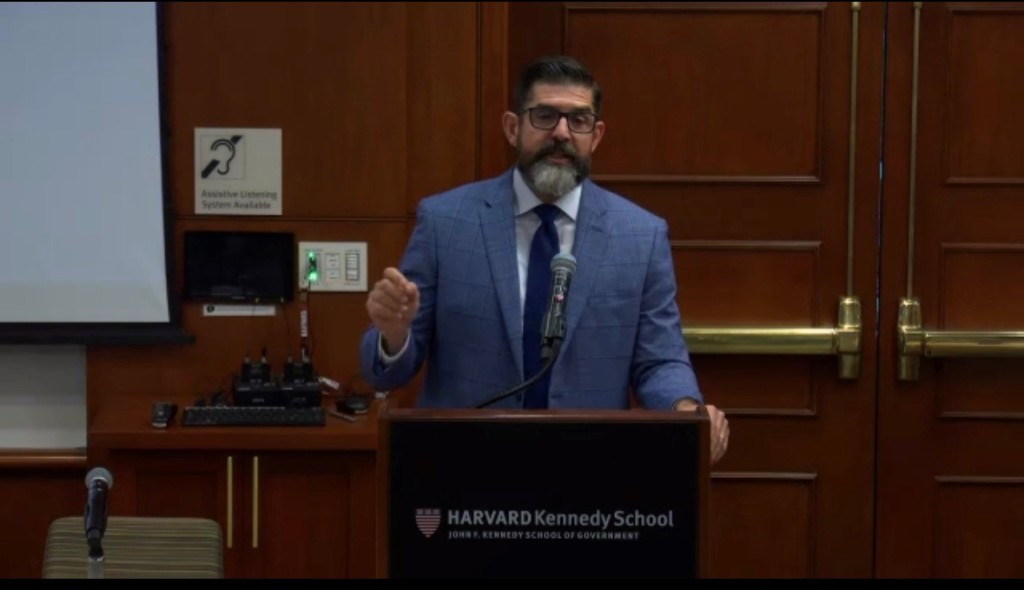
When it comes to education, a rising tide lifts all boats, Florida’s education commissioner told a national audience of school choice supporters and education entrepreneurs.
Look at Miami-Dade County, where leaders saw the tsunami coming and grabbed their surfboards.
“The district figured out that movement in South Florida was coming so fast and becoming so popular that the only way they could survive was to improve their services, (and) to improve their offerings,” Manny Diaz Jr. told those attending a conference sponsored by Harvard University called “Emerging School Models: Moving from Alternative to Mainstream.”
Despite the dire warnings that opponents have repeatedly issued since Gov. Jeb Bush and Florida lawmakers first began stirring up that school choice wave in 1999, none of the predicted devastation has come true, Diaz said.
Now, 70% of students in Miami-Dade attend a school of choice in the nation’s third-largest public school district. Those include charters, magnets, public schools with open enrollment policies and specialty academies, as well as the nation’s largest education choice scholarship programs.
Such a win-win situation didn’t stop the teachers unions and other school choice opponents from sounding the same alarms when he sponsored education choice legislation as a state senator.
“When we passed House Bill 1, they said the sky was going to fall,” Diaz said. “They were completely wrong.”
Over more than two decades, the legislation has created new options, including multiple scholarships with different funding sources that serve students with a variety of needs.
HB 1 was the latest advance. Signed by Gov. Ron DeSantis in 2023, it granted scholarship eligibility to all families regardless of income and converted all traditional private school scholarship programs to education savings accounts. The change allows parents the flexibility to spend their student’s allocation on tuition and fees, curriculum, part-time tutoring, and other approved expenses.
Diaz said the key to Florida’s success is its continuous quest for improvement, which at times has involved the passage of new expansions each year.
“It is a relentless chase of continuing to push,” he said. “The best defense is to be continually on offense.”

SailFuture in St. Petersburg, Florida, a unique, seafaring educational innovation that helps troubled teens chart new courses for their lives, is a quarterfinalist for a $1 million award powered by the Center for Educational Reform.
Five Florida education providers are among 64 quarterfinalists from 33 states and the District of Columbia who are in the running for a prestigious $1million award for educational excellence.
SailFuture in St. Petersburg, RCMA Immokalee Community Academy, Hope Ranch Learning Academy in Hudson, Colossal Academy in Davie, and Kind Academy in Coral Springs all are vying for the prize that recognizes those providers who strive to offer education that meets the four adjectives whose first letters spell the acronym for the award: Sustainable, Transformational, Outstanding, and Permissionless.
(reimaginED profiled three of the quarterfinalists here, here, and here.)
Yass Prize founder Janine Yass said it was her goal this year to find the best innovators in education in the country.
“Their ideas and enthusiasm are pushing the status quo for children who deserve access to awe-inspiring education,” Yass said.
She and her husband, Jeff, launched the prize, which is powered by the Center for Education Reform, to find and advance the work of education providers who continued to serve children despite the challenges brought on by the COVID-19 pandemic.
Center founder Jeanne Allen, who also serves as director of the Yass Foundation for Education, said she looks forward to getting to know the new quarterfinalists, who deserve recognition for their efforts to transform education.
“If we could just clone them and the thousands more who applied, we could more than make up the deficiencies brought on by years of mediocrity and COVID learning that have wrought havoc on our kids,” Allen said. “This is a start.”
Each of the 64 finalists are guaranteed a STOP award of $100,000. They now move into the next round, where 32 providers will be selected and will have a chance to receive a $200,000 award and take part in a “hybrid accelerator program” that will pair them with technology leaders and investors who could help them expand their ideas and methods.
At the end of the “accelerator process,” seven finalists will be named, one of whom will win the $1 million prize. Each of the other finalists will receive a $250,000 award.
Michael Moe, CER director and founder of Global Silicon Valley, a growth investment platform in California who served as an early adviser to the initiative, cited education entrepreneurs as a critical piece of the country’s continued economic strength and growth.
“The work that all of these quarterfinalists are accomplishing to educate the future generations is truly transformative,” Moe said.

