“Pacific Rim” is without a doubt the greatest “giant robots smashing giant monsters” movie in the long and storied history of cinema. Okay, so the only real competition was the wretched “Pacific Rim 2” and maybe a few Japanese movies with people wearing rubber suits stomping on model buildings. Honest Trailers described “Pacific Rim” as either “The Most Awesome Dumb Movie of All Time” or “the Dumbest Awesome Movie of All Time.” “Pacific Rim” did indeed have everything your inner 9-year-old craves, including the above “Today we are cancelling the Apocalypse!” speech from the great Idris Elba.
So anyhoo – when do we get to cancel the apocalypse talk with regards to Florida schools?
I first started following the K-12 debate in Florida back in the late 1990s. Then, sadly as now, the air was filled with claims about the “destruction of the Florida public school system.” Among the many problems with this fevered story is the fact that the Florida Constitution guarantees public school funding and the public supports that guarantee. A quick perusal of the National Assessment of Educational Progress (NAEP) – the most highly respected source of apples-to-apples K-12 data available, shows consistent improvement in outcomes over time. The below chart shows the percentage of Florida students scoring “Basic or Better” (top four lines) and “Proficient or Better” (bottom four lines) from the earliest available results (1990) to the most recent (2017). Note that all the lines are trending up – which in this case is what you want.
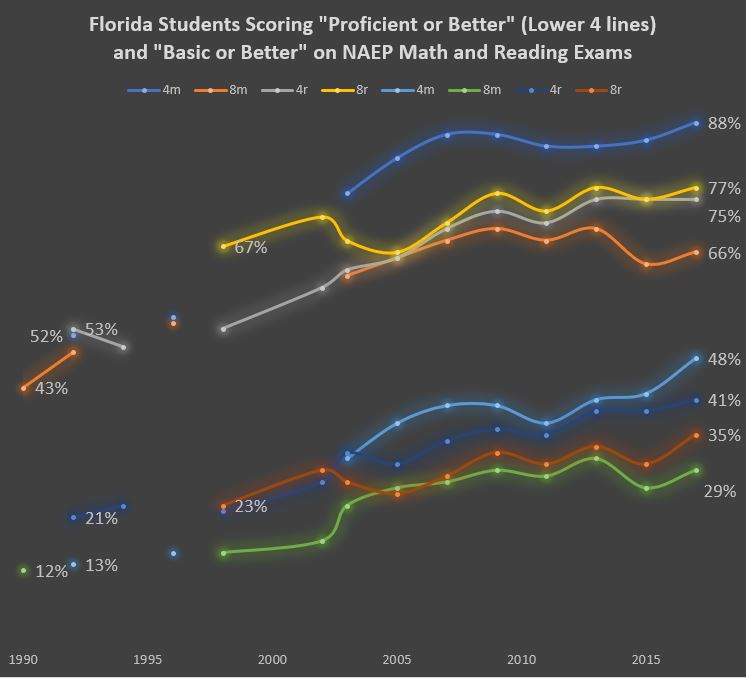
The trend in Florida students scoring “Below Basic” is easier to follow. “Below Basic” is the lowest achievement level on NAEP, so what you want to see in this next graph is the numbers trending down. Sure enough:
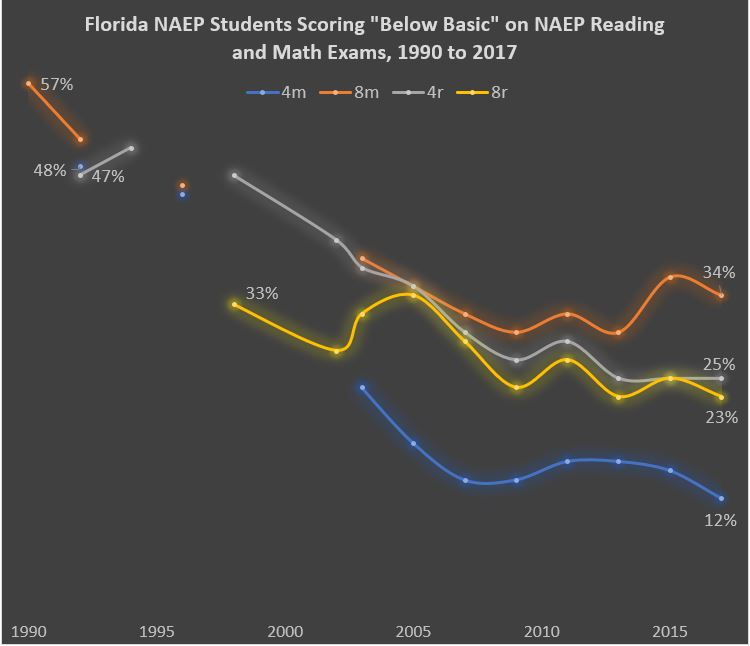 There are of course things to disagree over and debate, but for those liberally pushing Florida K-12 apocalypse narratives, I simply want to pose the following questions: How do you square this obvious evidence of academic improvement among Florida students with impending predictions of doom? Is there a nefarious plot to improve public schools to death? The comment section awaits. I’ll hang up and listen.
Florida’s public schools were handed another solid but overlooked report card this week from another respected, independent source.
The 27-page, data-stuffed, “Decade of Progress” progress report from the Southern Regional Education Board is yet more evidence that Florida’s public schools are making steady progress despite the claims of some critics. The trend lines are often especially strong for low-income and minority students.
For example, between 2003 and 2011, the percentage of low-income eighth-graders scoring at the basic level or above on the reading portion of the National Assessment of Educational Progress rose from 55 to 65 percent in Florida – a 10-point gain. Over the same period, the percentage of more affluent eighth-graders who reached the bar rose 5 percentage points, from 78 to 83 percent.
For each of its 16 member states, the SREB looked at a wide array of academic indicators to see how much the needle moved over the past decade, and how those gains or losses compared nationally and regionally. Besides commonly cited indicators like NAEP scores, graduation rates and AP results, the board looked at less-publicized statistics like college enrollment rates, ninth-grade “enrollment bulges” and grade-level progression in high school.
According to the report, the percentage of recent high school graduates enrolling in college in Florida increased from 57 to 71 percent between 2000 and 2010. Nationally, the numbers rose from 56 to 67 percent. Meanwhile, the percentage of college freshmen in Florida who returned for a second year remained steady at 86 percent.
The SREB report comes as Florida faces mounting criticism for its testing and accountability regimen, which many critics, including local school board members and parent groups, say has been ineffective. Despite that backdrop, the report was all but ignored by Florida media (an exception here), as was this recent report that found Florida’s graduation rates are among the fastest-rising in the nation.

