 School security: Broward County School Board members express support for the hiring of armed "guardians" to protect schools that don't have sworn resource officers. Board members say they would prefer the guardians to be retired police officers or military veterans. Most would be stationed in elementary schools. Sun-Sentinel. The Lake County School Board approves a security plan that will put a resource officer in every school and arm some school administrators. Daily Commercial. The Volusia County School District has paid 100 percent of the cost for having deputies at middle and high schools since 2008. But with the law now requiring an armed guard in every school, school officials are asking the county for help to hire armed guardians to cover elementary schools. Daytona Beach News-Journal. The Polk County Sheriff's Office has begun training more than 100 applicants to become armed guardians. Training includes handgun and rifle handling, how to engage active shooters and written tests. WFTS. WKMG. Lakeland Ledger. The Manatee County School Board is considering several changes to its student conduct code that are required by new state laws. The proposals revise the situations in which the district can send students to mental health agencies, when it can remove students through the Baker or Marchman acts, would broaden the definition of a threat to any of its schools, and would prohibit firearms from being stored in students' vehicles. Bradenton Herald. Sarasota County school leaders meet with law enforcement officials today to discuss school security and the district's proposal to start its own police force. Sarasota Herald-Tribune. Northwest Florida school and law enforcement officials meet to share ideas on how to provide school security. Panama City News Herald.
Amendments support: Only four of the 13 constitutional amendments that will be on November's ballot have the support needed to pass, according to a poll from the Florida Chamber of Commerce. One of of the four is Amendment 8, which would limit school board members' terms to eight years, require the teaching of civic literacy in public schools and establish an alternative path to approval for public and charter schools that does not involve local school districts. The poll indicated 75 percent support for Amendment 8. Sixty percent is required for passage. News Service of Florida.
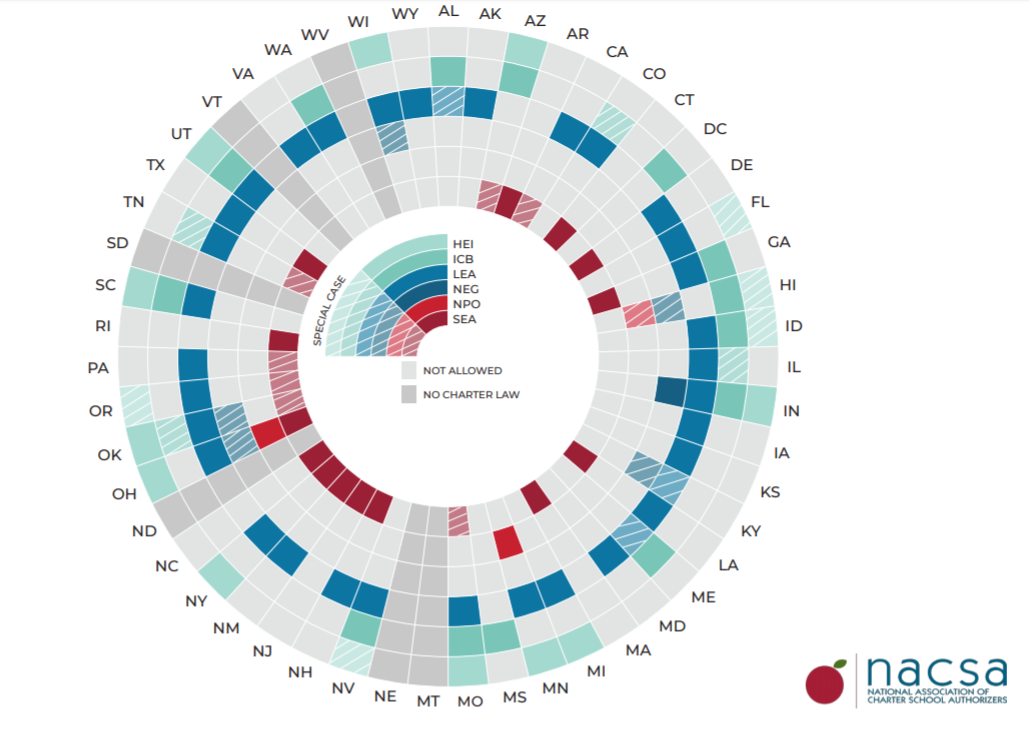
Florida is among the states where school districts (LEAs) are largely the only charter school authorizers allowed. Source: NACSA
Wyoming, Alaska, Virginia, Maryland, Iowa, Kansas and, for the most part, California.
What does Florida have in common with those states? Its charter school authorizing landscape, according to a new policy brief from the National Association of Charter School Authorizers.
Of the 44 states that allow charter schools, the brief shows, nearly all of them allow some kind of entity other than a school district — a statewide board, colleges or universities, the state education agency — to authorize charter schools.
Florida joins the handful of states where districts are the only authorizers allowed. A state constitutional amendment could soon change that, if voters approve it in November. The state technically allows universities to authorize charter schools. But those are only in rare cases where higher education institutions want to set up new lab schools for teaching and research.
Similarly, in California, districts are generally the only authorizers allowed, but the state Board of Education can hear appeals from charter school applicants that local school boards reject. The state may authorize those schools, but districts still handle day-to-day monitoring and oversight. (more…)
Last month, fresh charter school numbers had several observers asking: Why are fewer charters opening?
A new report from the National Association of Charter School Authorizers offers some clues. In short, it finds fewer groups are applying to open new schools.
Over the past five years, the approval rate for charter school applications nationwide has hovered right around 35 percent. But the total number of applications has declined.
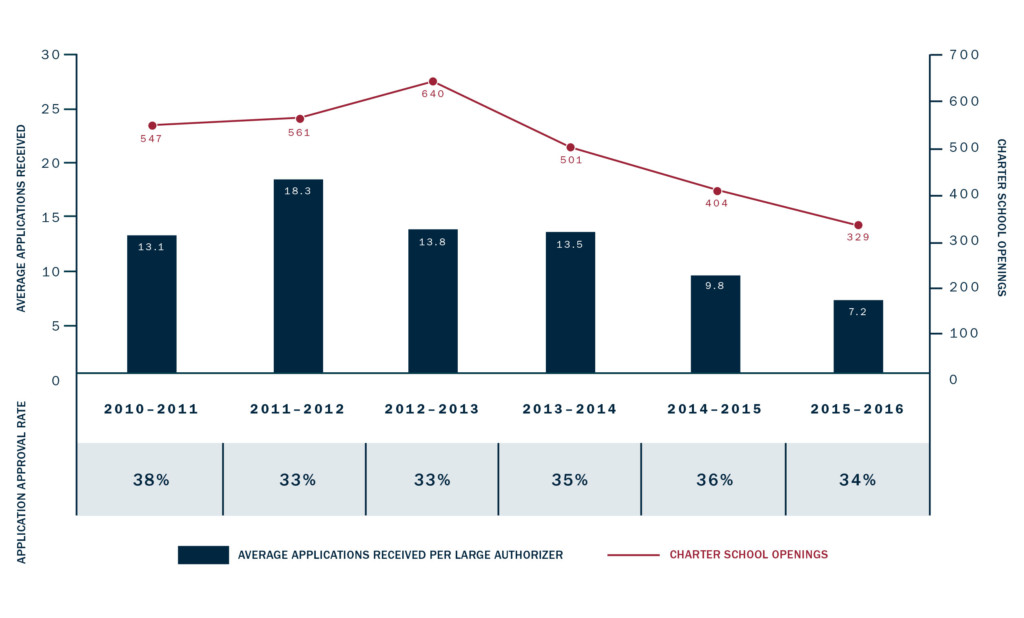
The approval rate for charter school applications has hovered right around 35 percent, but fewer schools are applying to open. Chart via NACSA.
Why are fewer groups applying to open new charter schools? The authorizers group says that's a question for future research.
“As the sector continues to think through why growth is slowing, our findings suggest figuring out what’s driving the decline in charter applications will be a central part of the answer,” M. Karega Rausch, NACSA's vice president of research and evaluation, said in a press release. “That’s why we think it’s important to dig deeper into the data and find out why fewer applications are being proposed and what’s helping—or hindering—strong applications.” (more…)
Florida's charter school laws continue to get middling rankings from the National Association of Charter School Authorizers. The state's rating remains unchanged in the group's latest national report, leaving it tied with Arizona for the 18th-best charter school oversight policy in the country.
The state's executive branch is trying to tackle some of the issues raised in the third edition of the annual report, which came out this week.
In a nutshell, Florida gets pretty good marks for charter school accountability. Districts are required to keep track of charters' performance, and schools can lose their contracts if they don't meet academic goals. The lowest performers — those that earn consecutive F's through the state grading system — can be shut down automatically.
But the state falls short when it comes to holding districts accountable for the charters they oversee. Local school boards sponsor all but a handful of the state's more than 650 charter schools.
There are several issues here.
A new report calls for states to subject virtual charter schools to greater scrutiny.
States need to overhaul the way they fund and regulate online charter schools and rein in "large-scale underperformance," a new report argues.
The argument isn't coming from the usual anti-charter school suspects. The report was released this morning by the National Alliance for Public Charter Schools, the National Association of Charter School Authorizers, and the pro-charter advocacy group 50CAN (aka the 50-State Campaign for Achievement Now).
The three groups say they support full-time virtual schooling, and that the model can be beneficial for some students. But the report says recent research has found negative effects so significant and widespread that "[t]he breadth of underperformance by full-time virtual charter schools convinces us that states need to change the policy framework within which these schools can operate."
"If traditional public schools were producing such results, we would rightly be outraged," the report adds. "We should not feel any different just because these are charter schools."
Online learning companies and some allied advocacy groups have disputed some of the most widely cited studies of virtual charters' effectiveness, pointing out that virtual charters often serve disadvantaged students who change schools frequently, making their performance hard to gauge.
The report addresses this argument, noting that in a study by Stanford University's Center for Research on Education Outcomes, the "mobility" rates of virtual charter students and their comparison groups in traditional public schools are similar. Other observers have concluded the negative findings are simply too strong to explain away. (more…)
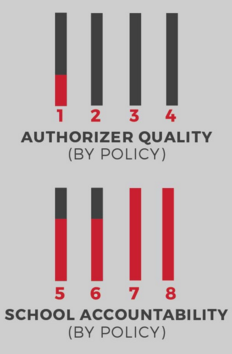
A new report grades charter school policies in Florida and other states.
From new laws to constitutional amendments, Florida lawmakers will have a raft of charter school changes to consider when their annual session convenes next month. Many of those proposals are aimed at improving charter school oversight, which is also the focus of a new report on state charter school laws by the National Association of Charter School Authorizers.
The group is focused on improving charter school quality. Its 2015 state policy rankings place Florida near the middle of the pack.
Florida's score improved this year, thanks in part to a new standard charter school contract that will require charters to provide yearly updates on their progress toward the academic goals in their contracts.
The state receives pretty good marks for charter school accountability, but its score suffers because it doesn't allow entities other than school districts to sponsor charters, and doesn't evaluate authorizers based on the performance of the schools they oversee. (more…)
As a spate of sudden failures has brought Florida's charter schools under a microscope, the state’s second-largest school district stands out.
Broward County is home to more charter schools than most states. And no district in Florida has shuttered more charters that opened since the 2012-13 school year. Some of those schools foundered shortly after they opened, uprooting students and sometimes leaving the district on the hook for millions of dollars.
A review by a national organization finds the district could be doing more to curb the problem.
The report, along with a similar evaluation of neighboring Miami-Dade County, sheds new light on a sometimes-overlooked dimension of Florida's charter school debate: The role of districts in stopping charter applicants who are not qualified to run schools.
Completed this summer by the National Association of Charter School Authorizers (NACSA) and obtained through a public records request, the review finds a "lack of rigor" in Broward’s process for reviewing charter school applications, which seemed "focused on statutory compliance rather than a quality assessment of a school’s likelihood of success."
Leslie Brown, the district’s chief portfolio services officer, said Florida law ties authorizers’ hands. Districts might spot red flags with charter schools that want to open, but as long as an application meets all the requirements in state law, a district that says “no” risks being overturned on appeal.
"There's a bit of a gap between what this national association includes in their principles and guidelines,” she said, and “what we have to do in Florida with regard to charter schools."
Sudden failures have created black eyes for the state’s more than 650 charter schools, prompting calls for change from charter boosters and critics alike. The turmoil became the subject of award-winning investigations by two newspapers, including one by the South Florida Sun-Sentinel that focused largely on Broward.
Katie Piehl, NACSA’s director of authorizer development, said Florida charter schools are three times as likely as their counterparts nationally to fail within a year of opening, which has prompted her group to make the state a priority.
With few exceptions, districts are the only groups allowed to authorize charter schools in the state, which makes them the first line of defense. Piehl said district officials sometimes feel hamstrung by state law, but when it comes to weeding out weak charter applicants, some do better than others.
"You're able to see some districts that are able to, within the confines of the existing law, make high-quality application decisions," she said.
There are different ways to slice and dice the data on charter school failures, but Broward appears to be ground zero for the problem. It's seen more first-and-second year closures than any other urban school district in Florida, and significantly more Miami-Dade County, its larger neighbor to the south.
While districts are getting more stringent in their reviews of charter school applications, Broward's approval rate remains relatively high, according to numbers state officials recently presented to a state legislative panel.
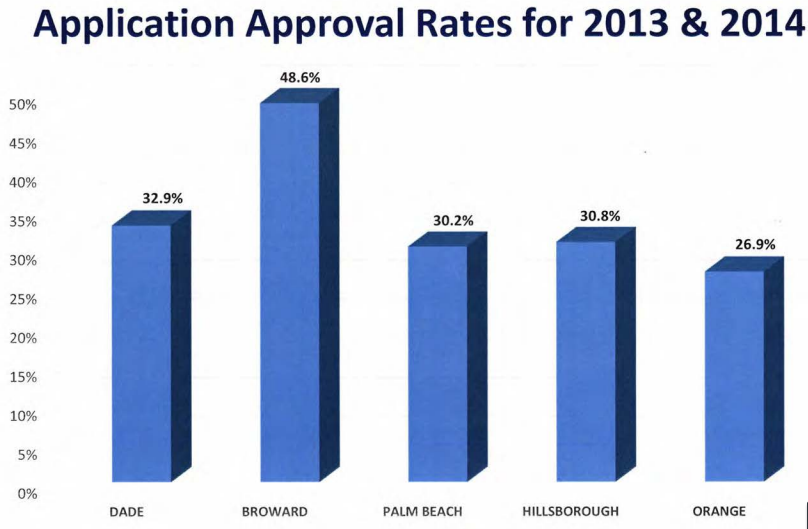
This graph by the Florida Department of Education shows Broward has recently approved applications at a higher rate than other urban districts.
NACSA's report acknowledges Broward’s charter school office has a small staff tasked with vetting dozens of applications and a growing portfolio of roughly 100 schools, while contending with a "seemingly ever-changing and limiting state statute."
At the same time, it says Broward's "current interpretation of Florida law hampers its work and creates an open- door mentality, yielding approval of applicants that then close within the first few months of operation."
Charter schools were first conceived as a bargain. Teachers (or, in the case of some of Florida's oldest and most successful charters, parents) would receive the freedom to start new schools and experiment with different educational models. In exchange, they would face greater accountability for their academic results.
That bargain is threatened by a "paperwork pileup," a new report by the American Enterprise Institute argues. Charter schools are startup enterprises. The more hoops they have to jump through during the application process, the fewer promising new schools will be launched. Every page added to a charter school application puts those teachers or parents at a greater disadvantage.
In practice, however, the charter bargain has become fairly one-sided. Charter school authorizers often include hundreds of tasks in the application to open a charter school, creating an onerous and lengthy process that risks freezing out potential school operators. To be sure, many application tasks are well within authorizers’ rights to require, but others are unnecessary and unduly burdensome for applicants. This is a real problem for the groups of teachers that Shanker envisioned, who might lack the time or resources to tackle these outsized applications and create new educational options for students.
In short, the report focuses on what has become a timely topic in Florida: How do you set a high bar for prospective charter schools, without creating needless barriers?
(more…)
Florida's two largest school districts could soon be searching for charter schools looking to serve their most disadvantaged neighborhoods.
The state Department of Education has chosen three school districts, including Broward and Miami-Dade Counties, to receive grants intended to entice more national charter school networks to open in Florida's academically struggling urban areas and stoke new collaborations between districts and charters.
Duval County, the third district chosen from four that applied, already has a high-profile charter school collaborator in KIPP Jacksonville.
The two South Florida districts indicated in their grant applications that they intend to recruit similar "high-impact" charter schools from around the country. They described plans to seek proposals from charter networks looking to open schools in high-needs areas and work with the districts on improving results for children in poverty.
First, their school boards need to sign off. John Schuster, a spokesman for the Miami-Dade County school district, said in an email that a school board committee would likely vet the charter school collaboration grant this week, which would allow the full board to decide how to proceed at its Feb. 11 meeting.
A spokeswoman for the state education department said it has so far committed about $665,000 in grant funding to each district — a three-way split of $2 million in Race to the Top funding, which is expected to start flowing to districts once their final plans are approved.
 State and district education officials are heading back from Miami, where the National Association of Charter School Authorizers is wrapping up its annual conference.
The group represents the school districts, nonprofits and other organizations that sponsor and regulate charter schools.
Improving charter school authorizing might not pack as much sizzle as other education policy issues, but it's getting increased attention from people who want to improve the quality of the education system as a whole. And it's definitely relevant to Florida's debates over charter school accountability.
In Florida, authorizers are basically synonymous with school districts, but other states allow nonprofit organizations to sponsor charters, and 17 states have active, statewide charter school authorizing bodies.
Creating a statewide charter school authorizer is part of NACSA's recently released package of policy recommendations. The goal, according to the group, is to give charters at least two potential authorizers to choose from in each jurisdiction. Courts, however, have blocked efforts to create a statewide authorizing body in Florida.
The authorizers group also recommends setting a floor for charter performance by automatically closing charters that fail to meet minimum academic standards. Florida, which requires most charter schools to close if they receive two F's in a row, is one of just seven states with "default closure" provisions on the books - a topic covered in this Education Week dispatch from the NACSA conference.
The group's policy brief recommends creating exceptions to the automatic closure rule for some schools that cater to struggling students.
It also recommends creating standards for schools looking to have their charters renewed, and setting accountability standards for authorizers themselves. The full set of policy papers can be found here.

